

A pet device is only as useful as its weakest link. If the collar, camera or alert button can’t talk reliably to your phone, your Wi-Fi, your other gadgets and, above all, your dog, it stops being a safety tool and becomes one more thing to troubleshoot. Compatibility decides whether an alert reaches you in seconds, whether a video feed loads over a weak signal, and whether you pay a monthly fee to keep things working. This guide explains what compatibility really covers and gives you a checklist to run before you buy.
TL;DR
- Compatibility is more than “works with iPhone or Android.” It covers your network, apps, other smart devices, the hardware setup and your dog’s behavior.
- Pet devices mostly run on Wi-Fi and Bluetooth, and mixing brands in one smart-home network can be complex.
- Incompatibility shows up as missed alerts, dropped video, extra subscriptions and security gaps, not just inconvenience.
- Check network, phone, contacts, mounting, privacy settings and the dog’s response before you commit.
- For alert devices, compatibility with the people who must receive the alert matters as much as compatibility with gadgets.
Table of Contents
- What compatibility means for a pet device
- Why it matters: what compatible systems can do
- What goes wrong when things don’t fit
- Compatibility with the dog: the overlooked half
- Compatibility with the people: who receives the alert
- Data accuracy: compatible is not the same as correct
- A pre-purchase compatibility checklist
- Our perspective
- Where to start with iPupPee
- Related reading
- FAQ
- Sources
What compatibility means for a pet device
Most people hear “compatibility” and think of one question: will it work with my phone? That is the smallest part of it. A connected pet device sits in a chain, and every link has to hold.
- The device and your network. Home Wi-Fi strength, router settings and the device’s connection method.
- The device and your phone or tablet. Operating system, app version, notification permissions.
- The device and other devices. Doors, cameras, feeders, smart speakers, hubs.
- The device and the physical space. Camera range, microphone and speaker direction, mounting position.
- The device and the dog. Size, comfort, and whether the dog will actually use it or respond to it.
- The device and the people. Who gets the alerts, on which phones, and whether they can act on them.
A 2025 peer-reviewed review of the Internet of Pets notes that pet systems commonly rely on Wi-Fi and Bluetooth, and that bringing devices from different manufacturers into one smart-home network can be complicated. That is the technical core of the problem: there is no single universal standard that every pet product follows, so each purchase is a small compatibility decision.
Why it matters: what compatible systems can do
When the pieces fit, the benefits are practical. The same 2025 review describes compatible systems that combine remote feeding and health or activity monitoring with location alerts, automated doors, video, two-way communication, barking notifications and remote treat delivery. The documented benefits include earlier awareness of possible health or behavior changes, safer location and access control, contact while you’re away, and remote training or calming support.
Veterinary guidance points the same way. VCA Animal Hospitals explains that home monitoring systems can stream video to a smartphone, tablet or computer, that two-way audio lets you talk to your pet, that bark alerts can notify you, and that remote treat dispensers can support training or calming, as long as the treats fit the dispenser.
Notice the pattern. Every benefit depends on a handoff: camera to app, app to phone, phone to you, sound to dog. If one handoff fails, the benefit disappears at exactly the moment you need it.
What goes wrong when things don’t fit
Missed or delayed alerts
An alert that depends on a network the device can’t hold onto is not an alert. Notification permissions switched off on a phone, a router that drops a device after a firmware update, or an app that needs a newer operating system than yours can all silence a device without any visible error. For a dog owner who lives alone, or a handler with a medical condition, a silent failure is the worst kind.
Weak signal in the places that matter
The spots where you want a pet device are often the spots with the worst Wi-Fi: a back garden, a basement, a far bedroom. The Verge’s March 2024 hands-on report on caring for pets with smart-home gear found that one camera system’s local processing and storage helped it stay connected to a phone over weak garden Wi-Fi and avoided a monthly subscription. The lesson is not about one brand. It is that how a device is built (what it processes locally, what it sends to the cloud) shapes both reliability and long-term cost.
Hidden costs
A device that technically works but needs a paid plan to unlock video history, extra contacts or cloud storage has a compatibility cost you only discover later. Before buying, ask what the device does without a subscription, and what each added feature costs per month.
Hardware mismatches
VCA’s guidance is a useful reminder that compatibility is physical too. Owners need to match camera range, audio direction, mounting, treat size and privacy controls to their home, and to how the pet is likely to respond. A treat dispenser that jams on your dog’s usual treats, or a speaker that carries your voice into the wrong room, is a compatibility failure even if the app connects perfectly.

Security and privacy gaps
This is the part most buyers skip. A 2023 study of pet technologies examined 20 popular pet tech apps and found that 2 exposed login and account details through non-encrypted traffic, while 14 communicated with third-party trackers before the user gave consent. In the same research, a user study across the UK, US and Germany found that 521 of 593 participants believed pet tech could be attacked, yet many took too few precautions to secure their devices.
The problem is not limited to apps. A 2026 Consumer Reports article said as many as 1.1 million Wi-Fi baby monitors and security cameras from one manufacturer may be vulnerable, exposing video feeds, stored photos, email addresses and location data, and that the same manufacturer also makes a pet camera sold under another brand. When a device carries live video from your home, how it connects and who can reach that connection are part of whether it is a good fit for your household.
If you run several connected devices, it is worth learning how to secure connected pet devices by protecting accounts, limiting data sharing and configuring each device deliberately. The review’s authors argue that commercial pet products should use more robust and secure connectivity than many prototypes, because stability, range and secure continuous monitoring matter when people rely on these devices in real homes.

Compatibility with the dog: the overlooked half
Most compatibility guides stop at the electronics. For dogs, the animal is part of the system.
- Size and build. A button, collar or accessory must suit a toy breed and a giant breed alike, or it excludes many owners.
- Behavior. A device that depends on the dog doing something (pressing, nudging, pulling) only works if the dog can learn it. That means training materials matter as much as hardware.
- Temperament. Two-way audio can calm one dog and excite another. VCA’s guidance stresses considering how your pet is likely to react to the intended use.
- Consistency. Dogs learn through repetition. A device that changes behavior with each update, or that is placed somewhere the dog can’t reach reliably, undermines the habit.
This is why we treat the training side of a device as part of its compatibility, not an optional extra.
Compatibility with the people: who receives the alert
For service dog handlers, seniors and people living alone, the question is not only “does it connect to my phone?” It is “who else needs to know, and can they act?” A useful alert system sends the message to more than one person, on whatever phones they have, and lets them see or hear what is happening. That covers a family member in another time zone, a neighbor, a caregiver and an emergency contact. Check that each of them can install the app, accept notifications and reach the video or audio feed without a separate account or fee.
Data accuracy: compatible is not the same as correct
A device that connects perfectly can still give data that deserves caution. Zoetis notes that wearable accuracy varies between brands and features, and that wearables should never be used to diagnose illness or replace veterinary advice.
Research in veterinary cardiology shows the same nuance. A 2016 study in the Journal of the American Veterinary Medical Association found that smartphone-based single-lead ECG devices accurately identified heart rates and rhythms in dogs and cats, yet remained limited compared with 6-lead or 12-lead diagnostic standards. A 2024 instructional report on blood pressure monitoring adds that both oscillometric and Doppler techniques can give continuous readings, but clinicians must know that Doppler values in cats often underestimate systolic and overestimate mean blood pressure.
The practical rule: use consumer devices to notice changes and start a conversation, then take unusual readings, sudden changes in behavior or any health concern to your veterinarian. Your vet decides what the data means.
A pre-purchase compatibility checklist
Run through this before you buy any connected pet device.
| Check | What to confirm | Why it matters |
|---|---|---|
| Network | Which Wi-Fi band and security type it supports; signal strength where the device will sit | Weak signal causes dropped video and delayed alerts |
| Phone and app | Supported iOS and Android versions; notification permissions; app update history | An outdated app can silently stop alerts |
| Contacts | How many people can receive alerts; whether they need accounts or paid plans | Alerts are only useful if someone sees them |
| Subscription | What works without a monthly plan; what each add-on costs | Hidden fees change the real price |
| Smart-home links | Whether it must connect to other devices to function | Cross-brand setups can be complex |
| Hardware fit | Camera range, audio direction, mounting, treat or accessory size | Physical mismatch defeats good software |
| Privacy | Encryption, consent for third-party tracking, account protection | Live video and location data are sensitive |
| The dog | Suitable for your dog’s size; clear training instructions | The dog has to use it for it to work |
Two habits help after purchase. First, test the full chain once a month: trigger an alert and confirm each contact receives it. Second, keep apps and device software updated, and use a strong, unique password on every pet-device account.
Our perspective
We built iPupPee around a simple idea: the most important compatibility is between the dog, the person and the people who care about them. A dog should be able to send an alert with a simple button press, whatever its size, and a handler should not need a technical degree to receive it.
That is why the device is designed to work over Wi-Fi, to notify multiple contacts instantly, and to offer live video and two-way audio so the person who gets the alert can see and hear what is going on. It is also why we do not require a monthly subscription. A safety tool that depends on an ongoing fee is one more thing that can lapse at the wrong moment.
We also think training is part of the product. A button only helps if the dog understands what it is for, so we pair the device with training guides and a dog psychology and training course. For service dog teams, seniors and anyone living alone, we think this combination of hardware, communication and training is what makes an alert system dependable in daily life.
If you want to go deeper on how the pieces fit, our guide to connected pet ecosystems is a good next step.
Andrew
Where to start with iPupPee
If you want an alert system designed around the dog-to-human handoff, the iPupPee device is $129.99 as a one-off purchase. It sends Wi-Fi notifications to multiple contacts, supports live video and two-way audio, and is designed for dogs of all sizes. There is no monthly subscription fee.
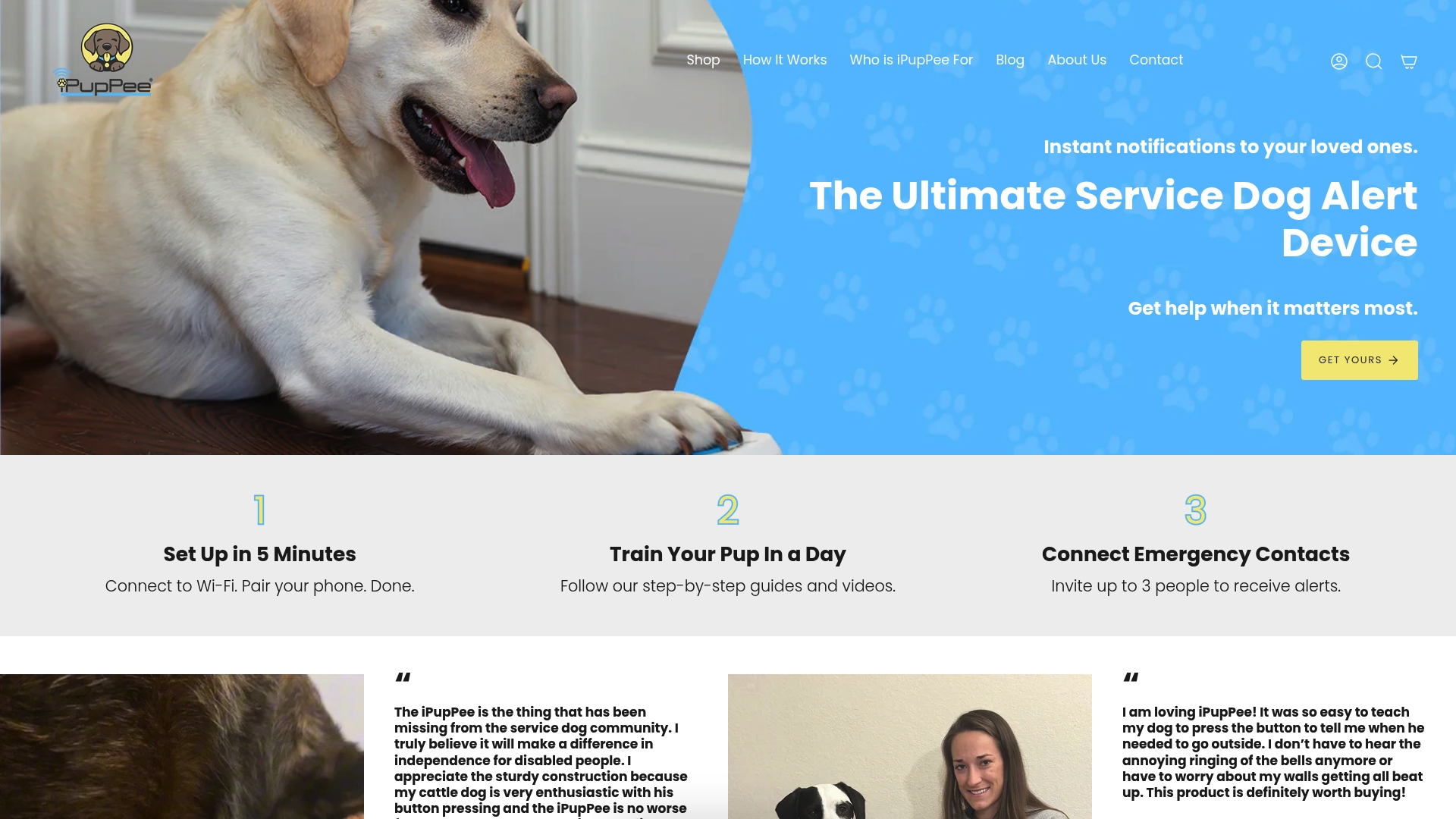
The Psychology & Training Course is $119 as a one-off purchase and teaches the dog-side skills that make a device work in practice. If you handle a service dog, our service dog page explains how the system fits that work, and How It Works walks through setup.
Related reading
If you’re still mapping out what connected dog gear can and can’t do, these guides cover the basics: what pet tech is and how it supports dog safety, the real benefits of smart dog devices, and how a 7 to 14 day baseline works for remote monitoring.
FAQ
What does pet-device compatibility actually mean?
It means every link between the device and your life works together: your Wi-Fi, your phone and app, other smart devices, the physical setup, the people who receive alerts and the dog itself. A device can pass the phone test and still fail on weak signal, a missing contact or a dog that can’t use it.
Can I mix pet devices from different brands?
Often you can, but it takes care. A 2025 academic review notes that integrating devices from different manufacturers into one smart-home network can be complex. If a device must work on its own for safety, choose one that does its main job without depending on other brands.
Do connected pet devices put my privacy at risk?
They can. A 2023 study found that 2 of 20 popular pet tech apps exposed login details through non-encrypted traffic and 14 contacted third-party trackers before consent. Use strong unique passwords, review app permissions and keep software updated.
Can a pet device replace a vet visit?
No. Wearable accuracy varies between brands, and these devices should never diagnose illness or replace veterinary advice. Use them to spot changes and bring what you see to your veterinarian.
Do I need a subscription for a connected pet device to work?
That depends on the product, so check before buying what works without a paid plan. The iPupPee device does not require a monthly subscription fee.
Sources
- The Internet of Things Empowering the Internet of Pets (Applied Sciences, 2025)
- Watching Your Watch Dog: Home Pet Monitoring Systems (VCA Animal Hospitals)
- How my smart home helps care for my pets (The Verge)
- Security and privacy of pet technologies (Frontiers in the Internet of Things, 2023)
- Meari Technology baby monitors security issue (Consumer Reports)
- Innovative Pet Tech That Makes Life Easier (Zoetis Petcare)
- Detection of heart rate and rhythm with a smartphone-based ECG (JAVMA, 2016)
- Oscillometric and Doppler techniques for continuous blood pressure (JAVMA, 2024)