

Contrary to popular belief, you don’t need a professional trainer to develop an effective service dog. Over 60% of handlers successfully train their own assistance dogs using structured methods and consistent positive reinforcement. With proper commitment, temperament assessment, and evidence-based techniques, you can transform your canine companion into a reliable partner that enhances your safety and independence. This guide walks you through proven training foundations, welfare-friendly methods, certification processes, and practical DIY strategies that empower you to train your service dog with confidence.
Table of Contents
- Understanding Canine Assistance Training Foundations
- Positive Reinforcement Versus Aversive Training Methods
- Ensuring Certification And Welfare In Service Dog Training
- Applying Canine Assistance Training: Diy Methods And Practical Tips
- Enhance Your Canine Assistance Journey With Ipuppee
- Frequently Asked Questions About Canine Assistance Training
Key takeaways
| Point | Details |
|---|---|
| Training combines three core elements | Service dog training integrates obedience, task-specific skills, and socialization for public access readiness. |
| Positive methods outperform aversive techniques | Evidence shows that praise and treats yield better obedience and welfare than punishment-based approaches. |
| DIY training is legally recognized | Handlers can train their own dogs if they perform disability-mitigating tasks and complete 300+ hours of public access work. |
| Certification validates skills without stress | Independent testing phases confirm readiness while maintaining low cortisol levels and positive welfare indicators. |
| Assistance dogs transform independence | Trained dogs significantly improve mobility, psychosocial wellbeing, and daily functioning for handlers with disabilities. |
Understanding canine assistance training foundations
Effective service dog training requires mastering three interconnected components: obedience commands, task-specific skills, and socialization. These elements work together to create a reliable partner capable of navigating complex public environments while responding to your unique disability-related needs.
Obedience forms the bedrock of all assistance work. Your dog must respond reliably to fundamental commands that handlers use daily:
- Sit and stay for controlled waiting in public spaces
- Heel for safe navigation through crowds and tight areas
- Come when called to maintain proximity and safety
- Down for extended settling in restaurants or medical appointments
Task-specific training addresses your individual disability requirements. This phase tailors your dog’s skills to practical assistance needs. Common tasks include retrieving dropped items, opening doors, providing balance support during transfers, alerting to medical conditions like low blood sugar, and applying deep pressure during anxiety episodes. The key is matching tasks directly to functional limitations your disability creates.
Socialization prepares your dog for the unpredictable nature of public access. Exposure to varied environments, sounds, surfaces, and social situations builds confidence and appropriate responses. A well-socialized service dog remains calm when encountering shopping carts, automatic doors, children, other animals, and unexpected noises.
Guide dog training demonstrates how phased approaches create reliable assistance dogs. The formal 8-phase methodology includes:
- Health screening and veterinary clearance
- Basic obedience and handler bonding
- Harness introduction and tethering mechanics
- Straight-line walking and obstacle detection
- Curb and stair navigation
- Traffic awareness and intelligent disobedience
- Complex route work and problem-solving
- Handler matching and transfer training
Understanding this progression helps you structure your own training timeline. While your specific tasks may differ from guide work, the principle of building complexity gradually applies universally. Start with foundational obedience, add task training once basic commands are solid, then layer in public access exposure as skills strengthen. For more effective assistance training tips, focus on consistency and incremental challenge increases.
Positive reinforcement versus aversive training methods
The training methodology you choose profoundly impacts both your dog’s welfare and the reliability of learned behaviors. Research reveals that positive reinforcement methods produce superior obedience and fewer stress behaviors compared to punishment-based approaches, yet 66% of owners still incorporate vocal corrections or physical punishment into their training routines.
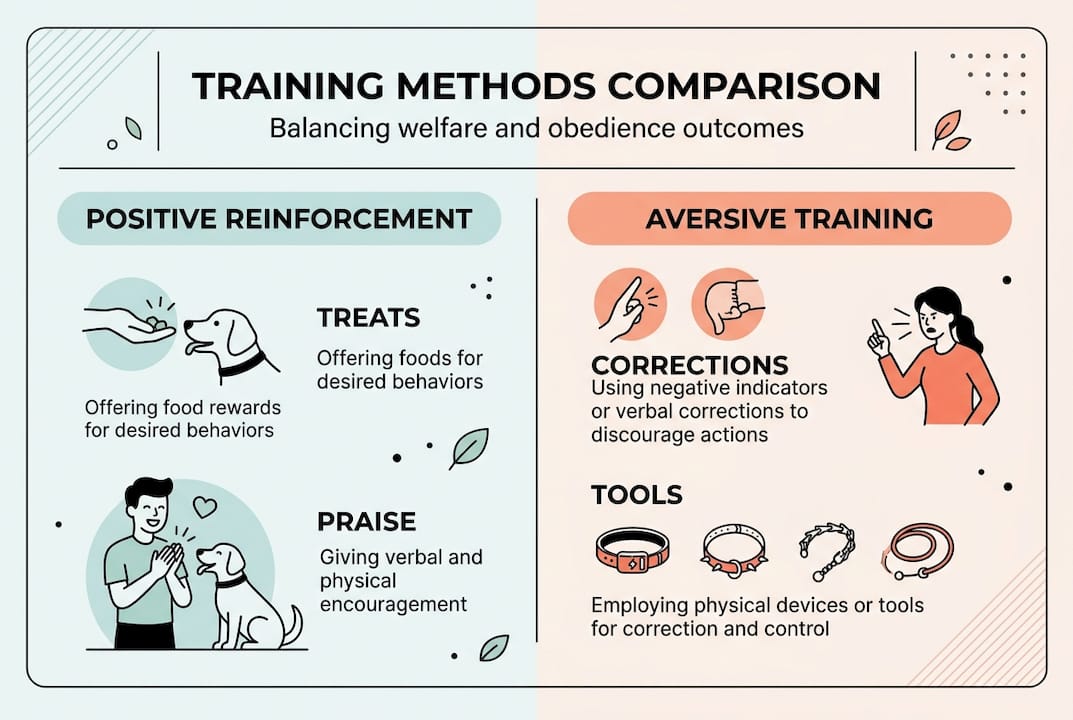
Positive reinforcement builds desired behaviors through rewards. When your dog performs correctly, you immediately provide something valuable: treats, praise, play, or access to desired activities. This creates a positive association with the behavior, increasing the likelihood your dog will repeat it. The method works because dogs naturally seek rewarding outcomes and will offer behaviors that historically produced good results.
Aversive training relies on unpleasant consequences to suppress unwanted behaviors. Common aversive tools include choke chains, prong collars, shock collars, leash corrections, and verbal reprimands. While these methods can produce quick compliance, they carry significant risks. Dogs trained with aversive methods show higher rates of anxiety-related behaviors, increased aggression toward handlers and strangers, and reduced problem-solving willingness.
Balanced training combines both approaches, using positive reinforcement as the primary tool but incorporating corrections for specific unwanted behaviors. Proponents argue this reflects natural canine learning and provides clearer boundaries. However, evidence consistently shows that purely positive methods achieve comparable or better obedience outcomes without the welfare costs associated with punishment.
| Training Method | Primary Tools | Obedience Outcomes | Welfare Impact | Best Applications |
|---|---|---|---|---|
| Positive Reinforcement | Treats, praise, play, life rewards | High reliability with strong motivation | Lowest stress, builds confidence | All training phases, complex tasks |
| Aversive Methods | Corrections, shock collars, prong collars | Quick compliance but inconsistent long-term | Elevated anxiety, potential aggression | Generally not recommended for service work |
| Balanced Training | Primarily positive with selective corrections | Variable depending on correction timing | Moderate stress if corrections are minimal | Requires expert timing to avoid welfare issues |
For service dog training specifically, positive methods offer critical advantages. Assistance work demands dogs that problem-solve, show initiative, and remain calm under stress. Aversive training can suppress the very behaviors you need: a dog willing to alert you to medical issues, retrieve items creatively, or disobey dangerous commands. Additionally, handlers with disabilities may struggle with the precise timing aversive methods require to avoid creating fear associations.
Pro Tip: Pair every correct response with immediate verbal praise, even when using treats. This builds a secondary reinforcer that works in public settings where food rewards aren’t always practical. Your enthusiastic “yes!” becomes a powerful motivator that bridges the gap until you can deliver a treat.
The welfare benefits extend beyond training sessions. Dogs trained with positive methods show lower baseline stress, stronger handler bonds, and greater resilience when facing novel challenges. These qualities prove essential for service dogs navigating unpredictable public environments daily.
Ensuring certification and welfare in service dog training
Certification processes validate your dog’s skills and public access readiness while maintaining welfare standards throughout testing. Understanding how certification phases work helps you prepare effectively without compromising your dog’s wellbeing or creating unnecessary stress during evaluation.
Most comprehensive certification programs use multi-phase testing that evaluates both technical skills and behavioral stability. The two-phase approach tests dogs first with their familiar handler, then with an unfamiliar evaluator. This dual assessment confirms that trained behaviors transfer reliably regardless of who provides cues, a critical requirement for dogs that may need to work with multiple family members or caregivers.
Research on guide dog certification reveals encouraging welfare findings. Cortisol measurements taken before, during, and after testing show no significant elevation compared to baseline levels. Behavioral observations confirm this physiological data: certified dogs display minimal stress indicators like excessive panting, trembling, or avoidance behaviors during evaluation. These findings demonstrate that well-prepared dogs experience certification as a manageable challenge rather than a traumatic event.
Key elements evaluated during certification include:
- Obedience reliability in distracting public environments
- Task performance accuracy and consistency
- Appropriate social behavior around people and animals
- Calm responses to unexpected stimuli
- Handler focus and attentiveness
- Proper public access manners in various settings
Verbal praise during testing plays a surprisingly important role in maintaining positive experiences. Evaluators who provide encouraging feedback help dogs stay motivated and confident throughout the assessment process. This approach aligns with positive reinforcement principles and reduces any anxiety associated with working with an unfamiliar person.
Pro Tip: Early temperament testing between 6 and 8 weeks predicts training success with remarkable accuracy. Puppies showing confident exploration, quick recovery from mild stressors, and moderate arousal levels typically excel in service work. If you’re selecting a puppy for training your own service dog, prioritize these traits over breed stereotypes or physical appearance.
Certification requirements vary by organization and jurisdiction, but most programs assess public access skills across multiple environments: retail stores, restaurants, medical facilities, and public transportation. Testing typically occurs over several sessions to evaluate consistency rather than single-instance performance. This multi-session approach better reflects real-world demands and identifies dogs that maintain standards across different contexts and energy levels.
The absence of stress during proper certification validates that testing protocols, when designed thoughtfully, support rather than compromise welfare. This knowledge should give you confidence that pursuing certification enhances rather than undermines the positive training relationship you’ve built with your dog.
Applying canine assistance training: DIY methods and practical tips
Training your own service dog is legally recognized under ADA guidelines when dogs perform specific disability-mitigating tasks and complete sufficient public access preparation. Success requires honest assessment of your dog’s suitability, structured training protocols, and commitment to the 300+ hour minimum for reliable public access skills.
Before investing significant time and resources, evaluate your dog’s fundamental temperament and health status. Ideal service dog candidates display:
- Calm confidence in novel situations without excessive fear or reactivity
- Natural focus on the handler rather than environmental distractions
- Moderate energy levels that allow for extended settling periods
- Sound physical health with no conditions that limit working capacity
- Appropriate age for training demands, typically 18 months to 5 years for starting formal task work
Task relevance to your specific disability is non-negotiable for legal protection under ADA regulations. Your dog must perform work directly related to your disability, not simply provide emotional comfort. Document how each trained task mitigates a functional limitation your disability creates. This documentation proves essential if your access rights are ever questioned.
| Training Phase | Time Investment | Key Activities | Success Indicators |
|---|---|---|---|
| Foundation Obedience | 2 to 4 months | Basic commands, handler focus, impulse control | Reliable response in low-distraction environments |
| Task Training | 3 to 6 months | Disability-specific skills, task chaining, reliability building | Consistent task performance on cue |
| Public Access Preparation | 6 to 12 months | Socialization, distraction proofing, environment exposure | Calm behavior in varied public settings |
| Advanced Proofing | Ongoing | Maintenance, generalization, novel situation adaptation | Consistent performance across all contexts |
Public access training demands structure and consistency throughout the 300+ hour minimum. Break this into manageable weekly goals rather than viewing it as an overwhelming total. Three to five training sessions per week, each lasting 45 to 90 minutes, creates steady progress without overwhelming either you or your dog. Vary locations systematically: start in quiet areas, gradually increase distractions, then tackle challenging environments like busy stores or medical facilities.
Seven practical solutions address common training challenges disabled handlers face:
- Adapt physical training techniques to your mobility limitations by using target sticks, verbal cues, and remote rewards rather than requiring you to bend or move quickly.
- Schedule shorter, more frequent sessions if fatigue limits your training capacity, maintaining consistency through daily brief practice rather than exhausting marathon sessions.
- Recruit trusted helpers for socialization outings when your disability makes certain environments difficult to access independently.
- Video record training sessions to review your timing and technique, compensating for any sensory processing challenges that make in-the-moment assessment difficult.
- Use environmental management to set your dog up for success, removing temptations and distractions during early learning phases.
- Build task duration gradually, starting with brief approximations and extending time requirements as your dog’s stamina and focus increase.
- Maintain detailed training logs documenting hours, locations, skills practiced, and progress milestones for both your own tracking and potential legal documentation needs.
Pro Tip: Use positive reinforcement consistently and maintain detailed training logs that document each session’s date, duration, location, skills practiced, and your dog’s performance. These records prove invaluable if you need to demonstrate your dog’s training history and provide concrete evidence of the 300+ public access hours required for legal recognition.
For additional guidance on structuring your training program effectively, explore this comprehensive training guide that breaks down each phase with specific exercises and troubleshooting strategies. When you encounter obstacles, this resource on training challenges and solutions offers targeted approaches for the most common issues disabled handlers face during DIY training.
Remember that successful DIY training requires honest self-assessment of both your capabilities and your dog’s aptitude. Not every dog possesses the temperament for service work, and not every handler has the physical or cognitive capacity to train independently. Recognizing when to seek professional assistance demonstrates wisdom rather than failure.
Enhance your canine assistance journey with iPupPee
Your commitment to training a reliable service dog deserves support from resources designed specifically for handlers with disabilities. iPupPee offers expert guidance, innovative communication tools, and comprehensive training resources that streamline your journey toward greater independence and safety.
Explore our comprehensive training guide that breaks down complex training phases into manageable steps tailored for handlers with varying physical and cognitive abilities. Discover how assistance dogs transform daily living through our detailed analysis of service dog benefits, covering mobility support, medical alerts, and psychosocial improvements backed by current research. Our platform provides the practical tools and evidence-based insights you need to train confidently and enhance your partnership with your canine assistant.
Frequently asked questions about canine assistance training
What basic tasks can I train my service dog to perform?
You can train tasks directly related to your disability, including retrieving dropped items, opening doors, providing balance support, alerting to medical conditions like seizures or low blood sugar, applying deep pressure during anxiety episodes, guiding around obstacles, and interrupting harmful behaviors. Each task must mitigate a specific functional limitation your disability creates to qualify for legal protection.
How long does it take to train a service dog to be fully functional?
Most service dogs require 12 to 24 months of consistent training to achieve full public access reliability and task proficiency. This includes foundation obedience (2 to 4 months), task-specific training (3 to 6 months), and public access preparation (6 to 12 months minimum). The timeline varies based on your dog’s aptitude, your training consistency, and task complexity.
Is DIY training recognized legally under ADA guidelines?
Yes, the ADA explicitly permits owner-trained service dogs provided they perform disability-mitigating tasks and demonstrate appropriate public access behavior. You must complete sufficient training, typically 300+ hours of public access work, and ensure your dog meets behavioral standards including remaining under control and not posing safety threats in public settings.
How can I reduce my dog’s stress during certification tests?
Prepare thoroughly through gradual exposure to testing environments and evaluator interactions before formal assessment. Practice with unfamiliar people giving commands to build transferability. Maintain your positive reinforcement approach during testing, using verbal praise to keep your dog confident and motivated throughout the evaluation process.
What are the most effective reinforcements to use during training?
High-value food treats work best for initial learning and complex task training, while verbal praise and life rewards like play or access to desired activities maintain behaviors long-term. Vary reinforcement types to prevent satiation and build intrinsic motivation. Match reward value to task difficulty, reserving your dog’s favorite treats for the most challenging skills.