

TL;DR:
- Standard household emergency plans often neglect pets, risking their safety during crises. Preparing two distinct kits and practicing evacuation drills ensure pets are protected and reduce response anxiety. Regularly reviewing and customizing plans and supplies is vital for effective pet safety during emergencies.
When disaster strikes, most people grab their go-bag and head for the door. But what happens to your dog? The hard truth is that standard household emergency plans almost never account for pets, and that gap can turn a manageable crisis into a heartbreaking loss. Ready.gov guidance recommends starting any pet safety plan with an evacuation plan, shelter options that allow animals, and two separate kits built for two very different scenarios. This guide walks you through everything you need to build a real, workable emergency response plan for your pet, including practical kits, drill strategies, and special considerations for service dog handlers.
Table of Contents
- Why every pet needs an emergency response plan
- Essential components of a pet emergency plan
- Building and maintaining a pet emergency kit
- Practicing your emergency response: Making it work under stress
- Why pet emergency plans fail—and what most advice overlooks
- Next steps: Equip your household for true pet safety
- Frequently asked questions
Key Takeaways
| Point | Details |
|---|---|
| Plan for pets | A pet-specific emergency plan prevents confusion and ensures every animal is protected if you must evacuate. |
| Kits matter | Have both shelter-in-place and evacuation kits—review and update their contents regularly. |
| Practice saves lives | Drill your emergency plan with your pets to reduce panic and improve real-life response. |
| First aid is a bridge | Use a first-aid kit for immediate needs, but seek veterinary care as soon as possible after an emergency. |
Why every pet needs an emergency response plan
Most families have some version of a home emergency plan. They know which door to use, where to meet outside, and who to call. But those same plans rarely mention the dog waiting by the back door or the service animal sleeping at the foot of the bed. That oversight is more dangerous than most people realize.
Evacuation centers operated by local governments frequently do not accept pets. Hotels along major evacuation routes fill up fast, and pet-friendly rooms go first. If you have not already identified where your pet can stay during an extended emergency, you will be making that decision under pressure, in traffic, with a stressed animal in the back seat. That is a recipe for poor choices and real risk.
FEMA’s pet preparedness guidance uses scenario-based decision trees to highlight exactly these kinds of concrete choice points: where to go, how to find pet-friendly shelters, and how to ensure your records and vet contact information are on hand before you need them. These details feel small until the moment they are not.
Here is what a solid foundation looks like before you even build a kit:
- Keep current vet records, vaccination certificates, and microchip registration details in a waterproof folder or digital cloud backup
- Know your pet’s behavior under stress so you can predict how they will respond during a loud, chaotic evacuation
- Identify at least two pet-friendly shelters or boarding facilities in advance, one local and one outside your immediate area
- Have a backup caregiver identified, someone who can take your pet if you cannot bring them yourself
- For service dog handlers, document your dog’s specific tasks, equipment, and legal status under the Americans with Disabilities Act
“Failing to plan for your pet is planning for your pet to be left behind.” That is not a scare tactic. It is the reality that animal welfare organizations and emergency managers see play out after every major disaster.
For a practical overview of pet emergency safety steps, start with a clear-eyed review of what your current plan does and does not cover. Most owners are surprised by how many gaps they find.
Essential components of a pet emergency plan
Once you understand why pet-specific planning matters, the next question is: what exactly goes into a solid plan? The answer has several layers, and each one matters.
The backbone of any plan is the two-kit system. Ready.gov is clear that pet emergency planning requires two distinct kits: a larger shelter-in-place kit designed to support your pet through an extended stay at home, and a smaller, lighter evacuation kit built for mobility and speed.
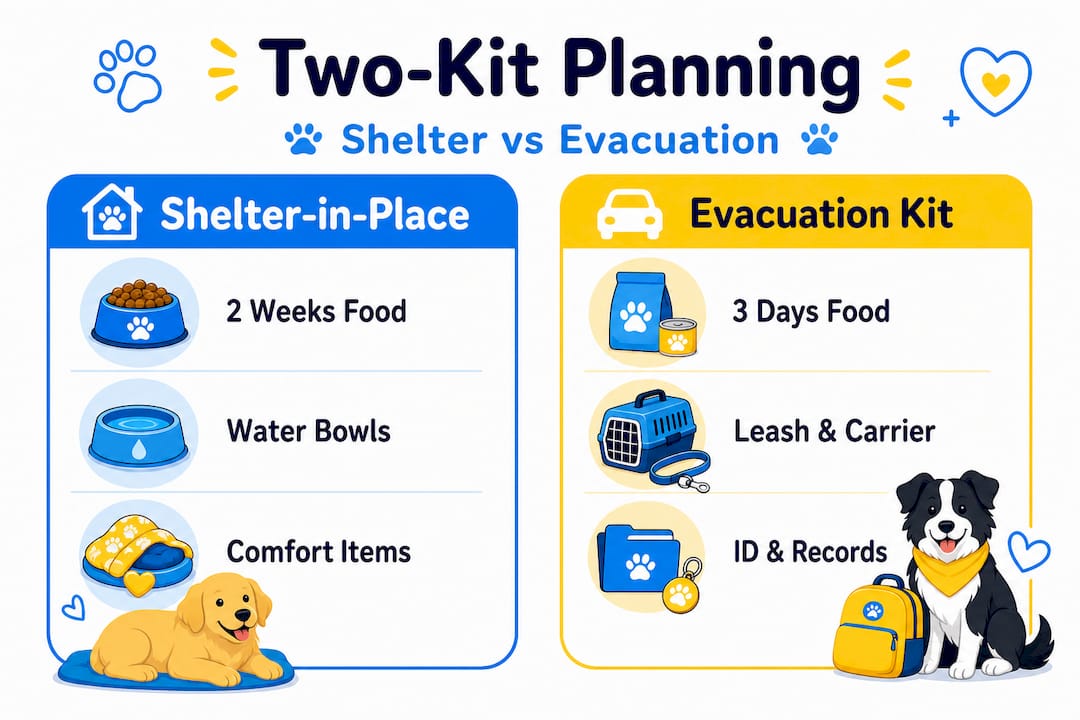
Here is a breakdown of what each kit should prioritize:
| Kit type | Purpose | Key contents |
|---|---|---|
| Shelter-in-place kit | Sustain your pet at home for 2 to 4 weeks | Bulk food, large water supply, medications, full bedding, crate |
| Evacuation kit | Fast exit, portable, 72 hours minimum | 3-day food/water, leash, carrier, documents, photo ID, small first-aid kit |
Building the plan itself follows a clear sequence:
- Write down your evacuation routes. Identify at least two routes out of your neighborhood that can accommodate an animal.
- Research shelter and lodging options in advance. Call ahead. Confirm pet policies in writing if possible.
- Create a pet profile card. Include your pet’s name, breed, age, medical conditions, medications, microchip number, and a current photo.
- Identify an out-of-area contact. Someone outside your region who can coordinate care if local lines of communication break down.
- Practice the sequence with your pet present. More on this in a later section.
Pro Tip: Store copies of your pet’s medical records and vaccination history in both your evacuation kit and a secure cloud folder. If your physical documents are lost in a flood or fire, your vet can pull digital records, but only if you have kept that information updated and accessible.
The dog emergency preparedness guide from iPupPee offers a thorough walkthrough of these steps, and training dogs for emergencies covers how to prepare your dog behaviorally, not just logistically.
Building and maintaining a pet emergency kit
Knowing you need two kits is step one. Actually building them, and keeping them current, is where most pet owners fall short.

Let’s start with a direct comparison of what goes into each kit type:
| Item | Shelter-in-place kit | Evacuation kit |
|---|---|---|
| Food | 2 to 4 week supply, sealed containers | 3-day supply, portioned bags |
| Water | Large jugs, enough for pet and humans | Portable bottles, collapsible bowl |
| Medications | Full supply with dosing instructions | One week minimum, labeled clearly |
| Crate or carrier | Full-size crate | Soft carrier or collapsible crate |
| Documents | Full vet records, registration | Copies, laminated pet ID card |
| First-aid kit | Full kit | Compact travel version |
| Comfort items | Favorite toy, full bedding | One small blanket or familiar item |
| Waste supplies | Full supply of bags, litter if needed | Small supply for 72 hours |
A veterinary-referenced first-aid kit typically includes gauze, bandage material, antiseptic wipes, a digital thermometer, tweezers, a muzzle, sterile saline, and a cold pack. However, it is important to understand what a first-aid kit cannot do. It is not a replacement for professional veterinary care. It handles surface wounds, minor injuries, and helps stabilize a pet while you get to a vet. Trying to treat a serious injury at home without professional guidance can cause more harm than good.
Per Ready.gov guidance, both kits should be reviewed and restocked on a regular schedule. Foods expire. Medications lose potency. Your pet’s health status changes. A kit you packed two years ago may not reflect your pet’s current needs at all.
- Rotate food and water every six months minimum
- Check medication expiration dates every three months
- Update the photo of your pet annually, or any time their appearance changes significantly
- Reassess kit weight and portability as your pet ages or if your household circumstances change
Pro Tip: Store your evacuation kit near your main exit, not in a garage or closet you might not be able to reach in a smoke-filled hallway. Seconds matter in a fast-moving emergency.
For service dogs, the kit needs additional customization. Include their harness, vest, working gear, and any documentation that confirms their legal status. Some service dog handlers also benefit from carrying a brief written description of the dog’s specific tasks, which helps first responders understand why the dog must stay with its handler.
For more pet safety tips, including common oversights that even experienced owners make, check out iPupPee’s resource library.
Practicing your emergency response: Making it work under stress
Here is something most pet emergency guides skip entirely: the plan you write is not the plan you will use. The plan you actually use in an emergency is the one you have practiced until it becomes automatic.
This matters more than most people expect. During a real emergency, your stress hormones spike, your thinking narrows, and your memory for procedural steps gets unreliable. That is not a personal flaw. It is basic human physiology. The way to counter it is repetition before the emergency happens.
Ready.gov frames an effective emergency response strategy as an operational playbook: pre-identify your destination options, stage your go-bag near the door, and practice the sequence so that decision-making under stress is faster and more reliable. That word “practice” is doing a lot of work in that sentence.
Here is how to run a practical drill with your pet:
- Set a timer for five minutes. This simulates the real-world pressure of a fast evacuation.
- Grab the evacuation kit and confirm it is ready to go. Open it, check the contents, close it.
- Put your pet’s leash, collar, and ID tag on. Confirm the fit and the ID information is current.
- Load your pet into their carrier or into the car. Note how long this actually takes.
- Drive to your first identified pet-friendly shelter or lodging. Confirm they still accept animals.
- Debrief. What took longer than expected? What did your pet struggle with?
For households with multiple people, assign roles in writing. One person handles the pet. One person handles the kits. One person handles the vehicle. Written backup instructions mean that if one person is away when the emergency happens, everyone else still knows what to do.
“The drill is where you find out your dog panics when the smoke alarm goes off, and your carrier latch sticks in cold weather. Better to learn that during a Tuesday afternoon practice than at 2 AM during an actual fire.”
Service animals and pets with anxiety require adjusted practice methods. Keep drills calm and controlled. Use positive reinforcement throughout. Never simulate a high-stress scenario in a way that traumatizes your pet. The goal is familiarity and calm association, not a stressful rehearsal that makes the real event harder.
Review training for emergencies with dogs for a structured approach to building this kind of behavioral resilience in your dog over time.
Why pet emergency plans fail—and what most advice overlooks
Most mainstream pet emergency checklists are well-intentioned but missing something important: they assume you will actually use what you prepare. In practice, the number one reason emergency plans fail is not lack of information. It is unused preparation.
Owners pack a kit in January and never open it again. They write down the name of a pet-friendly shelter but never call to confirm the policy is still in place. They assume someone else in the household knows the plan. None of these assumptions hold up under pressure.
The second major oversight is treating first aid as a destination rather than a bridge. MSD Veterinary Manual guidance is clear on this point: first-aid readiness should function as triage support, not definitive care. You use the kit to stabilize your pet and reduce immediate harm, and then you get to a vet as fast as possible. Owners who over-rely on their first-aid kit and delay veterinary care can inadvertently worsen outcomes for their pets.
Annual reviews are not optional. Your pet’s age, weight, medications, and behavioral profile change over time. A plan that worked well for your energetic three-year-old dog may be completely wrong for the same dog at age ten with a heart condition and mobility issues. Schedule a dedicated review twice a year, the same way you would schedule a dental cleaning or an oil change.
The most effective plans are also the most specific. Generic templates pulled from a government website are a starting point, not a finished plan. The details that make a plan actually work are the ones that are specific to your dog, your home, your neighborhood, and your family’s unique situation.
For a deeper look at essential emergency steps and a self-assessment of your current readiness level, start by reviewing whether your plan has been practiced recently. And for a broader picture of what complete pet readiness looks like, paws & preparedness is worth a careful read.
Next steps: Equip your household for true pet safety
You now have the framework. The next move is putting it into action before you need it.
At iPupPee, we build tools and resources specifically for pet owners who take safety seriously, including service dog handlers, seniors, and anyone living with a dog who needs reliable communication in a crisis. Whether you are building your first emergency kit or refining a plan you have had for years, we have the guidance and products to help you close the gaps. For a focused look at what real-time dog alerts can add to your emergency response, see our breakdown of dog emergency alerts and how they fit into a complete safety strategy.
Frequently asked questions
What should I include in a pet’s emergency kit?
Pack food, water, a leash, ID tags, medical records, bedding, a current photo, and a first-aid kit; Ready.gov recommends building both a shelter-in-place kit and a portable evacuation version.
How often should pet emergency kits be updated?
Review and refresh your kits at least twice a year, checking food and water expiration dates, medication potency, and whether your pet’s profile information is still accurate per Ready.gov.
Are there special emergency plan needs for service dogs?
Yes, service dogs need plans that account for their specific working gear, tasks, and legal protections; FEMA guidance notes that scenario-based pet preparedness must reflect the unique needs and equipment of service animals.
Is a pet first-aid kit enough in a medical emergency?
No, a first-aid kit addresses basic injuries but is never a substitute for professional veterinary care; MSD Veterinary Manual describes it as triage support designed to bridge the gap until you reach a vet.
Where can I find pet-friendly shelters if I need to evacuate?
Research local emergency management agencies, animal welfare organizations, and your county’s disaster preparedness office in advance; FEMA guidance stresses identifying pet-friendly shelters before an emergency, not during one.