
Environmental enrichment means changing your dog’s surroundings and daily routine so they can do the things dogs are built to do: sniff, chew, search, think, move and spend time with people. The best plan combines five kinds of activity, matches them to your dog’s age, health and temperament, and rotates them so they stay interesting. It also needs a person who is paying attention. That is where our training resources and our Wi-Fi alert device come in for owners who live alone, have limited mobility or work with a service dog. We cover the full routine below.
TL;DR
- Enrichment is a change to how your dog lives that increases normal behavior and helps them cope. It is not a toy purchase.
- Use five types: social, nutritional, occupational, sensory and physical. Mix and rotate them.
- An activity only counts if your dog engages with it and is not frightened by it.
- Supervise new or shreddable items, and manage food enrichment so it does not add weight.
- Short training sessions are enrichment, and so is a sniff-led walk, so limited mobility does not rule out a rich day.
Table of Contents
- What environmental enrichment actually is
- The five types of dog enrichment
- Fit the activity to the dog
- A simple daily routine
- Low-cost DIY enrichment, safely
- How to tell whether it is working
- What the research does and does not show
- When you cannot be there: communication and training
- Where to start with us
- FAQ
- Sources
What environmental enrichment actually is
Purdue veterinary researchers describe environmental enrichment as changing a dog’s environment to improve care. The goals are more behavioral diversity, more normal behaviors, positive use of the environment and better coping. They also note that barren or boring surroundings may contribute to abnormal behaviors, some of them self-injurious.
The RSPCA’s knowledgebase says enrichment lets dogs act on natural urges such as sniffing, playing, digging, running, exploring and socializing. It lists possible benefits: relaxation, less stress and anxiety, more resilience, stronger bonds with caregivers and fewer behavior problems. It also warns that enrichment that does not fit the dog can be ineffective or even harmful. Everything that follows is built around that point: fit comes first.
The five types of dog enrichment
Purdue’s Canine Welfare Science group sorts enrichment into five categories and recommends combining and rotating them. If you want a vet’s view on which types to rotate, this overview of enrichment types and examples is a good companion read.
| Type | What it means | Everyday examples |
|---|---|---|
| Social | Time with people or compatible dogs | Play sessions, calm time on the couch, a friendly dog walk partner |
| Nutritional | Making food a task | Puzzle feeders, hidden food, safe chews |
| Occupational | Giving the dog a job | Short training sessions, fetch, sports |
| Sensory | New smells and suitable sounds | Scent games, sniff walks |
| Physical | Safe things to climb, dig and move | Platforms, safe toys, a digging area |
Social
Social enrichment is not the same for every dog. Blue Cross advises basing social opportunities on each dog’s own preferences: a dog who is uneasy around other dogs can get just as much from time with favorite people. Our guide to meeting your dog’s social needs goes through seven practical ways.
Nutritional
This is the easiest place to start. Blue Cross suggests food scatters, snuffle mats, frozen food toys, activity feeders and food-filled boxes the dog is allowed to tear apart. Count these treats as part of the daily food allowance. The RSPCA cautions that feeding enrichment can contribute to obesity if it is not managed.
Occupational
Training counts. A few minutes of positive, reward-based practice gives a dog a task and your attention at once. This matters for service dog teams and pet trainers, whose dogs already work: variety outside the work routine keeps the job from becoming the dog’s whole life.
Sensory
Scent work, snuffle mats, food hidden in towels or paper, and sniff-led walks are accessible forms of sensory enrichment. A 2021 review by Emma Desforges found they are especially useful for dogs less motivated by toys or food. Our practical guide to dog sensory enrichment explains how to build a scent routine step by step.

Physical
Physical enrichment covers safe toys, platforms to hop on and a place to dig. A dig box in the yard or a shallow tub indoors works for many dogs. For senior dogs or dogs with joint problems, keep surfaces low and non-slip.

Fit the activity to the dog
The AAHA guidance on home enrichment says to tailor walks to the dog’s age and ability and to offer dog-safe food enrichment in moderation. The RSPCA adds that you should choose individually and assess safety, because the same activity can help one dog and harm another.
A few practical matches:
- Puppies and rescue dogs: keep sessions short and calm. A new dog may be wary of unfamiliar sounds and smells, so introduce one thing at a time and let the dog walk away from it. Scent games and scatter feeding make few demands and build confidence.
- Senior dogs: favor sniffing, gentle puzzle feeding and short training over high-impact play. Our article on safe, fun senior activities with pets covers options for older dogs and older owners.
- Dogs that dislike other dogs: put the social weight on people and quiet routines, and skip the dog park.
- Dogs that ignore toys: use their nose. Food-free scent games work well when a dog is not toy-driven.
- Working and service dogs: schedule enrichment that has nothing to do with the job. Sniffing, free play and rest all count.
If your dog has a medical condition, ask your veterinarian before changing diet-related enrichment or exercise level.
A simple daily routine
AAHA recommends varying enrichment across the day, with examples such as short training, scatter feeding, sniff walks, tailored walks and positive social contact. Here is one way to lay that out:
- Morning: a sniff-led walk. Let the dog stop and investigate instead of marching at your pace.
- Late morning: scatter part of a meal across the floor or a snuffle mat.
- Midday: a five-minute training session, then rest.
- Afternoon: a rotated puzzle or chew, supervised the first time.
- Evening: calm time together, or play if your dog enjoys it.
We also publish a routine built around sniffing, the 20/20/20 enrichment routine, and a list of mental stimulation ideas to calm and engage your pup.
One point deserves emphasis. The RSPCA says enrichment should not replace time with caregivers or, where appropriate, other animals. Shared play also helps you learn what your dog likes.
Low-cost DIY enrichment, safely
You do not need to spend much. The RSPCA lists scattering food, homemade snuffle mats and muffin-tin puzzles as low-cost options. For the muffin tin, put kibble or treats in the wells, cover them with balls sized so your dog cannot swallow them, and let the dog move the balls to reach the food.
Safety rules that go with every homemade item:
- Supervise new items and anything that can be shredded. The University of Illinois Fear Free DIY handout also advises supervising dogs with homemade food puzzles.
- Use materials without sharp edges or loose parts, and inspect and clean toys regularly.
- Remove the plastic bag from cereal boxes before turning them into toys. Preventive Vet warns that bags pose a suffocation risk, and that supervision matters because pieces can be chewed off and swallowed.
- Take away any item the dog starts to eat instead of play with.
How to tell whether it is working
Ohio State’s Indoor Pet Initiative puts the test simply: an activity is enriching only if the dog engages with it and is not made fearful by it. Putting a toy on the floor is not enrichment by itself.
Watch for these signs:
- Good: the dog approaches willingly, stays with the task, and settles afterward.
- Change it: the dog ignores it after a few tries. The RSPCA notes that repeating identical toys can reduce their value, so rotate.
- Stop: the dog backs away, freezes, or seems distressed. The RSPCA warns that inappropriate sounds or scents can upset dogs.
- Adjust the food: weight creeping up means smaller portions elsewhere in the day.
If your dog shows ongoing fear, destructiveness or distress when left alone, talk to your veterinarian or a qualified trainer. Enrichment is support, not a cure for a medical or serious behavior problem.
What the research does and does not show
Research is encouraging but still developing. A 2012 study of 117 kenneled dogs found more sleeping and less vocalizing during classical music than in other conditions, though it took place in one kennel. A 2023 shelter study found calmer body posture with scent enrichment and fewer vocalizations with tactile enrichment during cleaning time, which suggests different kinds of enrichment address different stress behaviors. A Faunalytics summary of work on separation anxiety found that responses varied by the type of enrichment.

The practical lesson matches the advice above: try several types, and let your own dog’s response guide you.
When you cannot be there: communication and training
Enrichment works best when a person is involved. Many of our readers cannot always be hands-on: seniors, people with disabilities, handlers living alone, and rescue organizations with many dogs to care for. For them, the routine needs to be simple and the dog needs a clear way to reach a person.
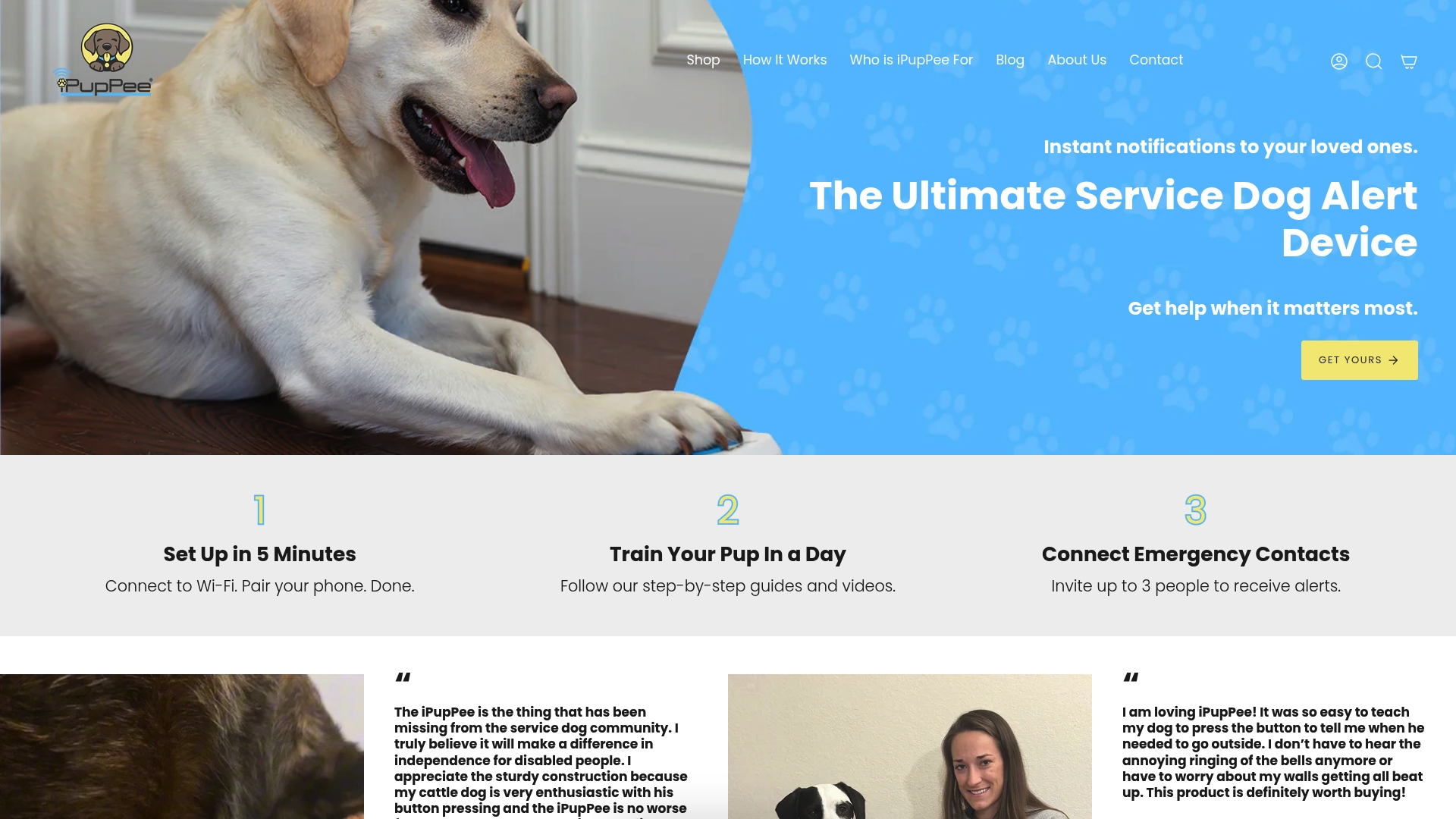
That is why we built the iPupPee. It is a Wi-Fi smart alert device: when the dog presses the button, a notification goes to you or to emergency contacts, with live video and two-way audio. It works for dogs of all sizes and there is no monthly subscription fee. Teaching a dog to press a button is training, and training is one of Purdue’s occupational enrichment types. Our guide on how interactive devices boost dog safety and cognition explains the thinking in more detail.
Our view
We build for people who share their lives with dogs and sometimes need help doing it: handlers with disabilities, seniors, owners living alone, and rescues placing dogs into new homes. In that world, enrichment is not a luxury. A dog with a purposeful job, a calm routine and a way to ask for help is a more settled dog.
We believe a dog’s mind needs as much care as its body. That is why we pair the device with training instructions and video guides, and why we offer an on-demand dog psychology and training course. Understanding why your dog does what it does makes every enrichment choice easier.
The most important ingredient is the relationship. Puzzle feeders and snuffle mats are useful, but the owner who notices, responds and teaches is what makes a dog feel safe. Our products are designed to support that bond, not replace it.
Andrew
Where to start with us
If you want one place to start, take the iPupPee device at $129.99. It sends instant alerts to multiple contacts when your dog presses the button, with live video and two-way audio, and comes with training guides. The Psychology & Training Course is $119 and gives you on-demand lessons on how dogs think and learn, which makes it easier to choose and adapt enrichment. You can see how the device works on our How It Works page, and the optional shipping protection is $5.00 at checkout.
For broader habits, our pages on dog mental health tips, healthy dog habits and the benefits of outdoor time round out the picture.
FAQ
What are some examples of environmental enrichment for dogs?
Scatter feeding, snuffle mats, puzzle feeders, sniff walks, scent games, short training sessions, safe chews and supervised play with a favorite person. Together they cover social, nutritional, occupational, sensory and physical needs.
How often should I change my dog’s enrichment?
Rotate regularly. The RSPCA notes that identical toys used repeatedly can lose their value, so keep a few options in reserve and bring them out in turn. Watch your dog’s interest and change an activity when engagement drops.
Can enrichment replace time with me?
No. The RSPCA says enrichment should not replace time with caregivers. Shared play and training strengthen your bond and show you what your dog prefers. Enrichment fills gaps in the day, but your company stays central.
Is DIY enrichment safe?
It can be, with care. Supervise new or shreddable items, avoid sharp edges and loose parts, remove cereal-box bags, and clean and inspect toys often. Stop any activity that frightens your dog or ends with them swallowing pieces.
Sources
- Implementing Environmental Enrichment for Dogs, Purdue Extension
- Why is enrichment important for dogs? RSPCA Knowledgebase
- 5 Types of Enrichment for Dogs, Purdue Canine Welfare Science
- Enrichment for dogs, Blue Cross
- Challenges and Solutions Surrounding Environmental Enrichment, PMC
- Enrichment: Supporting your pet’s mental and emotional wellbeing at home, AAHA
- How can I create low-cost DIY enrichment for my cat or dog? RSPCA Knowledgebase
- Fear Free DIY Enrichment Handout, University of Illinois
- Dog Enrichment: Toys, Games, and DIY Ideas, Preventive Vet
- Environmental Enrichment, Indoor Pet Initiative, Ohio State
- Behavioral effects of auditory stimulation on kenneled dogs
- Ruff Morning? The Use of Environmental Enrichment during an Animal Shelter Intervention
- Enrichment For Dogs With Separation Anxiety, Faunalytics
- Pet wellness care and enrichment types, Animal Care Hospital