

TL;DR:
- Adapting home environments and routines is essential for ensuring safety for both elderly dog owners and their pets, focusing on modifications like non-slip mats and stair gates.
- Proper leash selection, route planning, and weather considerations are crucial to prevent falls and injuries during walks, especially in hot conditions.
- Regular veterinary checkups and mindful visitor interactions help manage health risks and behavioral issues, safeguarding owner and dog alike.
Dog safety for elderly owners is the practice of adapting your home, daily routines, and caregiving habits to prevent injuries and support the wellbeing of both you and your dog. The risks are real on both sides: aging dogs face joint pain, cognitive decline, and heat vulnerability, while older adults face fall risks from leash pulls, slick floors, and unpredictable dog behavior. Getting this right means thinking about safety from two perspectives at once. This guide covers home modifications, walking practices, health monitoring, and managing visitor interactions so you can enjoy your dog’s companionship without unnecessary risk.
What does dog safety for elderly owners actually require?
Dog safety for seniors starts with recognizing that your home and routines were probably not designed with an aging dog or an aging owner in mind. Most accidents happen in familiar spaces, not unusual ones. A loose rug near the stairs, a dog that bolts toward the door, or a hot afternoon walk can each cause serious harm. The good news is that targeted changes to your environment and habits address the majority of these risks without restricting your dog’s quality of life.
The core principle is dual-perspective safety. You need to inspect your home and routines from your dog’s viewpoint and your own. A slick hardwood floor is a hazard for a senior dog with arthritis and a fall risk for you if your dog slides into your path. Addressing it once solves both problems. This dual safety check approach is the most efficient way to audit your living space.
Three named tools matter most in this foundation: stair gates to block risky vertical access, non-slip runners or rubber-backed mats for traction, and orthopedic dog beds to reduce joint strain. Each one serves your dog’s safety and reduces your own risk of a trip or fall. Start with these before moving to more complex changes.
How to modify your home to prevent accidents
Home modification is the highest-return investment you can make for pet safety for seniors. The changes are low-cost, one-time efforts that pay off every single day.
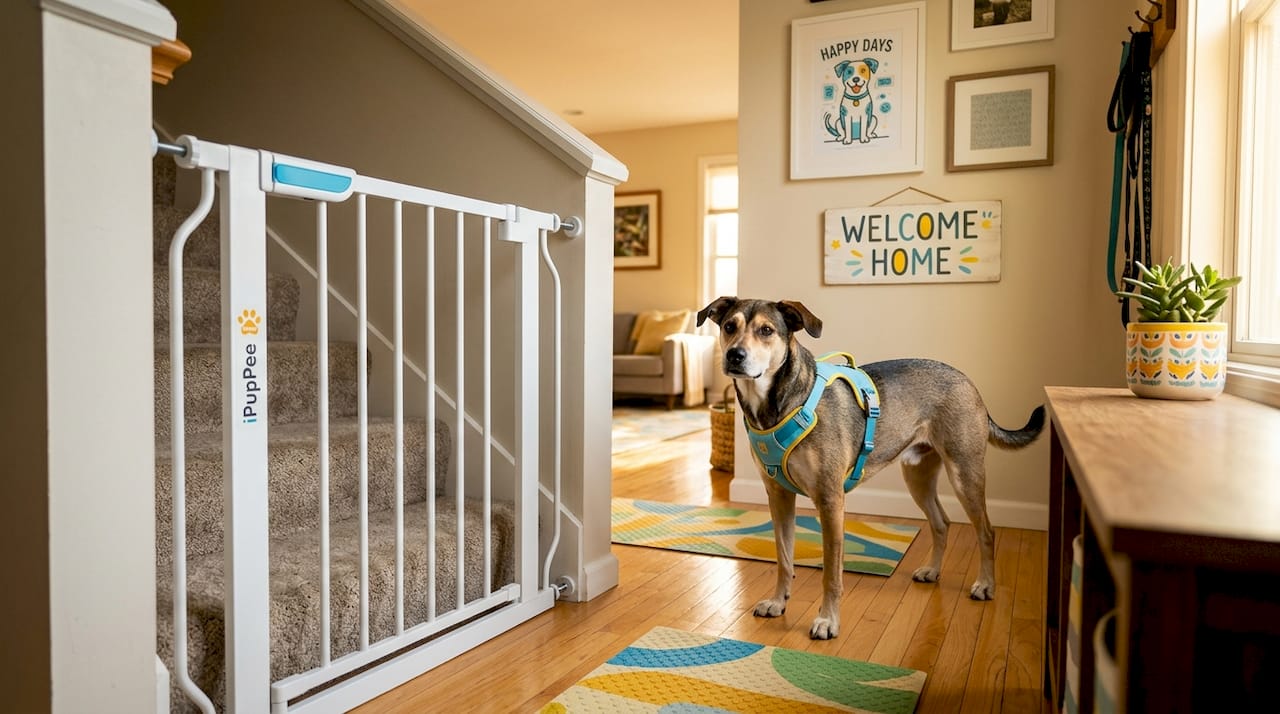
Stair gates and barriers are the first priority. Blocking staircases with gates reduces fall risk for elderly owners and keeps senior dogs from attempting climbs that could injure arthritic joints. Veterinarians recommend this specifically for dogs with mobility challenges. The key is choosing a gate that you can open and close easily, since a gate that frustrates you will get left open.
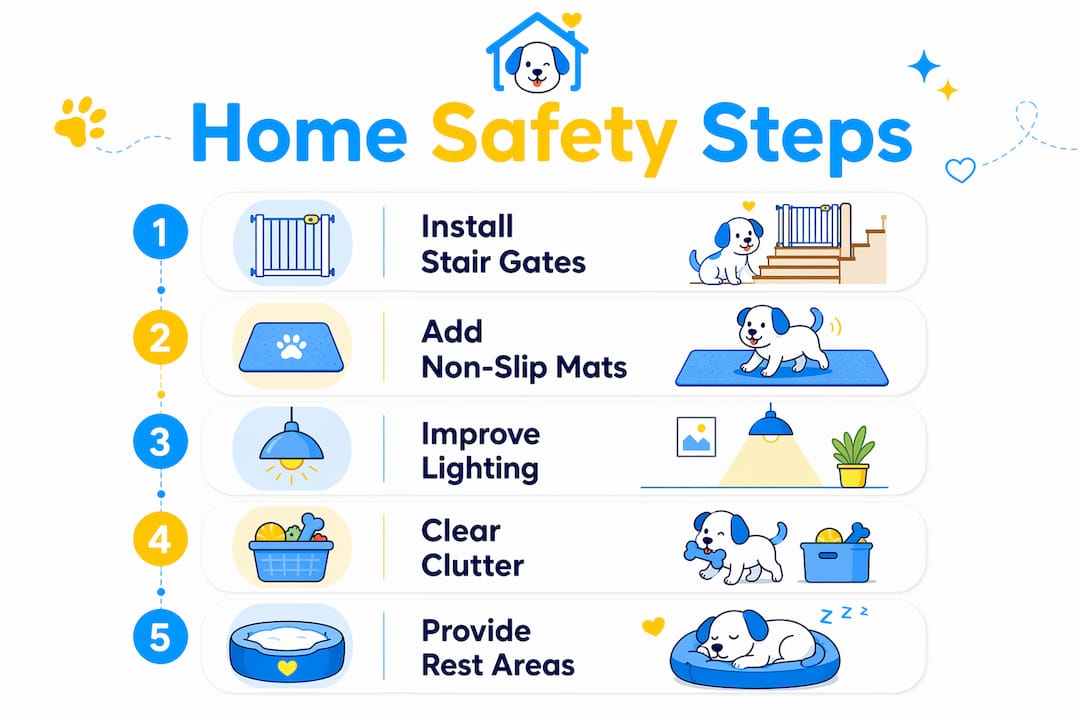
Floor traction is the second priority. Hard floors and loose rugs are among the most common environmental fall hazards for both elderly owners and dogs. Rubber-backed runners in hallways and near food and water bowls give your dog grip and give you a stable surface. Avoid decorative rugs with curled edges. Tape down any rug corners that lift.
Lighting and clutter deserve equal attention. Poor lighting in hallways and stairwells makes it harder to see your dog underfoot, especially at night. Install motion-activated nightlights in hallways, the kitchen, and near the dog’s sleeping area. Clear pathways of dog toys, food bowls placed in traffic lanes, and any cables or cords your dog might pull.
Rest areas matter more than most owners realize. Senior dogs with joint pain benefit from orthopedic foam beds placed in low-traffic areas where they can rest without being stepped over. The AKC notes that repeated exposure to slick floors compounds joint pain in senior dogs, so continuous environment adaptation is necessary, not a one-time fix.
For dogs with significant mobility challenges, veterinarians recommend canine support harnesses for both indoor movement and outdoor walks. These allow you to steady your dog on stairs or slick surfaces without bending awkwardly, which protects your own back and balance.
Pro Tip: Walk through your home at your dog’s height, literally crouching down, to spot hazards you miss from standing height. Exposed wires, unstable furniture legs, and low shelves with toxic plants only become visible from that angle.
The goal is not to restrict your dog to one room. Balancing dog autonomy with safety means providing clear boundaries like gated staircases while allowing freedom in lower-risk areas. A dog that feels confined becomes anxious, which creates new behavioral risks.
How can elderly owners walk their dog safely?
Walking is where many dog-related falls happen, and the fix is almost always about equipment and planning rather than strength or speed.
-
Choose the right leash. A 4 to 6 foot, sturdy, non-retractable leash gives you maximum control with minimum slack. Retractable leashes extend unpredictably and can wrap around your legs. A fixed-length leash lets you anticipate your dog’s movement and brace before a pull happens.
-
Check your posture before you start. Hold the leash with both hands when your dog is likely to pull. Keep your elbows slightly bent, not locked. Bent elbows absorb sudden jerks; locked elbows transfer the force directly to your shoulders and can pull you off balance.
-
Plan your route deliberately. Choose well-maintained, well-lit paths with smooth surfaces. Avoid routes with cracked sidewalks, loose gravel, or steep curb drops. Walk the route once without your dog to identify hazards before you add the variable of a moving animal.
-
Time your walks around the weather. The RSPCA advises walking dogs early morning or late evening during hot weather to prevent heat injury to both dog and owner. Midday heat raises pavement temperatures to levels that burn paw pads and cause heat exhaustion in dogs faster than most owners expect.
-
Test the ground temperature before you go. Press the back of your hand to the pavement for five seconds. If you cannot hold it there comfortably, the surface is too hot for your dog’s paws. This RSPCA five-second test requires no tools and takes three seconds to perform.
-
Know how to handle a sudden pull. If your dog lunges, step sideways rather than backward. Stepping backward is the fastest way to lose your balance. A sideways step keeps your center of gravity over your feet and gives you a moment to regain control.
Pro Tip: Pre-commit to a cool-walk plan before summer arrives. Identify two or three shaded routes, set your walk times in your phone calendar, and keep a collapsible water bowl in your bag. Having the plan ready means you make the right call automatically, even on a day when the heat catches you off guard.
For elderly owners managing dogs with pulling habits, dog training for seniors through a certified professional trainer can reduce leash tension significantly. A single session focused on loose-leash walking often produces immediate results without requiring physical strength from the owner.
What health risks should you watch for in senior dogs?
Senior dogs face a cluster of health challenges that directly affect your safety as an elderly owner. Cognitive decline, reduced hearing, and joint pain all change how a dog responds to commands and handles stress. A dog that once stopped reliably on command may now need a physical cue because it simply cannot hear you.
Watch for these signs that your dog’s health is affecting safety:
- Heatstroke warning signs: heavy panting, excessive drooling, lethargy, and unsteady movement. The RSPCA recommends fresh water, shade, cooling towels, and frozen treats during heatwaves. Contact your vet immediately if your dog shows these signs.
- Mobility changes: stumbling, reluctance to climb stairs, or difficulty rising from rest. These signal joint pain that makes your dog unpredictable on leash and more likely to fall into your path.
- Grooming resistance: a dog that suddenly resists brushing or flinches when touched may be experiencing pain in areas you cannot see. Veterinary guidance recommends using grooming sessions as body checks to detect lumps, sores, or swelling early.
- Behavioral changes: increased anxiety, confusion, or aggression in a previously calm dog can signal cognitive dysfunction syndrome, the canine equivalent of dementia.
Vet visit frequency matters. Veterinary experts recommend moving from annual to semi-annual or even quarterly checkups for aging dogs. Catching a health issue early keeps your dog more predictable and manageable, which directly protects you. A dog in pain is a dog that may snap, pull unpredictably, or collapse during a walk.
You can find more guidance on managing these risks in Ipuppee’s resource on senior pet safety, which covers both environmental adjustments and health monitoring strategies for aging dogs and their owners.
How to manage dog interactions safely with visitors
About 60% of dog bites come from familiar dogs, not strangers. This matters because elderly owners often assume their dog is safe with family members and grandchildren simply because the dog knows them. Familiarity reduces caution, and reduced caution is where bites happen.
Follow these rules for every visitor interaction:
- Ask first, always. Teach every visitor, including grandchildren, to ask before approaching the dog. This gives you a moment to assess your dog’s body language before contact happens.
- Read the dog’s signals. A dog that turns away, licks its lips, yawns, or tucks its tail is communicating discomfort. These are not signs of aggression yet, but they are warnings. Redirect the visitor before the dog escalates.
- Create a safe retreat. Every dog needs a space, a crate, a bed in a quiet room, or a gated area, where it can go when overwhelmed. Supervision gaps in elderly dog owners increase bite risk, so a designated retreat reduces the need for constant monitoring.
- Brief visitors before they arrive. A quick phone call or text before a visit, explaining your dog’s current mood or health status, prevents the rushed greeting at the door that triggers most incidents.
- Manage high-energy arrivals. Ask visitors to enter calmly and ignore the dog for the first few minutes. This lets your dog settle before interaction begins.
These routines are especially practical for elderly dog owners who may not have the physical speed to intervene quickly if an interaction escalates. Prevention through structure is more reliable than reaction.
Key takeaways
Dog safety for elderly owners requires adapting both the home environment and daily routines to protect the owner and the dog simultaneously, with the greatest gains coming from floor traction, leash selection, and consistent vet care.
| Point | Details |
|---|---|
| Home modifications first | Install stair gates, non-slip mats, and orthopedic beds before addressing other risks. |
| Leash length controls falls | Use a 4 to 6 foot, non-retractable leash to maintain control and reduce tripping risk. |
| Time walks around heat | Walk early morning or late evening and use the five-second pavement test before going out. |
| Vet visits protect you too | Semi-annual checkups catch health changes that make dogs unpredictable and harder to manage. |
| Familiar dogs bite most | Apply visitor interaction rules consistently, even with family members and grandchildren. |
What I’ve learned from watching elderly owners and their dogs
I have spent years reading about and working with the intersection of pet ownership and aging, and the pattern I keep seeing is this: most accidents are not random. They are the result of a home or routine that was never updated after the dog or the owner started aging. The owner adapted to the dog’s younger behavior, and then both of them got older at the same time without anyone noticing the gap.
The instinct most people have is to restrict the dog. Keep it in one room. Shorten the walks. Reduce the interaction. That instinct is understandable, but it usually makes things worse. A bored, under-stimulated dog is a more anxious and unpredictable dog. The better move is to adapt the environment so the dog can still move freely, just in spaces that are safe for both of you.
The other thing I want to say directly: the companionship a dog provides to an elderly owner is not a luxury. Research consistently links pet ownership to lower blood pressure, reduced loneliness, and better mental health outcomes in older adults. The goal of all this safety work is not to make dog ownership more complicated. It is to protect something genuinely valuable. A few rubber-backed mats and a better leash are a small price for that.
If you are caring for an elderly parent with a dog, the same logic applies. Do not suggest they give up the dog unless there is truly no safe path forward. There almost always is.
— Andrew
How Ipuppee can support your pet safety setup
Ipuppee specializes in practical solutions for dog owners who need safety and communication tools that actually work in daily life. Whether you are looking for guidance on home modifications, leash safety, or managing a senior dog’s changing needs, the Ipuppee blog covers these topics with the same depth you found here.
Explore Ipuppee’s dedicated resources on dog safety at home for step-by-step guidance on environmental adjustments, or browse the safety tips for dog owners guide for a broader overview tailored to seniors and owners with special needs. For device-based solutions that support independence and communication between you and your dog, visit ipuppee.com to see the full range of products designed with owners like you in mind.
FAQ
What is the safest leash type for elderly dog owners?
A 4 to 6 foot, sturdy, non-retractable leash is the safest choice for elderly owners because it provides consistent control and eliminates the unpredictable slack that causes tripping. Retractable leashes extend without warning and can wrap around legs during sudden movements.
How do I know if it is too hot to walk my dog?
Press the back of your hand to the pavement for five seconds. If you cannot hold it there comfortably, the surface is too hot for your dog’s paws and the walk should be postponed until early morning or late evening, following RSPCA guidance.
How often should a senior dog see the vet?
Senior dogs benefit from semi-annual or quarterly vet visits rather than annual checkups, since health changes in aging dogs happen faster and affect both the dog’s wellbeing and the owner’s safety during daily care.
What home changes reduce fall risk for elderly dog owners?
Installing stair gates, adding rubber-backed non-slip mats on hard floors, improving hallway lighting, and clearing clutter from walking paths are the four changes that reduce fall risk most directly for both elderly owners and their dogs.
Can familiar dogs still be a bite risk around family visitors?
Yes. Roughly 60% of dog bites involve familiar dogs, which means family members and grandchildren are not automatically safe. Consistent interaction rules, including asking before approaching and providing the dog with a retreat space, reduce this risk significantly.