

Device-based dog-to-human communication matters because it turns a dog’s alert into an immediate, actionable human notification. That shift improves safety and independence for handlers and caregivers, but it works best as an addition to training and medical monitoring, not a replacement for either.
TL;DR:
- Device-based alerts provide faster notification, primarily benefiting individuals living alone or those with medical conditions that require immediate attention.
- Trained dogs’ alert sensitivity to events like hypoglycemia is limited to around 36%, and false positives are frequent, so alerts should complement medical devices.
- Reliable alert systems depend on clear, consistent training focused on one specific purpose, with regular refreshes and professional guidance if needed.
- Practical use requires a stable Wi-Fi connection, regular device maintenance, and prior agreement on response procedures among multiple contacts.
- The iPupPee device costs $129.99 with no subscription, designed to give dogs a physical communication method that bridges the gap between observation and human action.
Table of Contents
- Why device-based communication matters for daily safety and independence
- What the research says about alert reliability and its limits
- How alert devices actually work day to day
- Training steps that produce reliable, specific alerts
- Who benefits most from a device-based alert system
- What real use looks like beyond the research
- Getting started with iPupPee’s devices and training
- Sources
- FAQ
Why device-based communication matters for daily safety and independence
A dog can sense something is wrong long before a person notices, but that observation only helps if it reaches someone who can act. A button press that triggers an app notification, live video, or two-way audio closes that gap in seconds rather than minutes. For a person living alone, that speed can mean the difference between a manageable situation and an emergency that goes unanswered.
This kind of connectivity changes what people can actually do with their day. Someone who needs a dog’s alert to reach a caregiver can run errands, travel, or spend time alone at home with more confidence, because the dog’s signal does not depend on someone being within earshot. Occupational therapy research treats assistance dogs as a form of assistive technology that supports participation and independence, and a connected alert device extends that same idea: it makes the dog’s contribution usable at a distance.
The practical gains show up in a few specific ways:
- Faster response times because alerts go straight to a phone instead of waiting for someone to notice the dog’s behavior.
- More independence for solo activities like errands, travel, or working in another room.
- Support for dignity and autonomy, letting a person rely on trained behavior instead of constant supervision.
Occupational therapy research links assistance dogs to improved participation in daily activities, and treats them as assistive technology worth building on rather than working around.
What the research says about alert reliability and its limits
Peer-reviewed research on alert dogs gives a useful reality check: trained dogs help, but they are not perfect detectors. A 2016 clinical study on dogs trained to alert for hypoglycemia in people with type 1 diabetes found that dogs alerted 3.2 times more often during hypoglycemic events than during stable glucose periods, evidence that the training does pick up something real. But sensitivity was limited to 36%, meaning the dogs missed a majority of hypoglycemic episodes, and false positives were common.
A related study using blinded continuous glucose monitoring found much the same pattern: CGM devices often caught hypoglycemia earlier than the dogs did, and dog alerts carried a high false-positive rate. The researchers recommended treating dog alerts as one piece of a monitoring strategy rather than a standalone signal.
- Trained dogs alert more during hypoglycemia than during stable periods, but miss many events.
- False positives are common enough that alerts should prompt a check, not a conclusion.
- CGM and other medical monitors typically detect problems earlier and more consistently than a dog can.
A dog’s alert works best as a trigger for verification, not a diagnosis on its own. The psychosocial value, the reassurance of having an extra set of senses in the house, is real, but it sits alongside the clinical numbers rather than replacing them.
How alert devices actually work day to day
Most device-based systems follow a similar sequence, whether the dog is alerting for a medical event, a fall, or simply because someone needs help.
- The dog activates a physical interface, usually a large button or panel sized and placed for paws rather than fingers.
- The device sends a Wi-Fi notification to a paired app, often reaching one or several contacts at once.
- The app can open live video and two-way audio, so the person receiving the alert can see what is happening and talk to the handler directly.
- The handler or caregiver decides what to do next, whether that is a phone call, a visit, or contacting emergency services.
Real-world use comes with limits worth planning around: notification speed depends on a stable Wi-Fi connection, battery life needs regular checking, and any camera-enabled device raises privacy questions about who can view footage and when. Multi-contact alerting helps when one person cannot respond immediately, but it also means agreeing in advance on who acts first.
Training steps that produce reliable, specific alerts
Reliable alerts do not happen by accident. They come from training that gives the dog one clear job before adding complexity.
- Pick a single, specific purpose for the button before training starts, such as “someone needs help” rather than a vague general-purpose signal.
- Use consistent, reward-based conditioning, rewarding the exact behavior every time so the dog associates the action with a predictable outcome.
- Move from simple to complex cues gradually, only adding new buttons or meanings once the first one is solid.
- Watch for accidental activations and correct them calmly instead of ignoring them, since an uncorrected false alert teaches the dog that pressing works even without a real reason.
- Refresh training periodically and adjust methods to fit the dog’s natural style. A dog trained retrieving may need a different physical interface than one trained to nose-target.
Ipuppee’s own step-by-step button guidance walks through this progression in more detail, and a service dog training curriculum covers more advanced scenarios. When accidental activations persist or the dog’s needs are complex, a professional trainer or occupational therapist can help troubleshoot the specific behavior pattern.
Pro Tip: Train one button, one meaning, one reward pattern before you ever introduce a second button.
Who benefits most from a device-based alert system
Device-based communication is not a fit for every household, but it solves a clear problem for several groups.
- Service-dog handlers who need a documented, reliable way to signal for help during a task or medical event.
- People with diabetes or seizure risk who want an added layer of awareness alongside continuous glucose monitoring or seizure-detection tools.
- Mobility-limited individuals who may not be able to reach a phone quickly during a fall or medical event.
- Caregivers supporting seniors who live alone or spend parts of the day unsupervised.
The highest-value scenarios tend to involve someone alone at home, a need to confirm a medical event before acting, or a situation where the handler cannot easily speak or move. In any of these, pairing the device with existing medical monitors, a caregiver network, or a documented emergency plan makes the whole system more dependable than any single piece alone.
What real use looks like beyond the research

The clinical studies set realistic expectations, but daily life is where a device earns its place. A dog that reliably presses a button when something is wrong gives a handler a second layer of awareness that does not depend on being watched or overheard. That matters most in the ordinary moments: a quiet afternoon alone, a nap, a moment when a phone is out of reach.
Ipuppee’s own training and background resources reflect what handlers report in practice: the value shows up gradually, as the dog’s signal becomes trustworthy through repetition rather than a single training session.
— Andrew
Getting started with iPupPee’s devices and training
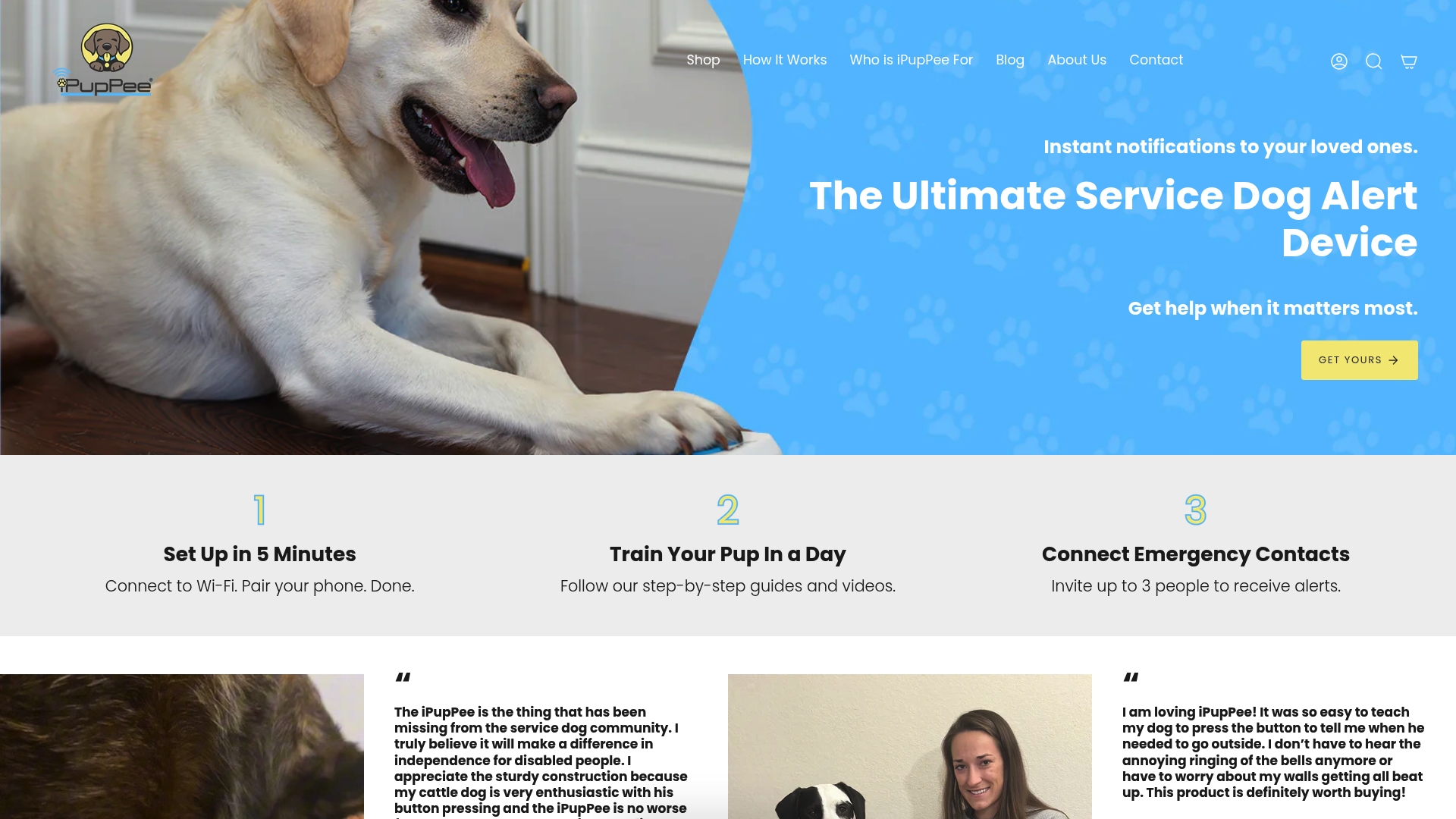
Independence should not depend on being close enough to be heard. A smart alert device gives a dog a physical way to reach you, with Wi-Fi notifications, live video, and two-way audio sent straight to your phone, so a dog’s alert reaches you whether you are in the next room or across town.
Getting started is straightforward:
- Choose the iPupPee device, priced at $129.99 as a one-off purchase, built for dogs of any size and requiring no monthly subscription.
- Pair it with the Psychology & Training Course, offered as a one-off purchase, for structured, step-by-step conditioning.
- Add shipping protection at checkout for an optional small fee if you want coverage against damage, loss, or theft in transit.
If you are ready to give your dog a reliable way to reach you, start with the iPupPee product page and build your training plan from there.
Sources
- Examining the use of assistance dogs to enhance participation in everyday occupations for people with mobility challenges (PMC)
- Reliability of trained dogs to alert to hypoglycemia under real-life conditions (SAGE Journals)
FAQ
Why does device-based communication matter for service dog handlers?
It matters because it turns a dog’s observation into an alert a handler or caregiver can actually receive and act on, even from another room or another location. This closes the gap between what the dog notices and when a human can respond, supporting both safety and independence.
How reliable are dog alerts for medical events like hypoglycemia?
Trained dogs alert more often during hypoglycemic events than during stable periods, but a 2016 clinical study found sensitivity limited to 36%, with common false positives. Dog alerts work best as a prompt to check a medical monitor, not as a stand-alone diagnosis.
Can a communication device replace a continuous glucose monitor?
No. Research comparing trained dogs to blinded CGM found CGM often detects hypoglycemia earlier and more consistently, so a device or dog alert should supplement medical monitoring rather than replace it.
How much does the iPupPee device cost?
The iPupPee alert device is priced at $129.99 as a one-off purchase, with no monthly subscription required. A separate Psychology & Training Course is available for $119 as a one-off purchase.
What causes false alerts and how can training reduce them?
False alerts usually come from unclear button goals or inconsistent rewards during training. Starting with a single, specific purpose for the button and using consistent, reward-based conditioning reduces accidental activations over time.