

Start socialization the day you bring your puppy home, as early as 7 to 8 weeks old, and plan on formal group classes once your facility’s health rules clear you. Most training centers ask for at least one vaccine given seven or more days before class, plus deworming. If your pup isn’t old enough or hasn’t cleared those requirements yet, don’t wait around: run short, supervised at-home sessions and controlled social exposures right now.
- Begin gentle socialization and handling exercises at home once your puppy is around 7 to 8 weeks old
- Enroll in formal group classes when your facility’s health rules allow
- Prioritize safe, positive exposure as much as practical before the critical socialization period closes
According to the AVSAB’s puppy socialization position statement, the risk of a puppy dying from an infectious disease is far lower than the risk of it developing lifelong behavioral problems from inadequate socialization during this window.
Key Takeaways
Puppies who begin controlled socialization by 7 to 8 weeks and enter structured training within six months show measurably better adult behavior than those who wait.
| Point | Details |
|---|---|
| Start socialization early | Begin safe, controlled exposure at 7 to 8 weeks rather than waiting for full vaccination. |
| Target 12 to 16 weeks for classes | Enroll in formal group classes once your facility’s vaccine and deworming rules are met. |
| Six months is the real deadline | Training attendance anytime before six months lowers the odds of adult behavioral problems. |
| Use micro-sessions | Run four to six one to three minute training bursts daily instead of long sessions. |
| Check readiness, not just age | Curiosity, quick recovery from startles, and short focus bursts signal a puppy is ready for group settings. |
Table of Contents
- Puppy Training Schedule From 0 to 12 Months
- Why the First Few Months Shape Your Dog’s Whole Life
- Group Classes or At-Home Training: How to Choose
- Vaccination Rules and Safe Ways to Socialize Before Class
- Is Your Puppy Ready for Group Classes? Check These Signs
- What Actually Happens in a Puppy Class
- Your Week-by-Week Puppy Training Roadmap
- How Ipuppee Supports Safe Early Training
- A Realistic Take on Puppy Class Timing
- Sources
Puppy Training Schedule From 0 to 12 Months
A puppy training timetable only works if you know what to prioritize at each stage. The early months matter more than any other stretch of your dog’s life, and trying to cram socialization in later rarely produces the same results.
Here’s how the age bands generally break down:
- Early weeks: bonding, gentle handling, and crate introduction (usually with the breeder or shelter)
- Next weeks: critical socialization window; controlled exposure to new people, sounds, and vaccinated dogs, plus short training bursts
- When safe and permitted by facilities: enrollment for formal group classes
- Later months: focus on impulse control and “proofing” behaviors around distractions
- Up to a year: longer training sessions aimed at real-world reliability and continued social exposure
| Age Range | Primary Focus | Recommended Setting |
|---|---|---|
| Early weeks | Bonding, handling, and crate basics | Home or breeder environment |
| Following weeks | Critical socialization, introduction to cues | Home plus controlled outings |
| When facility permits | Enrollment in formal group classes | Group class or trusted setting |
| Months after | Impulse control and proofing | Group class or private sessions |
| Approaching one year | Reliability and ongoing exposure | Group class or real-world settings |
Purina’s age-by-age training schedule lines up closely with this pattern: foundation skills at 8 to 12 weeks, basic cues by 12 to 16 weeks, and adolescent proofing from 4 to 6 months onward.
Why the First Few Months Shape Your Dog’s Whole Life
Puppies go through a critical socialization period that closes around 16 weeks of age. During this stretch, their brains are unusually receptive to new experiences, and what they learn to accept as normal now tends to stick for life. Miss the window, and even a well-meaning owner ends up managing fear or reactivity for years instead of preventing it in the first place.
Meaningful exposure isn’t just letting your puppy sniff around the yard. It means introducing different surfaces, sounds, people of various ages and appearances, and other vaccinated dogs, all in short, positive doses that end before your puppy gets overwhelmed.
A 2021 study published in Animals tracked whether the timing of a puppy’s first training class affected adult behavior, and found something worth remembering:
Puppies who attended structured training at any point within their first six months showed reduced odds of adult behavioral problems, and there was no meaningful difference between starting at one to three months versus four to six months.
That finding, from the MDPI Animals study, reframes the whole conversation. Getting into training within six months matters more than nailing the exact week. Skip socialization entirely, though, and the fallout is predictable: fear responses to strangers, avoidance of new environments, and in some cases aggression that shows up months or years later when it’s much harder to unwind.
Group Classes or At-Home Training: How to Choose
Group classes give you something home practice can’t: real-time trainer feedback and supervised exposure to other puppies your dog didn’t grow up with. A good instructor spots problems, like a puppy that freezes around bigger dogs, before they turn into habits. At-home training, meanwhile, lets you control the pace entirely and manage health risk on your own terms, which matters if your puppy hasn’t cleared vaccination milestones yet.
Weigh these factors when deciding which to lean on first:
- Your facility’s minimum age and vaccine requirements
- Your puppy’s temperament (confident pups often handle groups sooner than anxious ones)
- Household risk factors, including other pets or health concerns
- Whether small-group or private sessions are available as a middle ground
Pro Tip: If your puppy seems too young or too nervous for a full class, ask trainers about a private “meet and greet” session first. Many will let a shy puppy observe from a distance before joining the group, which builds confidence without the pressure of jumping straight in.
Vaccination Rules and Safe Ways to Socialize Before Class
Most training facilities require at least one vaccine administered seven or more days before the first session, along with a recent deworming treatment. The AVSAB explicitly warns against waiting for the full vaccine series before allowing any socialization, since that delay routinely pushes puppies past the point where new experiences register as normal rather than threatening.
Before enrolling, ask trainers a few direct questions:
- How often are floors and equipment sanitized between classes?
- What’s the group size, and is it capped for puppy-specific sessions?
- Is the class indoors, outdoors, or a mix?
- What’s the policy if a puppy shows signs of illness?
If your pup isn’t eligible yet, you still have real options: private trainer sessions, playdates with fully vaccinated adult dogs in clean settings, or short supervised outings that avoid high-traffic dog areas. None of these require waiting on the sidelines.
Is Your Puppy Ready for Group Classes? Check These Signs
Age alone doesn’t tell you whether a puppy is ready to handle a room full of strangers and other dogs. Temperament matters just as much. Run through this checklist before you register:
- Curiosity outweighs hesitation. Your puppy investigates new objects or people rather than backing away.
- Quick recovery after a startle. A loud noise or sudden movement causes a brief flinch, not a lasting freeze or bolt.
- Basic bite inhibition. Play biting is soft and stops when you redirect it.
- Short bursts of focus. Your puppy can hold attention on you for a few seconds at a time, even with distractions nearby.
Warning signs that mean you should wait or start smaller include persistent fear, lunging or growling at unfamiliar people or dogs, current illness, or physical stress symptoms like excessive panting and tucked-tail avoidance. When in doubt, a private lesson or a socialization-only session beats throwing an unready puppy into the deep end.
What Actually Happens in a Puppy Class
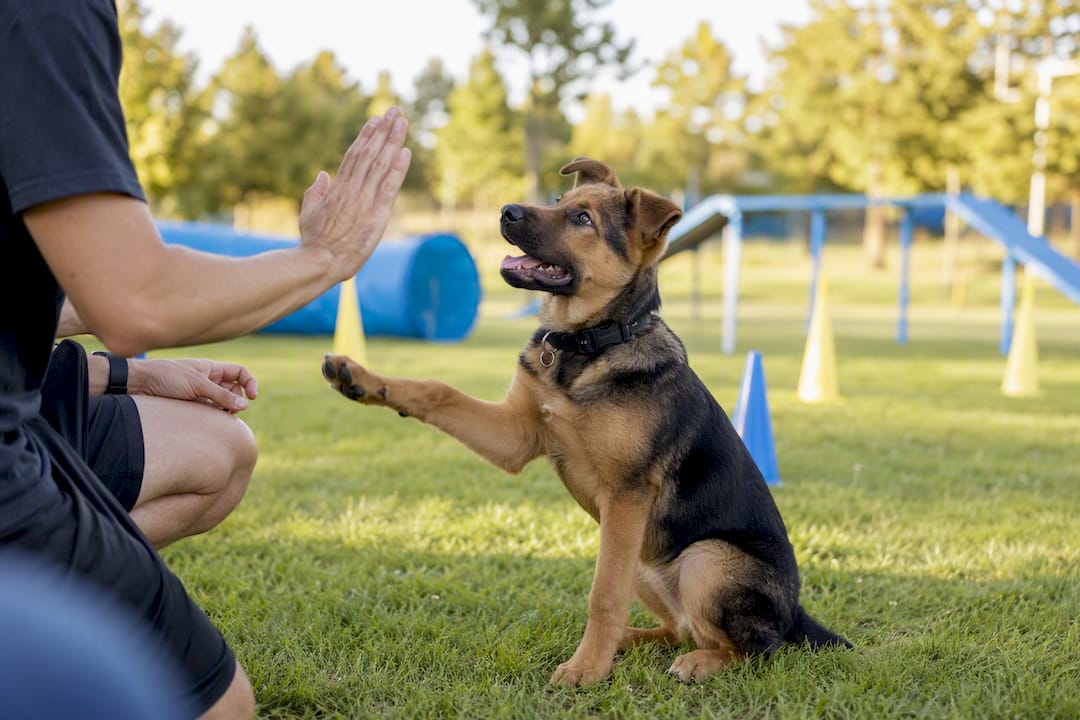
Long, 45 minute training blocks rarely work on young puppies, whose attention spans max out in minutes, not hours. That’s why responsible trainers build classes around micro-sessions: focused bursts of one to three minutes, repeated several times through the class and reinforced again at home.
A typical session for young puppies looks like this:
- Brief handling and calm greeting exercises to settle nerves
- Short cue practice (name recognition, sit, touch) in one to two minute intervals
- Controlled play breaks with size-appropriate puppies
- A final round of easy wins so the puppy ends on success
Homework between classes should mirror that same structure. Practice name recognition during meal prep, ask for a sit before the food bowl goes down, and run short recall games across a hallway or living room.
Pro Tip: End every practice session, in class or at home, on something your puppy nails easily. Ending on a win, even something as simple as a solid sit, keeps motivation high for the next round.
Your Week-by-Week Puppy Training Roadmap
Consistency beats intensity when you’re working with a young puppy. A realistic rhythm for the first three months looks like four to six micro-sessions daily, each running one to three minutes, paired with two or three supervised social exposures per week once your vet clears controlled outings.
| Week | Focus | Daily Micro-Sessions |
|---|---|---|
| Weeks 1 to 2 (home) | Name response, handling, potty routine | 4 |
| Weeks 3 to 4 | Sit, touch, crate calm time | 6 |
| Weeks 7 to 8 | Short recall, controlled exposures | 6 |
| Weeks 8 to 16 | Group class integration, proofing basics | 4 plus class |
Track these milestones as you go:
- Responds to their name within one to two seconds, most of the time
- Sits on cue without a treat lure by hand signal alone
- Recalls across a room indoors
- Settles calmly in a crate for 20 to 30 minutes
Once your puppy hits adolescence around four to six months, sessions can stretch longer and shift toward proofing: practicing cues around real distractions like other dogs, food on the counter, or a knock at the door. By six to 12 months, you’re less focused on teaching new commands and more on building reliability everywhere your dog goes. Our guide to good ages for puppy training walks through this progression in more detail, and the puppy training checklist is worth keeping on your fridge during these months. For a stepwise look at socialization tactics specifically, The Lab Shop’s guide covers practical exposure exercises that pair well with a class schedule.
How Ipuppee Supports Safe Early Training
Training doesn’t stop being useful once your puppy graduates from group class. It’s an ongoing process, and the tools you use to communicate with your dog matter just as much as the lessons themselves. Ipuppee’s alert devices give dogs a way to signal for help or attention long after basic obedience is in place, which is especially useful for households managing service dogs, seniors living alone, or dogs still building confidence around new people.
A few resources worth bookmarking as you move through this timeline:
- Puppy obedience basics and building safe connections
- Safety training essentials for new puppy owners
- Understanding why dog socialization matters
A Realistic Take on Puppy Class Timing
The obsession with pinning down the “perfect week” to start class misses what the MDPI research actually found: getting into structured training within six months matters far more than hitting an exact date. Most owners waste weeks agonizing over whether week 10 or week 14 is “correct” when either works fine, as long as socialization starts now.
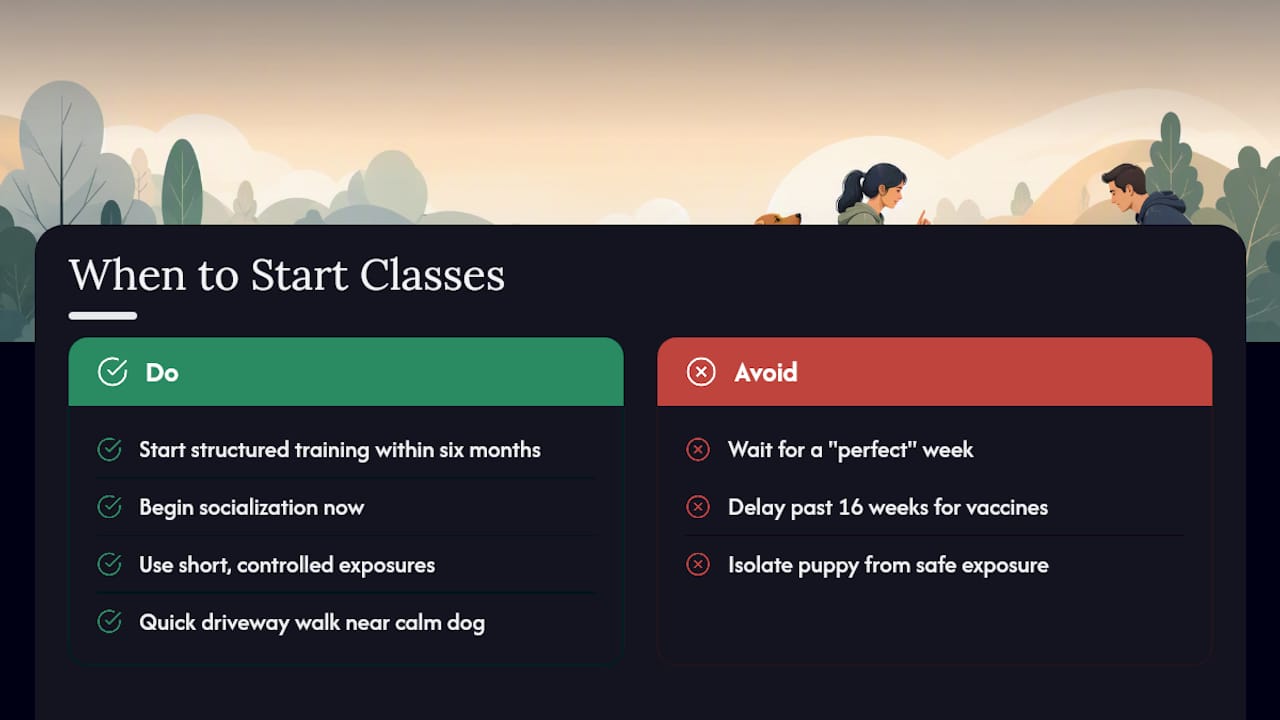
Where conventional advice falls short is the vaccine myth. Too many new owners hear “wait until fully vaccinated” and stall out past 16 weeks, right when the window that matters most is closing. That’s backward. Controlled, sanitary exposure beats isolation every time.
If you take one thing from this article, prioritize starting something, anything positive and controlled, this week. A five-minute driveway walk past a calm, vaccinated neighbor dog does more for your puppy’s future than three more weeks of waiting for a perfect moment that doesn’t exist.
— Andrew
Sources
- AVSAB puppy socialization position statement
- Early training attendance associated with reduced adult behavior problems — Animals (MDPI), 2021
- Puppy training schedule by age — Purina