

Multispecies interaction, in the context of service dogs and trained companions, means dog-to-human communication carried out through trained behaviors and simple devices like buttons or soundboards. A dog presses a button, and that action alerts a person to a need, an event, or a request. Service-dog handlers, caregivers, and everyday pet owners use this kind of interaction to build clearer, two-way understanding with their dogs.
TL;DR:
- Most dogs take several weeks to a few months of consistent, short sessions to reliably use a single communication button, with individual variability influencing progress.
- Handler timing, consistency, and proper modeling are crucial, while poor reward timing or inconsistent wording can significantly slow learning.
- Non-food buttons like “outside” or “water” produce faster and more reliable results than food-related signals during initial training.
- Device-mediated communication is valuable in both assistance-dog work and everyday household needs, enhancing independence, reducing frustration, and strengthening trust.
- Proper handler training and professional guidance remain essential, with tools like the iPupPee device and guided courses simplifying training and troubleshooting.
Table of Contents
- How button and soundboard communication actually works
- Common use cases: service dog tasks and everyday needs
- A starter training plan for teaching your dog one button
- Troubleshooting, pitfalls, and welfare considerations
- What the research shows and what to realistically expect
- Definition and scope of multispecies interaction
- Types of multispecies interactions in dog-human communication
- Why device-mediated communication matters for dogs and their people
- Examples of device-based interaction in real households
- How these methods get used in service-dog programs and research
- Training the human is the real long-term work
- If you want a ready device and guided training: iPupPee options
- Sources
- FAQ
How button and soundboard communication actually works
Augmentative interspecies communication (AIC) devices, whether physical buttons, wall-mounted soundboards, or a simple hanging bell, work as a relay. The dog performs a specific action, the device produces a consistent signal (a word, a sound, a chime), and the person responds in a predictable way. Over repeated pairings, the dog learns that pressing a particular button reliably produces a particular outcome.
The learning mechanics behind this are not mysterious. They rest on modeling, pairing, and reinforcement, the same principles used in most dog training. A study covered by UCSD Today found that pet dogs taught by their owners could associate recorded words on soundboard buttons with real outcomes and respond appropriately, even without other cues from the owner present.
A typical progression looks like this:
- The handler models the press by pushing the button themselves right before doing the action.
- The dog watches this pairing repeat across many short sessions until the connection starts to form.
- The handler rewards any attempt the dog makes to mimic the press, then gradually fades their own modeling.
Timing and consistency from the handler matter as much as the dog’s aptitude. A press that gets rewarded five seconds late, or a cue that changes from session to session, slows the whole process down.
Common use cases: service dog tasks and everyday needs
Device-mediated communication spans a wide spectrum, from life-saving medical alerts to simple household convenience. On the service-dog end, hearing dogs use trained alerts to flag doorbells or alarms, diabetic alert dogs signal blood sugar changes, and seizure response dogs notify a handler or trigger a device before or during an episode. Assistance Dogs International notes that medical alert dogs often do more than detect: they fetch supplies and repeat alerts persistently, sometimes complementing wearable medical technology rather than replacing it.
On the everyday side, the same principles show up in less dramatic but still useful ways:
- A bell by the door for potty requests.
- A dedicated button for “outside” or “play.”
- A visitor-alert button near the entryway.
Reported benefits include greater independence for the dog, less guesswork and frustration for the handler, and stronger bonding between the two. Individual variability is real, though. Some dogs pick up button use in weeks, others take much longer, and a few never generalize the skill beyond a single context.
A starter training plan for teaching your dog one button
Start with a single, concrete, non-food task like “outside,” since concepts tied to daily physical needs tend to click faster than abstract concepts. AKC’s guidance on button training recommends beginning with words the dog can immediately connect to an experience.
- Place one button near the exit and model the press yourself every single time before you open the door.
- Say the word aloud as you press, then immediately follow through with the action, so the press and the outcome always pair together.
- Reward any attempt the dog makes to touch or paw the button, using praise, play, or the activity itself rather than food at this early stage.
- Deliver the reward within one to two seconds of the press, since delayed rewards weaken the association.
- Gradually stop modeling the press yourself once the dog initiates on its own, then introduce mild distractions before adding a second button for a different concept.
Pro Tip: Avoid starting with a food-related button. It tends to shift the dog’s goal from communicating a need to simply requesting a snack.
Expect this to take weeks to a few months of short daily sessions, not days. Progress is rarely linear, and a dog that presses reliably one week may regress the next as distractions or routines change.
Troubleshooting, pitfalls, and welfare considerations
The most common handler mistakes are inconsistent modeling, switching up wording between sessions, and reaching for a food-button too early, which muddies what the dog is actually learning to communicate. Poor timing on rewards is another frequent culprit behind slow or unreliable progress.
Watch for welfare signs along the way:
- Reluctance to approach the button may signal stress rather than disinterest.
- Frantic or repetitive pressing without context often means the dog has learned that pressing gets attention, not that it is communicating a specific need.
- A sudden drop in engagement can point to overtraining or fatigue.
To check whether a dog’s presses are deliberate rather than incidental, remove obvious handler cues (eye contact, hovering near the button, verbal prompts) and observe whether the dog still presses appropriately in context. If accuracy collapses without those cues, the behavior may be more habit than genuine signaling. When progress stalls or stress signs appear, simplify back to one button, shorten sessions, or bring in a professional trainer experienced in AIC methods.
What the research shows and what to realistically expect
The clearest evidence so far comes from the UCSD-linked study, which found that pet dogs trained by their owners could associate recorded soundboard words with real outcomes and respond appropriately even without other cues, a finding also documented in the PLOS ONE systematic review.
Separately, longitudinal research summarized in a PMC review of assistance-dog partnerships reports that people partnered with trained assistance dogs often see improvements in emotional wellbeing, social functioning, and quality of life within three to six months.
Social-media videos of dogs seeming to hold full conversations overstate what controlled research currently supports. The honest picture is promising but incomplete: dogs can learn meaningful word-outcome associations, but individual variability is high and more replication is needed before broader claims are warranted.
Definition and scope of multispecies interaction
In the sense used throughout this guide, multispecies interaction describes the structured exchange of information between a dog and a human, built through training rather than occurring naturally in the wild. It covers any method where a dog’s trained action (a button press, a nose bump, a bell ring) carries a specific, learned meaning that a person can act on.
The scope includes formal assistance-dog work, where a dog is trained to alert a handler to a medical event or environmental cue, and informal household communication, where a pet dog learns to request a walk or flag a visitor. Both sit on the same continuum: a dog learns that a specific action produces a specific, reliable human response.
This differs from natural canine communication like barking, body posture, or eye contact, which humans learn to interpret but which dogs do not perform with devices, or fixed vocabulary in mind. Multispecies interaction, as covered here, is intentionally trained and typically device-mediated, giving both species a shared, predictable channel that does not rely purely on inference.
Assistance Dogs International frames this scope around a central principle: the dog’s training exists to help a specific person, and handler participation is not optional. The device or button is simply the tool that makes the communication legible in the moment.

Types of multispecies interactions in dog-human communication
Within device-mediated communication, a few distinct types show up repeatedly. The first is request-based interaction, where the dog initiates: pressing a button for “outside,” “play,” or “water” to signal a want. The second is alert-based interaction, where the dog notifies a person of an external event or internal state, such as a diabetic alert dog signaling a blood sugar change or a hearing dog flagging a doorbell.

A third type is response-based interaction, where the dog answers a question or prompt from a handler, useful in some soundboard setups where a person asks “outside or inside?” and the dog selects a button. This type depends heavily on the dog reliably distinguishing between options, which takes longer to train than a single-button request.
These types are not mutually exclusive. A single dog might use request-based pressing for daily needs and alert-based signaling for a medical task, especially in service-dog households where both convenience and safety functions matter. The training principles overlap across all three types: modeling, pairing, consistent reinforcement, and patience while the association solidifies.
Why device-mediated communication matters for dogs and their people
The value of trained multispecies interaction goes beyond novelty. For service-dog teams, a reliable alert can mean the difference between a medical event caught early and one missed entirely. The PMC review of assistance-dog outcomes links these partnerships to measurable gains in emotional wellbeing and social functioning within months, not years, suggesting the communication channel itself supports the human side of the relationship as much as the practical alerts do.
For everyday households, the significance is more about reducing ambiguity. A dog that paces by the door might mean it needs to go out, wants to play, or has heard something outside. A trained button removes the guesswork, and that clarity tends to reduce frustration on both ends of the leash.
There is also a bonding component. Repeated, successful communication (a press, a response, a consistent outcome) reinforces trust between dog and handler. This mirrors principles found in augmentative communication tools used for people, where a predictable, low-friction channel reduces stress for someone who struggles to express needs through typical means. The parallel is not exact, since dogs and humans learn differently, but the underlying idea (giving a communication partner a reliable channel) holds across both contexts.
Examples of device-based interaction in real households
The clearest examples come from service-dog work. Hearing dogs are trained to physically touch or nudge a handler in response to specific sounds like alarms or knocks. Diabetic alert dogs learn to signal blood sugar changes through a trained behavior, sometimes followed by fetching a supply kit. Seizure response dogs may press a designated alert button or activate a device before or during an episode, giving caregivers or emergency contacts a heads-up.
In ordinary pet households, the examples are smaller in stakes but still meaningful. A bell by the back door becomes a reliable potty signal within a few weeks for many dogs. A dedicated “play” button lets a dog initiate a game rather than resorting to pawing or barking. A visitor-alert button near the front door gives a dog a specific way to flag someone at the entrance instead of relying on unstructured barking.
What ties these examples together is specificity. Vague, general-purpose buttons (“more,” “stuff”) tend to confuse dogs during early training, while concrete, single-purpose signals like “outside” or “water” produce faster, more reliable results according to AKC’s training guidance.
How these methods get used in service-dog programs and research
Beyond individual households, device-mediated communication has practical applications in formal assistance-dog programs and in ongoing behavioral research. Assistance Dogs International outlines training standards that treat the handler’s education as inseparable from the dog’s, since a well-trained dog paired with an inconsistent handler produces unreliable results in the field.
Researchers use soundboard and button setups as a structured way to study canine cognition and word association without relying purely on observational interpretation of barks or body language. The UCSD-linked study is a direct example: by giving dogs a fixed, controlled vocabulary of buttons, researchers could test whether responses were context-appropriate rather than random or handler-cued.
This same structure has practical value for medical alert programs, where consistent, verifiable signaling matters more than novelty. Organizations working with diabetic and seizure alert dogs use similar principles: a fixed, trained action tied to a specific outcome, reinforced consistently enough that both the dog and the people around it can trust the signal. As device-based training becomes more documented, it offers a clearer, more testable framework than relying solely on a handler’s read of subtle behavioral cues.
Training the human is the real long-term work
Most of the effort in device-mediated communication goes into training the person, not the dog. Consistency, patience, and accurate timing take longer to build in a handler than the underlying behavior takes to build in a dog. Assistance Dogs International is direct about this: training the handler is treated as essential to any assistance-dog partnership, not an afterthought.
Devices should support welfare-focused training, never replace it. For any medical alert task, work with accredited assistance-dog trainers and the relevant medical professionals rather than trying to build a safety-critical skill from general guidance alone.
— Andrew
If you want a ready device and guided training: iPupPee options
Building this kind of communication from scratch takes patience, and having the right tools removes some of the trial and error. The iPupPee device is a Wi-Fi enabled smart alert button that sends live video and two-way audio notifications to multiple contacts the moment a dog presses it, priced at $129.99 one-off, with no monthly subscription required.
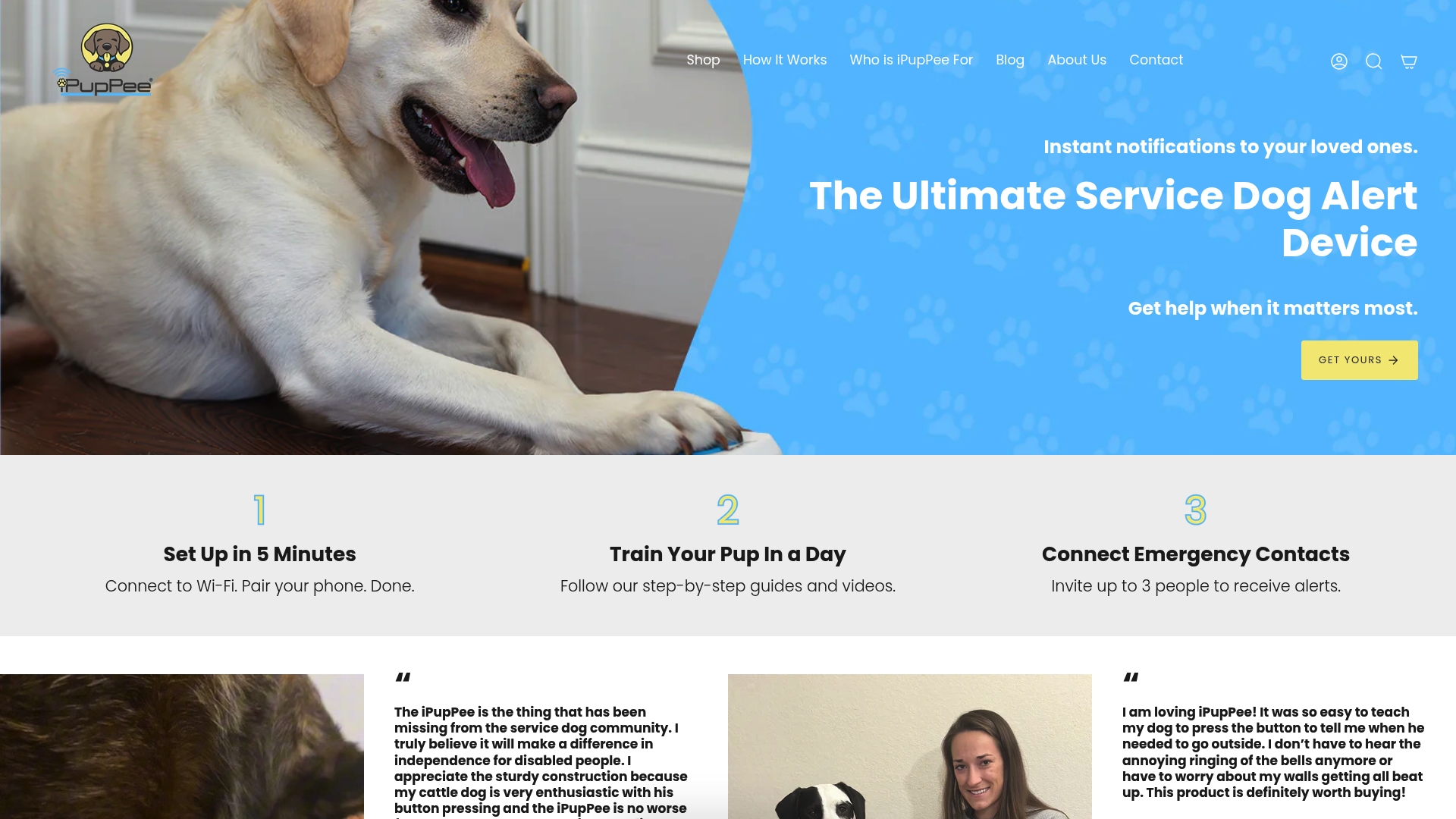
For handlers who want structured guidance alongside the hardware, the Psychology & Training Course walks through the same modeling, pairing, and reinforcement steps covered above, priced at a one-time fee.
- The device’s button interface maps directly to the starter training plan: model, pair, reward, fade.
- The course expands on troubleshooting and welfare checks for handlers working through setbacks.
- Orders can add shipping protection for $5.00 against damage, loss, or theft in transit.
Start with the iPupPee product page to see whether the device fits your household’s needs.
Sources
- Dogs use two-word button combos to communicate, study shows — UCSD Today
- Assistance dog research review — PMC
- How to teach your dog to talk using dog training buttons — AKC
FAQ
What does multispecies interaction mean for dogs and humans?
It refers to trained communication between a dog and a person, usually through a button, soundboard, or similar device, where a specific dog action reliably triggers a specific human response. It is built through modeling and reinforcement rather than occurring naturally.
How long does it take to train a dog to use a button?
Most dogs need weeks to a few months of short daily sessions before a single button becomes reliable, based on typical training progressions described by AKC. Progress varies widely between individual dogs, and adding a second button usually takes longer than the first.
Can any dog learn to use communication buttons?
Most dogs can learn at least one or two button associations with consistent modeling and reinforcement, though speed and reliability vary by individual. Dogs with more structured obedience training or service-dog backgrounds often generalize the skill faster.
Do communication buttons replace normal dog training?
No. Devices work best as an addition to welfare-focused training and handler consistency, not a replacement for it, since assistance-dog programs treat handler training as equally important as the dog’s. For medical alert tasks specifically, professional and veterinary guidance should shape the process.
What is the iPupPee device and how does it help with training?
The iPupPee is a Wi-Fi enabled alert button that sends live video and two-way audio notifications to multiple contacts when a dog presses it, priced at $129.99 one-off. It pairs with iPupPee’s Psychology & Training Course to guide handlers through the same modeling and reinforcement steps used in general button training.