

TL;DR:
- Traveling with dogs requires thorough preparation, including vet visits, proper restraint, and acclimation to travel gear. Proper planning ensures your dog’s safety, comfort, and reduces stress during trips by managing behavior and environment. Using certified gear, detailed checklists, and understanding airline policies help you achieve a smooth, enjoyable journey for both owner and pet.
Traveling with dogs takes more than tossing a leash in your bag and hitting the road. Dogs face real risks from unrestrained travel, unfamiliar environments, and the stress of disrupted routines. Whether you’re planning a weekend road trip or a cross-country flight, having the right traveling with dogs tips makes the difference between a smooth adventure and a stressful ordeal. This guide gives you the exact steps, gear recommendations, and vet-backed advice to keep your dog safe, calm, and genuinely comfortable from departure to arrival.
Table of Contents
- Key takeaways
- 1. Visiting the vet before you go
- 2. Building your traveling with dogs checklist
- 3. Road trip safety: restraint comes first
- 4. Flying with your dog: what you need to know
- 5. Choosing the right travel gear
- 6. Managing your dog’s behavior and stress during travel
- My honest take on traveling with dogs
- Travel smarter with Ipuppee
- FAQ
Key takeaways
| Point | Details |
|---|---|
| Start with a vet visit | Get a health check and travel clearance before any trip, especially for senior or short-nosed breeds. |
| Restrain your dog every time | Use a crash-tested harness or crate in the car to prevent injury and driver distraction. |
| Start carrier training early | Acclimate your dog to their crate or carrier weeks before travel, not the night before. |
| Prepare all paperwork ahead | Most destinations require a health certificate valid 10 to 30 days before travel. |
| Manage stress proactively | Reward calm behavior, bring familiar items, and plan for sniff breaks during long trips. |
1. Visiting the vet before you go
Before any trip, a vet visit is the single most important step in your traveling with dogs checklist. Veterinarians strongly recommend a pre-travel health check to assess your dog’s stress tolerance, confirm vaccinations are current, and identify any breed-specific risks like altitude sensitivity in bulldogs, pugs, or other brachycephalic breeds.
Most airlines and destination states require a Certificate of Veterinary Inspection, known as a CVI, that is valid for 10 to 30 days before travel. This certificate confirms your dog is healthy, disease-free, and rabies vaccinated. If you’re crossing international borders, a USDA endorsement and Dog Import Form may also be required, and processing through the relevant digital portals can take several weeks. Do not leave this for the last week.
Pro Tip: Take photos of your dog from multiple angles before departing. If you get separated during the trip, having recent, clear photos speeds up identification significantly.
2. Building your traveling with dogs checklist
Preparation gaps are where most travel problems start. Many owners underestimate how much time paperwork and acclimation actually take, which leads to rushed departures and unnecessary stress.
Your pre-travel checklist should cover:
- Health certificate from your vet (obtained within the required window)
- Vaccination records and microchip documentation
- Your dog’s regular food in a sealed container, enough for the full trip plus two extra days
- Water from home or bottled water to prevent digestive upset from new water sources
- Collapsible food and water bowls
- Familiar bedding or a worn t-shirt with your scent to reduce anxiety
- Favorite toys for mental stimulation during rest stops
- A current photo of your dog in case of separation
- Your vet’s contact info and a list of 24-hour emergency vet clinics along your route
That last item matters more than people expect. Researching emergency vet clinics along your route before you leave, and saving offline maps in case of no cellular service, is genuinely critical for road travel emergencies.
3. Road trip safety: restraint comes first
The most overlooked dog travel safety tip on road trips is also the simplest. Restrain your dog every single time. An unrestrained dog in a moving vehicle is a projectile in a crash. Even at low speeds, a 50-pound dog can generate hundreds of pounds of force. Crash-tested harnesses and crates are the best travel practices for dogs in vehicles, period.
Here’s how to do a road trip right:
- Use the back seat. Dogs should never ride in the front, where airbag deployment poses a serious injury risk.
- Secure the harness or crate properly. Harnesses should thread through a seatbelt buckle. Crates should be strapped down or wedged so they cannot slide or tip.
- Stop every 2 hours. Plan rest stops at parks, rest areas, or quiet spots where your dog can walk, sniff, and relieve themselves.
- Control the feeding schedule. Avoid feeding a large meal within 2 to 3 hours of departure to reduce motion sickness risk. Offer small amounts of water at every stop.
- Never leave your dog in a parked car. Even on a 70°F day, interior temperatures can spike above 100°F in minutes.
- Keep the car climate controlled. Your dog cannot regulate heat as efficiently as you can. Keep airflow steady and watch for excessive panting.
Pro Tip: If your dog gets carsick, try keeping the windows slightly cracked and positioning the crate so your dog faces forward. Reducing visual movement through side windows often helps.
4. Flying with your dog: what you need to know
Air travel is where the rules get specific fast. As part of any solid dog travel guide, understanding airline policies before you book is non-negotiable.
Here are the key requirements to get right:
- Book early. Airlines limit the number of pets per cabin per flight. Spots fill up. Call the airline directly rather than assuming the website is current.
- Know the size limits. Most airlines require that your pet and carrier together weigh under 20 pounds for cabin travel. Larger dogs typically fly as cargo.
- Understand the fees. In-cabin pet fees typically range from $95 to $150 each way. Cargo travel starts around $435 each way, depending on route and weight.
- Prepare for screening. You will remove your dog from the carrier at the security checkpoint. Have a leash on your dog before you open the carrier door.
- Arrive early. Arriving 30 to 45 minutes earlier than your usual airport arrival time reduces stress and gives you buffer time for pet-specific screenings or private screening requests.
- Watch seasonal cargo rules. Many airlines restrict or ban cargo pet travel during summer and winter due to extreme temperatures. Check embargo dates before booking.
| Travel type | Weight limit | Typical fee | Key requirement |
|---|---|---|---|
| In-cabin | Under 20 lbs (pet + carrier) | $95 to $150 each way | Carrier fits under seat |
| Checked cargo | Over 20 lbs | $435+ each way | Approved hard crate |
| International | Varies by country | Variable | USDA health certificate |
Avoid sedatives unless your vet specifically prescribes them for the flight. Sedatives can cause breathing and cardiovascular problems at altitude and sometimes have the opposite of the intended effect, increasing distress instead of reducing it.
5. Choosing the right travel gear
Good gear makes the whole trip easier. Choosing poorly wastes money and, more importantly, puts your dog at risk.
For car travel, look for harnesses and crates that carry certification from the Center for Pet Safety, which uses crash-test data to rate products. CPS-certified gear is the gold standard and the only way to know a product has been tested under real-world collision conditions. Plenty of harnesses on store shelves carry zero crash-test validation despite their marketing claims.
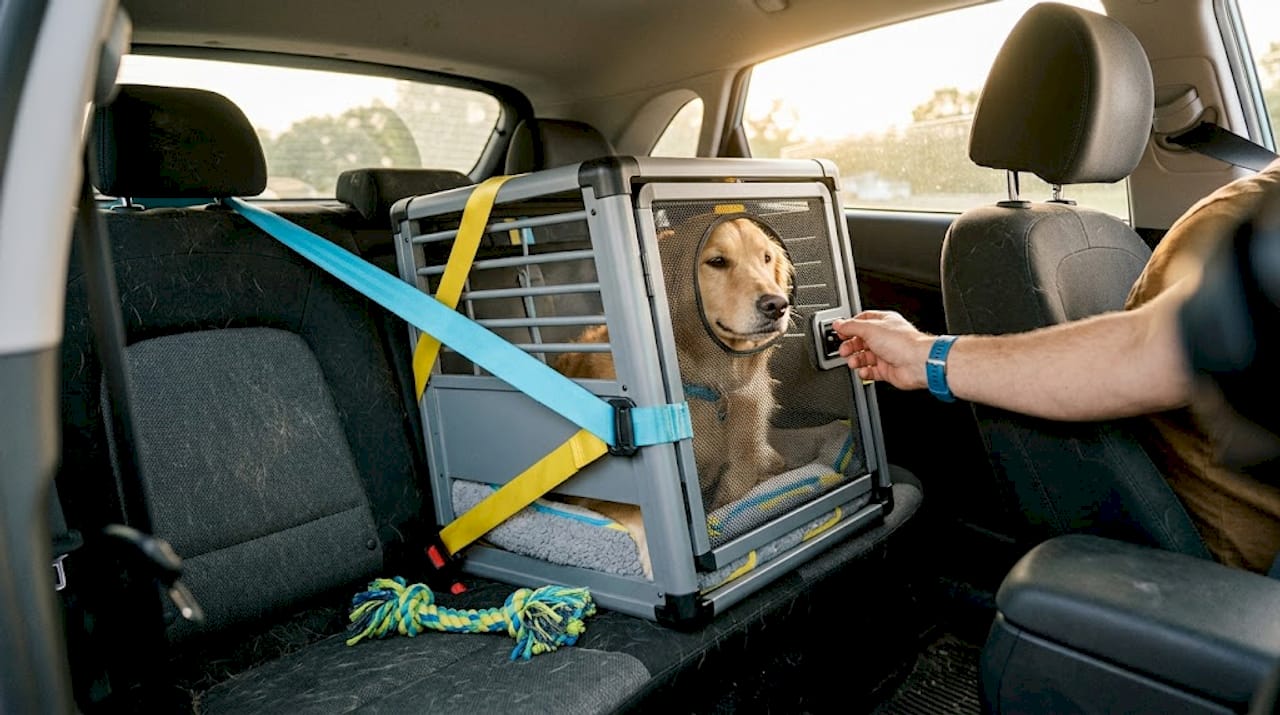
For air travel, your carrier must fit under the seat in front of you. Measure before you buy. Ventilation on three or four sides matters a lot for your dog’s comfort on longer flights. The carrier should be large enough for your dog to stand, turn around, and lie down, but not so large it slides around.
| Gear type | What to look for | Red flag |
|---|---|---|
| Car harness | CPS crash-test certification | No test data on packaging |
| Travel crate | Metal latch, solid floor, ventilated sides | Flimsy clips or plastic-only construction |
| Airline carrier | Fits under seat, 3 to 4 vent panels | Rigid top that hits seat back |
| GPS tracker | Lightweight, waterproof, real-time alerts | Requires Wi-Fi only |
GPS trackers are worth adding to your gear list, especially for hiking or outdoor trips where a dog could bolt. A lightweight, cellular GPS tracker clipped to your dog’s collar gives you real-time location even in low-signal areas.
Pro Tip: Start using travel gear at home weeks before your trip. Feed your dog meals inside the carrier or crate. Carrier acclimation training over several weeks dramatically reduces anxiety on travel day compared to introducing the crate the night before.
6. Managing your dog’s behavior and stress during travel
Staying calm yourself matters more than most owners realize. Owner stress directly transfers to dogs. If you’re anxious about the trip, your dog will mirror that. Slow down your movements, keep your voice steady, and avoid flooding your dog with nervous reassurance.
The most effective ongoing care strategies include:
- Reward calm proactively. Trainers advise reinforcing calm behavior before anxiety appears, not after. Offer treats and praise when your dog is relaxed in their crate or harness, even before you start moving.
- Use rest stops for sniffing. Sniffing during rest stops is one of the most effective ways to lower travel stress. It provides mental enrichment that physically calms the nervous system. Let your dog sniff freely for a few minutes instead of rushing them back into the car.
- Maintain feeding routines. Skipping meals or feeding at random times adds digestive stress on top of travel stress. Stick to your dog’s normal schedule as closely as possible.
- Bring familiar items. Mental enrichment from familiar objects like a favorite toy or a blanket from home are genuinely effective at reducing anxiety during transitions. This is not just comfort; it is practical anxiety management.
- Watch for distress signals. Excessive panting, drooling, yawning, whining, or refusing water are signs your dog is struggling. If these appear, find a safe place to stop, give your dog a break, and reassess.
For managing dog anxiety naturally, a consistent pre-travel routine and reward-based conditioning are far more effective long-term than any single product or quick fix.
My honest take on traveling with dogs
I’ve talked to a lot of dog owners who treat travel preparation the way people treat reading terms and conditions: they assume it won’t matter until it suddenly does. That’s the pattern I see most often when trips go wrong.
The single biggest mistake I’ve seen is skipping or rushing the vet visit. Not because health certificates are bureaucratic boxes to tick, but because a vet who knows your dog can genuinely tell you whether your dog should be in cargo at all. Some dogs, particularly older ones and flat-faced breeds, have no business in the cargo hold of a plane. That’s a conversation you want to have before you’ve already bought the ticket.
The second thing I’d push harder on is acclimation training. Introducing a crate on the day of a flight is setting your dog up for a miserable experience. Two to three weeks of gradual crate exposure, feeding meals inside it, and doing short practice car rides changes everything. Your dog stops seeing the crate as a threat and starts treating it as their space.
What I’ve found most surprising is how much the dog-owner bond benefits from well-planned travel. When you travel with intention, you pay close attention to your dog’s signals in a way that daily life rarely demands. That attentiveness builds trust. The trips that go smoothly aren’t the ones where everything went perfectly. They’re the ones where the owner was genuinely prepared and stayed calm when small things went sideways.
— Andrew
Travel smarter with Ipuppee
Planning a trip with your dog involves more moving pieces than most owners expect, from safety gear to behavior management to real-time communication. Ipuppee is built specifically to support dog owners who take their pet’s safety seriously. Whether you’re exploring safe mobility solutions for travel or looking for practical resources that go deeper than a basic checklist, Ipuppee has guides and tools designed for exactly that. Visit Ipuppee to explore products and educational resources that make traveling with your dog safer and a lot less stressful.
FAQ
What documents does my dog need for travel?
Most airlines and destination states require a Certificate of Veterinary Inspection valid for 10 to 30 days before travel. International trips may also require a USDA-endorsed health certificate and a Dog Import Form.
Can I sedate my dog for a flight?
Veterinarians advise against sedating dogs for flights unless specifically prescribed. Sedatives can cause breathing problems at altitude and sometimes increase rather than reduce stress in dogs.
How often should I stop on a road trip with my dog?
Plan rest stops at least every 2 hours to allow your dog to walk, relieve themselves, and sniff freely. Sniff breaks provide real mental enrichment that lowers travel-related stress.
What is the safest way to restrain a dog in a car?
Use a crash-tested harness or secured crate rated by the Center for Pet Safety. Keep your dog in the back seat and never allow them to ride unrestrained, regardless of trip length.
How do I help my dog adjust to a travel carrier?
Start introducing the carrier two to three weeks before your trip. Feed meals inside it, let your dog sleep in it, and do short practice trips so the carrier becomes a familiar, safe space before travel day.