

TL;DR:
- Most dogs struggle with alone time due to natural social instincts and past trauma, often leading to separation anxiety. Proper setup, gradual desensitization, and positive associations are essential for teaching dogs to relax independently without stress. Progress depends on individual pace, emphasizing patience and routine consistency to ensure lasting confidence and calmness.
Leaving your dog alone and coming home to shredded cushions, howling neighbors, or a guilt-ridden pup pressed against the door is not just frustrating — it is a sign that your dog needs real support, not just more practice. Most dogs do not naturally know how to relax when their people are gone, and without the right training, that gap can widen into full separation anxiety. The good news is that alone time is a teachable skill, and the method you use matters far more than how quickly you push through it. This guide walks you through every stage of building a calm, confident dog who can handle your absence without stress.
Table of Contents
- Understand alone time challenges for dogs
- Set up your training environment and tools
- Step-by-step process to teach alone time
- Troubleshooting and age-appropriate alone time
- Maintaining progress and preventing regression
- The real secret: rethinking alone time training for dogs
- Support every step of your dog’s training journey
- Frequently asked questions
Key Takeaways
| Point | Details |
|---|---|
| Gradual training works best | Introduce alone time slowly and only increase duration if your dog remains relaxed. |
| Safety and comfort first | Always use a safe space with positive associations and never exceed age-appropriate limits. |
| Watch for signs of distress | Barking, accidents, or panic signal the need to step back or seek help. |
| Rewards enable learning | Feed meals and provide favorite toys during alone time to build your dog’s confidence. |
| Consistency is key | Practice alone time regularly in different settings to prevent regression and maintain progress. |
Understand alone time challenges for dogs
Dogs are wired for social connection. In the wild, being separated from the pack meant danger, and that instinct is still very much alive in your living room. When you walk out the door, your dog does not understand “I’ll be back in two hours.” They just know you are gone.
Research suggests 8 out of 10 dogs find it hard to cope when left alone. That is not a small subset of sensitive dogs — it is the overwhelming majority. The difference between a dog who manages and a dog who spirals often comes down to early training and consistent exposure.
It is important to separate normal adjustment stress from true separation-related distress. Normal stress looks like a dog who whines briefly when you leave and then settles. Distress looks like:
- Barking or howling that continues for extended periods
- Destructive chewing, especially near exits (doors, window frames)
- Pacing or repetitive movements
- Toileting accidents in a house-trained dog
- Attempts to escape, sometimes causing injury
- Excessive drooling or panting
Separation-related anxiety can begin within minutes, and in some dogs it even starts before you leave. If your dog follows you from room to room, watches your “going out” rituals with growing tension, or becomes clingy in the hour before departure, that is anxiety building before the door even closes.
“Separation-related behavior is not naughtiness. It is a genuine emotional response that requires careful, compassionate training, not punishment.” — RSPCA
Puppies and rescue dogs tend to be most vulnerable. Puppies have never learned to be alone. Rescue dogs may carry past trauma around abandonment. For both groups, learning about natural solutions for dog anxiety and dog behavioral training can provide a solid foundation before starting alone-time work.
Set up your training environment and tools
With the “why” clarified, it is time to get your space, tools, and routine set up for effective training.
A good training environment does two things: it keeps your dog physically safe and emotionally comfortable. Using a crate, exercise pen, or designated room gives your dog a predictable, manageable space that does not overwhelm them. Open access to an entire house can actually increase anxiety because there is too much space to monitor and too many exit points that feel just out of reach.
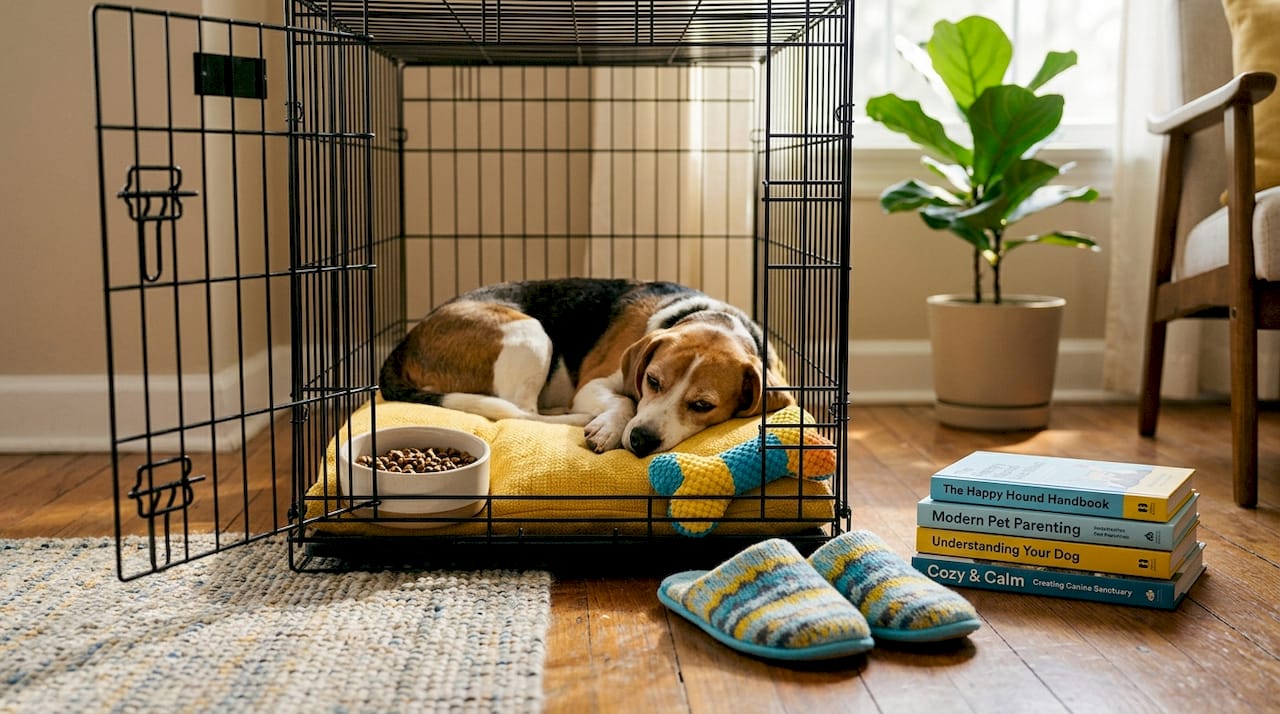
AKC recommends a safe confinement area (crate or exercise pen) and feeding meals inside it to build a strong positive association. When your dog learns that great things happen in their space, the space itself becomes comforting rather than confining.
Here is a quick overview of the tools worth having on hand:
| Tool | Purpose | Best for |
|---|---|---|
| Crate (wire or plastic) | Safe, den-like space | Puppies and anxious dogs |
| Exercise pen | Larger contained area | Active or crate-resistant dogs |
| Interactive puzzle toys | Mental stimulation, distraction | All ages |
| Frozen stuffed chew toy | Long-lasting engagement | Puppies and adults |
| Cozy bedding or blanket | Comfort and scent association | All dogs |
| Water bowl (spill-proof) | Hydration during alone time | All dogs |
| White noise machine | Reduces outside trigger sounds | Sound-sensitive dogs |
Before you begin training, run through a basic safety checklist:
- Remove electrical cords and small objects from the confinement area
- Ensure proper ventilation and a comfortable room temperature
- Check that the crate or pen cannot tip or collapse
- Remove collars with ID tags that could snag on crate bars
- Confirm no toxic plants are within reach
- Check for gaps where a small dog or puppy could get stuck
Pro Tip: Reserve one or two special toys or chews that your dog only gets during alone time. This creates a strong positive connection to the alone-time routine and gives your dog something to look forward to when you leave.
You can also explore puppy safety essentials and basic puppy training for more ideas on setting up a safe and stimulating environment. For physical enrichment, well-designed plush dog toys can make alone time genuinely engaging for your dog.
Step-by-step process to teach alone time
Once your setup is ready, you can start practicing alone time with a proven, stepwise approach.
Rushing this process is the single most common mistake owners make. The goal is to keep your dog below the anxiety threshold at every stage. If they are calm, you can progress. If they show stress, you step back. No exceptions.
Here is the full sequence:
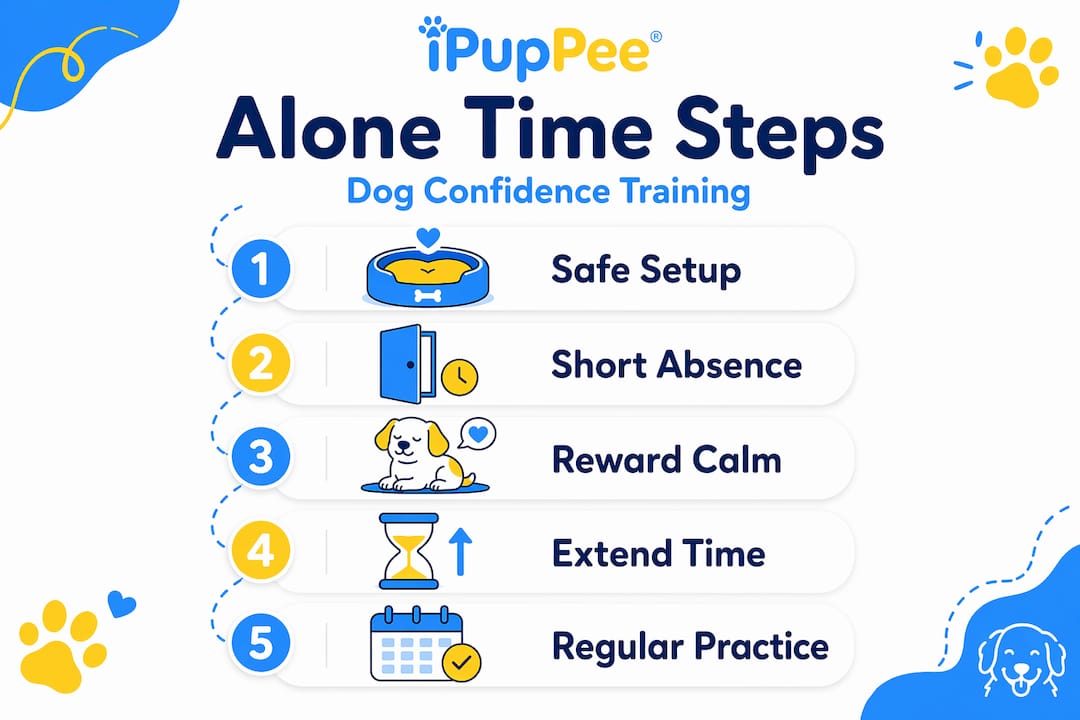
- Introduce the space positively. Feed meals inside the crate or pen. Toss treats in randomly throughout the day. Never use the space for punishment. Let your dog go in and out freely at first.
- Practice short closures with you present. Close the door for 10–30 seconds while you sit right there. Reward calm behavior with quiet praise or a treat. Open before your dog fusses.
- Build to brief absences in the same room. Move just a few feet away. Return before any stress begins. Reward calmness consistently.
- Leave the room entirely for short periods. Step out for 30 seconds, come back calmly. No dramatic greetings. Keep it low-key.
- Gradually extend duration. Begin with short in-house absences and only increase duration as long as the dog remains calm. Add a few minutes at a time.
- Add real-world context. Practice departure cues (putting on shoes, picking up keys) without actually leaving. This reduces the predictive anxiety those cues can trigger.
- Vary your routine. Leave at different times of day, for different durations, through different doors. Unpredictability teaches your dog that departures are normal, not catastrophic.
RSPCA says to very gradually increase time so it is never frightening, only advancing when the dog stays under threshold. If your dog becomes anxious, you have moved too fast.
Here is a comparison that shows why pace matters:
| Approach | Typical result |
|---|---|
| Gradual desensitization (stay under threshold) | Calm, confident dog who generalizes well |
| Rushed or forced separation | Increased anxiety, possible regression, damaged trust |
Pro Tip: Always end a training session on a calm, successful note. Even if that means stepping back to a shorter absence you know your dog handles well, a positive ending builds confidence over time.
For deeper support, explore dog independence training and a detailed puppy training checklist to stay organized throughout each phase.
Troubleshooting and age-appropriate alone time
With the main method learned, you should know how to adjust based on your dog’s age, progress, or setbacks.
One of the most important things to understand is that bladder capacity is not negotiable. A young puppy simply cannot hold it as long as an adult dog, and expecting them to do so sets everyone up for failure.
Here are the general guidelines for how long a dog can be left alone based on age:
| Age | Maximum alone time |
|---|---|
| Under 10 weeks | About 1 hour |
| 10–12 weeks | About 2 hours |
| 3 months | About 3 hours |
| 4 months | About 4 hours |
| 6 months | About 5 hours |
| Adult (over 1 year) | Up to 6–8 hours (with exercise before and after) |
Puppy alone-time limits by age reflect both bladder development and emotional maturity, so treat these as firm upper limits, not targets to push toward quickly.
If your dog regresses — suddenly struggling with a duration they previously handled well — do not push forward. Step back two or three stages in the training process and rebuild. Regression is normal, especially after changes like a new home, a new family member, or a health issue.
“Separation distress is not defiance or stubbornness. It is a genuine welfare concern that requires patient, step-by-step management.”
If the dog panics quickly or cannot calm even after step-backs, treat it as true distress and consider seeking help from a certified veterinary behaviorist or qualified trainer. Some dogs need medication alongside behavioral work to make real progress.
Warning signs that suggest you should seek professional help:
- Self-injury (bleeding paws, broken nails from digging)
- No improvement after several weeks of consistent step-back training
- Anxiety that appears to be worsening despite your efforts
- Signs of depression or appetite loss
For additional guidance on common setbacks, check out puppy training challenges and broader dog training solutions that address a wide range of scenarios.
Maintaining progress and preventing regression
After building your dog’s confidence, ongoing practice is key to lasting success.
Many owners make the mistake of doing all their training during the early weeks and then stopping completely once their dog seems comfortable. The problem is that alone-time comfort can erode quickly without regular reinforcement, especially after life changes or gaps in routine.
Common mistakes that lead to backsliding include:
- Only practicing alone time right before you actually need to leave for work
- Making departures emotional or dramatic (long goodbyes, apologetic tone)
- Skipping rewards once the dog “seems fine”
- Stopping practice sessions entirely after early success
- Forgetting to practice in new environments
Unsuccessful sessions signal a need to step back in the training ladder, not to push harder or punish. If your dog had a rough day, acknowledge it and go back to an easier level tomorrow.
Generalization is also important and often overlooked. Your dog needs to learn that “alone is okay” in more than one location. Practice alone time in different rooms, at a friend’s house, or in a training class environment. Use the same calm departure cue and the same type of reward wherever you practice.
Pro Tip: Keep a simple training log to track session length, your dog’s response, and how long it took them to settle. Patterns in the data will tell you when to move forward and when to hold steady.
Investing in comfort tools can reinforce the good work you are doing. A well-designed dog calming bed can help your dog associate their alone-time spot with genuine relaxation. You can also explore how to calm a dog for proven techniques that complement your alone-time training.
The real secret: rethinking alone time training for dogs
Let us zoom out from strategies and steps to what really matters in long-term alone-time success.
Most guides, including very good ones, present alone-time training as a fairly linear process: follow the steps, hit the milestones, done. That works well for many dogs. But it underestimates how profoundly individual dogs vary, especially rescues and sensitive breeds like border collies, vizslas, and Velcro dogs of all types.
We have seen two very different families go through this process. One family pushed through the steps in two weeks because their schedule demanded it. Their dog appeared fine but started showing subtle signs of stress three months later: destructive behavior when routines changed, reluctance to enter the crate. They had moved too fast for that particular dog, and the anxiety surfaced later.
The second family took seven weeks on the same process. Some weeks they barely moved forward at all. One week they went backwards entirely after a house move. But at the end, they had a dog who could genuinely relax alone in multiple environments, with multiple people, without regression. That is lasting success.
The uncomfortable truth is that the timeline is not yours to set. Your dog sets it. Your job is to stay honest about what you are actually seeing, not what you hope to see. Owner guilt is real — nobody wants to feel like they are “failing” training. But slowing down is not failure. Slowing down is respect.
Building true independence in a dog is not a two-week project. It is an ongoing investment that pays back in years of calm coexistence, less damage to your home, and a dog who genuinely feels safe in their own skin even without you in the room.
Progress in this type of training is often invisible on any given day. You will not see a dramatic breakthrough. You will just gradually notice that your dog settles faster, fusses less, and seems more relaxed when you return. That quiet shift is the whole goal.
Support every step of your dog’s training journey
Looking for more guidance and ongoing support as you work through alone-time training?
At iPupPee, we know that every dog is different and that training questions do not follow a predictable schedule. Whether you are working with a brand new puppy, a rescued adult dog, or a sensitive breed that needs extra patience, we have put together practical resources designed to meet you exactly where you are.
From step-by-step iPupPee training resources and detailed safety guides to tools that support communication and independence for dogs and their owners, our blog and product library cover the full journey. If anxiety is part of your dog’s picture, our dog anxiety help resources offer natural, evidence-backed strategies you can start using today. Browse our guides, download checklists, or reach out to our team for personalized support anytime.
Frequently asked questions
How long can I leave my puppy alone?
Young puppies should only be left alone for 1–2 hours max, while fully mature dogs can manage up to 6–8 hours depending on age, breed, and bladder control.
What if my dog panics every time I leave?
Pause training, step back to shorter absences, and consider consulting a professional behaviorist, since persistent panic may indicate true separation anxiety that goes beyond normal adjustment.
Are crates necessary for alone-time training?
Crates are not required but work very well for building safe, positive associations with alone time; exercise pens or a designated room are equally valid alternatives for dogs who resist crates.
Can toys help my dog feel comfortable alone?
Yes, special toys or chews reserved exclusively for alone-time sessions create strong positive associations with your absence and give your dog a healthy outlet for their energy and attention.