

Many people mistakenly believe emotional support animals have the same legal rights as service dogs, leading to confusion and access conflicts. Understanding service dog protocol is critical for handlers to assert their legal rights and for the public to interact respectfully. This guide covers the legal framework, handler responsibilities, common misconceptions, and practical strategies to ensure proper service dog etiquette in 2026.
Table of Contents
- Introduction To Service Dog Protocol
- Legal Framework And Handler Rights
- Handler Responsibilities And Public Etiquette
- Common Misconceptions And Legal Distinctions
- Challenges And Real World Access Issues
- Identification And Certification Clarifications
- Practical Application: How To Navigate Service Dog Protocol
- Discover Tools And Resources For Service Dog Handlers
- FAQ
Key takeaways
| Point | Details |
|---|---|
| Service dog protocol encompasses legal rights, handler duties, and public etiquette standards | Understanding these components prevents access denial and ensures respectful interactions |
| ADA grants service dogs full public access rights while excluding emotional support animals | Only two questions may be asked: is it a service animal and what work does it perform |
| No federal law requires service dog certification or ID cards | Handler explanations of tasks performed are the only valid proof needed |
| Handlers must maintain control of their dogs and educate the public on the ‘4 No’s’ etiquette | No petting, feeding, distracting, or interfering with working service dogs |
| Approximately 40% of handlers experience access denial incidents annually | Calm communication and rights documentation help resolve conflicts effectively |
Introduction to service dog protocol
Service dog protocol refers to the combined legal standards, behavioral expectations, and interaction guidelines that govern how service dogs and their handlers operate in public spaces. This framework ensures handlers receive equal access while maintaining public safety and minimizing conflicts. Proper protocol knowledge helps handlers confidently assert their rights and educates the public on respectful interaction practices.
The importance of understanding service dog protocol extends beyond legal compliance. When handlers know their rights and responsibilities, they can navigate public spaces with confidence and address challenges effectively. The public benefits from clear guidelines that prevent unintentional violations and awkward encounters. This shared understanding reduces conflicts, promotes accessibility, and protects the working relationship between service dogs and their handlers.
Service dog protocol consists of three core components:
- Legal rights and protections granted under disability laws like the ADA
- Handler responsibilities for controlling and managing their service dogs
- Public etiquette rules for interacting with service dog teams
- Educational efforts to increase awareness and compliance
These elements work together to create an environment where handlers can exercise their rights while the public understands how to support rather than hinder service dog work. The following sections explore each component in detail, addressing legal frameworks, practical responsibilities, common misconceptions, and real world application strategies.
Legal framework and handler rights
The Americans with Disabilities Act (ADA) legally defines service dogs as animals individually trained to perform tasks for people with disabilities. These tasks must directly relate to the person’s disability, distinguishing service dogs from pets or emotional support animals. Under ADA, service dogs have full public access rights to areas where the public is normally allowed, including restaurants, hotels, stores, and transportation.
When a service dog’s presence is questioned, businesses and public entities may only ask two specific questions:
- Is the dog a service animal required because of a disability?
- What work or task has the dog been trained to perform?
These questions protect handler privacy while allowing legitimate verification. Staff cannot request medical documentation, disability details, or proof of the dog’s training. This limited inquiry scope prevents invasive questioning while addressing legitimate safety and access concerns.
Service dog handlers do not have to provide documentation or carry certification cards. No federal requirement mandates official paperwork for service dogs. Handlers need only provide clear, direct answers to the two permitted questions. This simplicity protects handlers from excessive scrutiny while maintaining accountability.
| Legal Aspect | Handler Rights | Business Limitations |
|---|---|---|
| Access | Full access to public areas | Cannot deny based on breed or size |
| Questions | Answer only two permitted questions | Cannot ask for medical records or documentation |
| Proof | Verbal explanation of tasks | Cannot require certification or ID cards |
| Control | Must maintain control at all times | Can remove only if dog is disruptive or not housebroken |
International travelers should research service dog legal rights explained for destination countries, as laws vary significantly. Some nations require advance registration or health certificates. Understanding disability assistance dogs safety independence protocols helps prepare for international travel.
Handler responsibilities and public etiquette
Handlers must maintain control and proper behavior of their service dogs in all public settings. Control typically means keeping the dog on a leash, harness, or tether unless these devices interfere with the dog’s work or the handler’s disability prevents their use. In such cases, voice commands or signals must effectively control the dog.

Service dogs should remain calm, focused, and non disruptive in public spaces. Handlers are responsible for their dog’s behavior and must prevent aggressive actions, excessive barking, or interference with others. If a service dog becomes disruptive and the handler cannot regain control, businesses may legally ask the team to leave.
Educating the public on proper service dog interaction prevents distractions that compromise the dog’s effectiveness. The ‘4 No’s’ framework provides clear guidance:
- No petting without explicit handler permission
- No feeding treats or food to the working dog
- No distracting with sounds, gestures, or eye contact
- No interfering with the handler or dog’s movement
These rules protect the dog’s focus and the handler’s safety. Even well meaning interactions can distract a service dog from detecting medical alerts or guiding its handler. Understanding service dog etiquette tips helps the public support rather than hinder service dog teams.
Handler advocacy plays a critical role in improving public compliance. Clear communication about the dog’s working status and polite education of curious individuals builds understanding. Many handlers use vests or patches stating “Do Not Pet” or “Working Dog” to reduce unwanted interactions.
Pro Tip: When facing access disputes, remain calm and state your rights clearly and factually. Escalating emotionally rarely helps and may complicate resolution. Offer to answer the two permitted questions and explain the dog’s specific tasks.
Reviewing service dog responsibilities guide and service dog handler essentials provides comprehensive preparation for public access situations.
Common misconceptions and legal distinctions
The most widespread misconception conflates service dogs with emotional support animals. Service dogs receive intensive training to perform specific disability related tasks like detecting seizures, guiding blind individuals, or alerting to dangerous blood sugar levels. Emotional support animals provide comfort through their presence but lack specialized task training.
This distinction carries significant legal implications. Emotional support animals lack public access rights and can be legally refused entry to restaurants, stores, and other public places where service dogs are welcome. ESAs receive housing and air travel accommodations under different regulations, but these protections do not extend to general public access.
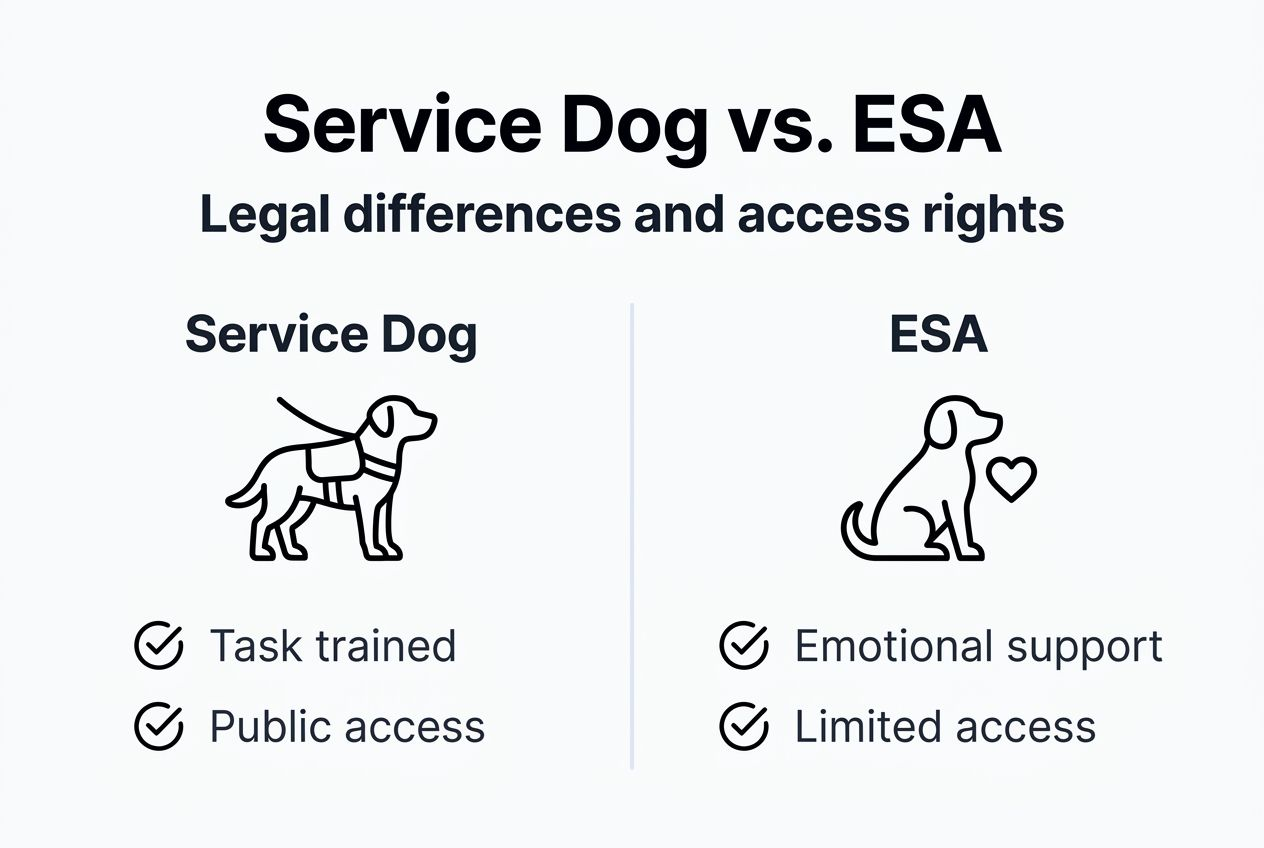
| Characteristic | Service Dog | Emotional Support Animal |
|---|---|---|
| Training | Task specific for disability | No required training |
| Public Access | Full rights under ADA | No public access rights |
| Documentation | None required | May need for housing/flights |
| Legal Protection | ADA nationwide | Fair Housing Act only |
| Species | Dogs (miniature horses in some cases) | Various species allowed |
Another persistent myth claims service dog certification or ID cards are legally required. No federal or state law mandates certification for service dogs. Numerous online vendors sell unofficial certificates and ID cards, but these have zero legal standing. Businesses cannot require handlers to present such documentation.
Common fraudulent certification schemes prey on uninformed handlers:
- Online registries charging fees for worthless certificates
- Fake service dog identification cards with official looking designs
- Vests and patches sold as proof of service dog status
- Registration websites claiming national or federal authority
These scams undermine legitimate service dog teams by creating confusion about legal requirements. Handler knowledge and clear answers about the dog’s function matter infinitely more than paper credentials. Understanding service dog legal rights explained helps handlers avoid falling for certification scams.
The proliferation of fake service dogs wearing purchased vests creates additional challenges for legitimate handlers. Public skepticism increases when untrained pets misbehave while wearing service dog gear, leading to access difficulties for properly trained teams.
Challenges and real world access issues
Despite clear legal protections, many service dog handlers face denied access to public places due to inadequate knowledge among business staff and the general public. Studies indicate approximately 40% of handlers experience access denial incidents, ranging from outright refusal to invasive questioning that exceeds legal limits.
Common access challenges include:
- Staff claiming health codes prohibit dogs despite ADA requirements
- Demands for documentation or certification cards
- Breed discrimination against certain dog types
- Confusion between service dogs and emotional support animals
- Assumptions that only blind individuals use service dogs
Businesses have legal obligations to allow service dogs unless specific exceptions apply. They may only exclude a service dog if it poses a direct threat to health and safety that cannot be eliminated through reasonable modifications, or if the dog is not housebroken or is out of control and the handler cannot regain control.
“Many access denials stem from well intentioned but misinformed staff who lack training on ADA requirements. Education rather than confrontation often resolves these situations most effectively.”
Practical strategies for handling access denial:
- Calmly state you have a service dog trained to perform disability related tasks
- Offer to answer the two permitted questions
- Avoid revealing unnecessary medical information
- Ask to speak with a manager if frontline staff refuse access
- Document incidents with date, time, location, and staff names
Pro Tip: Carry a concise summary of ADA service dog rights on your phone or in writing. Having specific legal language ready can help educate resistant staff without escalation. Record details immediately after incidents for possible legal follow up if needed.
Handlers should familiarize themselves with service dog handler essentials to prepare for access challenges. Building confidence through knowledge reduces stress when facing denial situations.
Identification and certification clarifications
No federal requirement for certification cards exists under ADA, and most states follow this standard. The absence of mandatory certification protects handler privacy and reduces barriers to service dog access. However, this creates confusion as many assume official documentation is required.
Online vendors capitalize on this confusion by selling unofficial certificates with no legal standing. These documents often feature official looking seals and language suggesting federal or state authority. In reality, no government agency certifies service dogs or maintains a national registry.
The importance of relying on the handler’s clear explanation of tasks cannot be overstated:
- Verbal descriptions of specific trained tasks constitute valid proof
- Certification cards add no legal weight to access rights
- Handler explanations must be accepted by businesses
- Paper documentation is legally meaningless for public access
Risks of assuming certification ensures access include false confidence in purchased credentials and increased vulnerability to scams. Handlers who believe they need certification may delay obtaining a service dog or waste money on fraudulent documents.
Tips to avoid scams and misinformation:
- Ignore websites selling service dog registration or certification
- Understand that legitimate service dog training programs do not provide legally required certificates
- Focus on actual task training rather than paperwork
- Educate yourself on ADA requirements from official government sources
- Report fraudulent certification schemes to consumer protection agencies
While identification cards are not required, some handlers choose to carry them for convenience. Voluntary ID cards can speed interactions by quickly communicating the dog’s status. However, handlers should never feel pressured to produce such cards, as they have no legal standing.
Practical application: how to navigate service dog protocol
Successfully navigating service dog protocol requires both legal knowledge and practical skills. Handlers who prepare thoroughly experience fewer access issues and resolve conflicts more effectively. The following steps provide actionable guidance for asserting rights and ensuring smooth public access.
- Carry a concise written summary of ADA service dog rights to present if questioned or challenged
- Practice clear, confident responses to the two permitted questions
- Research accessibility policies of frequently visited businesses and venues
- Join handler support groups to share experiences and learn from others’ strategies
- Document all access denial incidents with complete details for potential legal action
- Educate willing individuals politely when they violate service dog etiquette
- Prepare backup plans for situations where access is wrongly denied
Educating the public requires patience and strategic communication. Use advocacy programs and community presentations to raise awareness about service dog protocol. Many handlers find that brief, friendly explanations prevent future violations better than confrontational approaches.
Calm communication proves essential during access disputes. Escalating emotionally rarely achieves desired results and may complicate resolution. State your rights factually, offer to answer permitted questions, and request manager assistance when necessary. Most conflicts resolve through education rather than legal intervention.
International travel with service dogs demands additional research and preparation. Service dog legal rights explained extends to understanding differences in laws across countries. Some nations require advance notification, health certificates, or quarantine periods. Airlines have specific policies that may differ from ground transportation rules.
Pro Tip: Join online and local service dog handler communities to exchange advice and support. Experienced handlers offer invaluable insights on managing specific venues, airlines, and challenging situations. This network provides emotional support and practical problem solving resources.
Preparing legally and practically reduces barriers to full participation in public life. Review service dog handler essentials regularly to stay current on protocol changes and best practices. Confidence grows with knowledge and experience, making each public outing smoother than the last.
Discover tools and resources for service dog handlers
Navigating service dog protocol becomes significantly easier with access to reliable information and supportive resources. iPupPee provides comprehensive guides specifically designed for service dog handlers seeking to understand their legal rights and responsibilities. The platform offers detailed articles covering everything from basic protocol to advanced advocacy strategies.
Exploring service dog legal rights explained helps handlers master the ADA framework and respond confidently to access challenges. Additional resources on service dog handler essentials deliver practical tips for daily public access situations. These educational materials empower handlers to assert their rights effectively while maintaining positive relationships with businesses and the public.
Pro Tip: Regularly review updated guides to stay informed on 2026 protocol changes and emerging best practices. Laws and public awareness evolve, making ongoing education essential for maintaining smooth access and effective advocacy.
FAQ
What is the difference between a service dog and an emotional support animal?
Service dogs receive specialized training to perform specific disability related tasks like seizure detection or mobility assistance. Emotional support animals provide comfort through their presence but lack task training and public access rights under ADA. Businesses can legally deny entry to emotional support animals while welcoming service dogs.
Are service dogs required to have certification or ID cards?
No federal or state law requires service dogs to carry certification or ID cards. Handler explanations of the tasks their dog performs constitute the only legally recognized proof. Businesses cannot demand documentation, and online certification schemes have no legal standing under ADA.
What questions can businesses legally ask about my service dog?
Businesses may only ask if the dog is a service animal required because of a disability and what work or task it has been trained to perform. They cannot request medical documentation, inquire about the nature of your disability, or demand proof of training. These two questions balance access rights with legitimate verification needs.
Can a business refuse my service dog based on breed or size?
No, businesses cannot deny access based on breed, size, or appearance concerns. ADA prohibits breed specific restrictions for service dogs. A business may only exclude a service dog if it poses a direct threat that cannot be eliminated or if it is out of control and the handler cannot regain control.
What should I do if a business denies me access with my service dog?
Remain calm and clearly state you have a service dog trained to perform disability related tasks. Offer to answer the two permitted questions and request to speak with a manager. Document the incident with date, time, location, and staff names for potential legal follow up if resolution fails.
Recommended
- 7 Essential Service Dog Etiquette Tips for All Dog Owners – iPupPee
- Understanding Service Dog Behavior: 2025 Guide for Owners & Handlers – iPupPee
- Service Dog Responsibilities: Complete Expert Guide – iPupPee
- Service Dog Care Essentials: Must-Know Tips for 2025 – iPupPee
- Pet Friendly Car Service for Travelers - Ascend in Motion