

Specialized training improves rescue dog behavior by up to 50% compared to generic methods. This stunning gap reveals why trauma-informed approaches matter for rescue dog owners seeking effective communication and safety with their service animals. This guide explores evidence-based techniques, corrects common misconceptions, and shows you how to apply proven methods that transform anxious rescue dogs into confident, reliable companions.
Table of Contents
- Understanding Rescue Dog Behavior And Training Needs
- Challenges And Considerations In Training Rescue Dogs
- Effective Training Techniques For Rescue Dogs
- Common Misconceptions About Rescue Dog Training
- Comparing Training Approaches: Rescue Vs. Non-Rescue Dogs
- Integrating Communication Aids For Enhanced Safety
- Bridging Training Insights To Practical Application
- Explore Training Tools And Support For Rescue Dogs
- Frequently Asked Questions About Training Rescue Dogs
Key takeaways
| Point | Details |
|---|---|
| Trauma-informed training | Addresses past trauma and anxiety, improving outcomes by 35-50% over standard methods. |
| Extended training timelines | Rescue dogs typically need 20-30% longer training periods than non-rescue dogs. |
| Positive reinforcement priority | Trust-building through rewards boosts compliance by 40% and reduces stress markers. |
| Communication device integration | Alert systems improve safety response times by 20% and communication clarity by 84%. |
| Dispelling misconceptions | Understanding rescue dog capabilities and needs drives better training success rates. |
Understanding rescue dog behavior and training needs
Rescue dogs carry invisible baggage from their past. Trauma from neglect, abuse, or unstable environments creates behavioral patterns that standard training often misses. Many rescue dogs display anxiety, fear responses, and deep mistrust of humans. These aren’t character flaws but survival mechanisms learned through difficult experiences.
Training tailored to rescue dogs accounting for past trauma improves behavioral outcomes by 35-50% compared to generic training methods. This dramatic difference stems from addressing triggers, managing stress, and building trust at the dog’s pace rather than forcing compliance through rigid timelines.
Trauma-informed training recognizes that rescue dogs need:
- Gradual exposure to new experiences without overwhelming their nervous systems
- Consistent, predictable routines that rebuild trust in human caregivers
- Recognition of individual triggers and personalized desensitization protocols
- Extra time to process commands and respond without punishment for hesitation
Understanding your dog’s background matters enormously. A dog rescued from a hoarding situation faces different challenges than one surrendered due to owner illness. Review available history, observe behavioral cues, and adjust your approach accordingly. Small details like hand movements or tone of voice can trigger unexpected reactions rooted in past trauma.
“The most successful rescue dog training programs spend substantial time on behavioral assessment before introducing formal commands. This foundation of understanding creates faster progress than rushing into obedience work.”
With this understanding, we next explore the specific challenges and considerations you face when training rescue dogs.
Challenges and considerations in training rescue dogs
About 60% of rescue dogs experience initial setbacks during training due to anxiety and stress responses. These challenges aren’t failures but expected phases requiring patience and specialized strategies. Your rescue dog might freeze during simple exercises, react aggressively to benign stimuli, or regress after making progress.
Anxiety manifests differently across individual dogs. Some become hypervigilant and reactive, while others withdraw and shut down completely. Both responses complicate training because the dog’s brain prioritizes survival over learning new behaviors. Without proper desensitization, stress compounds and aggression risks increase significantly.
Training rescue dogs typically takes 20-30% longer than working with non-rescue dogs raised in stable environments. This extended timeline reflects the need to build foundational trust before advancing to complex commands. Rushing this process creates surface compliance that crumbles under stress, particularly dangerous for service dog roles requiring reliable performance.
Common training obstacles include:
- Inconsistent responses to familiar commands across different environments
- Separation anxiety interfering with independent task completion
- Resource guarding behaviors stemming from past scarcity experiences
- Fear-based reactivity toward specific people, objects, or situations
- Difficulty generalizing learned behaviors to new contexts
Pro Tip: Keep training sessions short (5-10 minutes) and always end on a positive note. Rescue dogs tire mentally faster than physically, and pushing beyond their capacity damages the trust you’re building.
Effective stress management transforms training receptivity. Monitor your dog’s body language for signs of overwhelm like lip licking, yawning, or tucked tails. When you spot these signals, scale back intensity immediately. Gradual trust-building through consistent positive interactions matters more than hitting arbitrary training milestones.
Understanding these challenges sets the stage for exploring proven, effective training techniques tailored to rescue dogs.
Effective training techniques for rescue dogs
Positive reinforcement training boosts trust by 40% compared to correction-based methods. This approach rewards desired behaviors with treats, praise, or play rather than punishing mistakes. For trauma-affected rescue dogs, positive reinforcement rebuilds their belief that humans bring good things, not pain or unpredictability.

Stress reduction techniques lower cortisol levels by 25% in rescue dogs undergoing training. Simple interventions like calm environments, predictable schedules, and adequate rest between sessions help dogs stay below their stress threshold. When cortisol stays manageable, learning pathways open and behaviors stick faster.
Desensitization reduces fear responses and aggression risk substantially. This systematic exposure to triggers at sub-threshold levels lets dogs build tolerance gradually. If your rescue dog panics around men with beards, you start with distant observation, then closer proximity, eventually progressing to interaction only when the dog shows relaxed body language at each stage.
Effective training follows this stepwise model:
- Establish a safe baseline where the dog feels secure and responds to basic attention
- Introduce simple commands in low-distraction environments using high-value rewards
- Build command reliability through consistent practice and immediate reinforcement
- Generalize behaviors across locations, with different people, and amid distractions
- Maintain skills through regular practice and periodic refresher sessions
Pro Tip: Match reward types to your dog’s preferences. Not all rescue dogs value food treats equally. Some respond better to toy play, others to verbal praise or physical affection. Experiment to find what motivates your specific dog.
Combining these techniques creates a reliable behavior foundation essential for service roles. Dog rescue training success depends on layering trust-building, stress management, and skill development rather than rushing through a linear curriculum.
Next, we dispel common myths that could hold you back from effective rescue dog training.
Common misconceptions about rescue dog training
Many owners believe rescue dogs need the same training as puppies from stable backgrounds. This misconception leads to frustration when standard methods fail. Tailored trauma-informed approaches improve results by 30-40% compared to generic protocols because they address the unique psychological needs of dogs with difficult histories.
Another damaging myth suggests that rescue dogs are inherently damaged or untrainable. Research consistently shows rescue dog temperament varies enormously, and with proper methods, most achieve excellent training outcomes. The difference lies in recognizing that progress timelines and techniques must adapt to individual trauma histories.
Common misconceptions include:
- Believing all rescue dogs will eventually “get over” their past without intervention
- Assuming aggressive behavior reflects permanent personality rather than manageable fear
- Thinking rescue dogs can’t become reliable service animals due to their backgrounds
- Expecting linear progress without setbacks or regression periods
- Believing communication devices replace rather than complement training efforts
Some owners invest in communication technology expecting it to solve behavioral issues without training work. While these devices enhance safety and clarity, they function best when integrated with solid foundational training. A dog that hasn’t learned impulse control won’t reliably use an alert button regardless of the technology’s sophistication.
The reality is that rescue dogs possess remarkable adaptability when given appropriate support. Their past experiences create challenges but not insurmountable barriers. Understanding true capabilities rather than accepting limiting stereotypes leads to dramatically better outcomes for both dogs and handlers.
Having cleared up these misconceptions, we now compare rescue dog training approaches to those used with non-rescue dogs.
Comparing training approaches: rescue vs. non-rescue dogs
Key differences between rescue and non-rescue dog training impact your strategy, timeline, and expectations. The table below illustrates why tailored protocols matter for certification success and long-term reliability.
| Training aspect | Rescue dogs | Non-rescue dogs |
|---|---|---|
| Average training duration | 20-30% longer timelines | Standard timelines |
| Behavioral risk factors | 2x higher without proper protocols | Lower baseline risk |
| Stress management needs | Critical for progress | Important but less intensive |
| Trust-building phase | Extended foundation required | Shorter, often assumed |
| Command generalization | Requires extra environmental variety | Progresses more linearly |
| Regression likelihood | Higher during stressful periods | Lower overall |
| Service certification success | Achievable with specialized training | Higher baseline rates |
Rescue dogs require 20-30% longer training periods because they need extra time building foundational trust before advancing to complex tasks. Non-rescue dogs raised in stable environments typically arrive at training with basic confidence in human guidance already established.
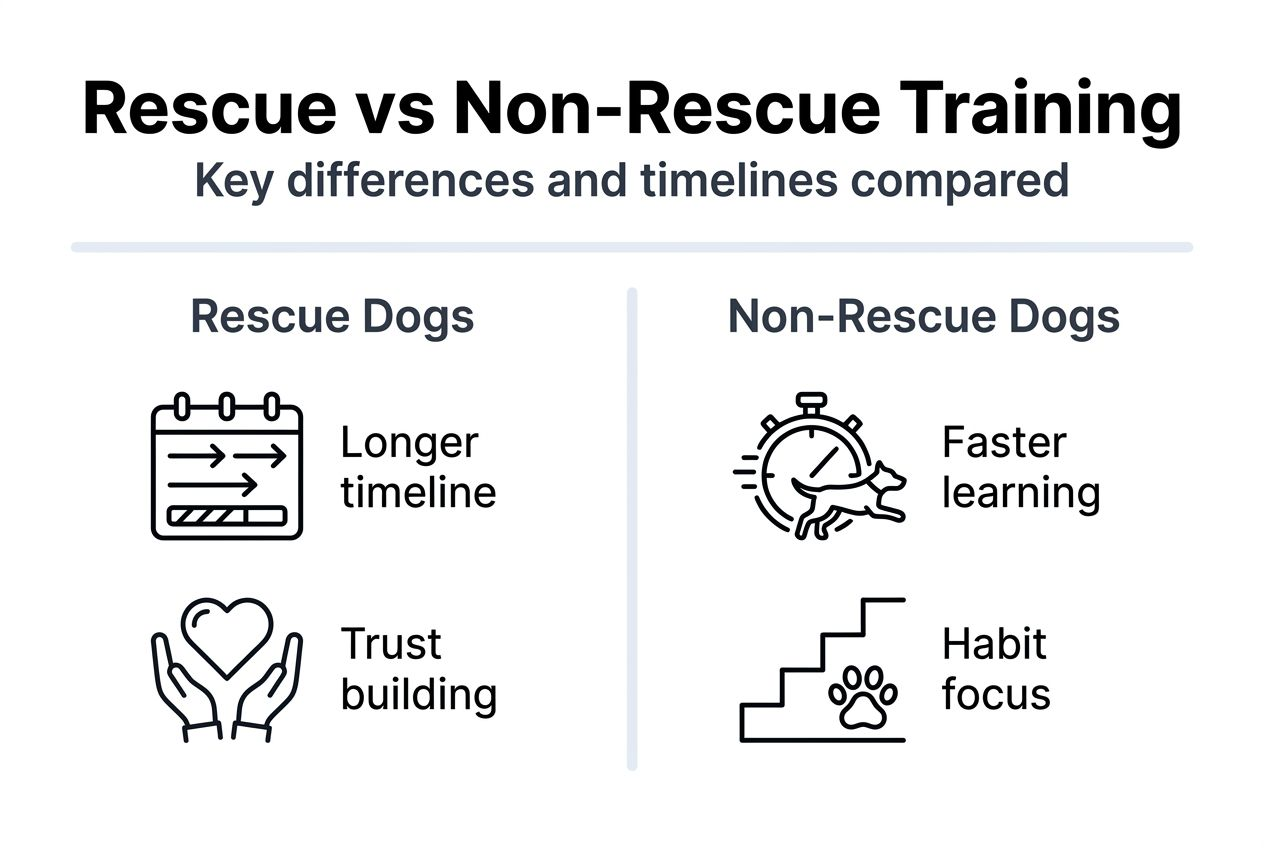
Without proper trauma-informed protocols, rescue dogs face twice the risk of developing problematic behaviors like reactivity or aggression. This elevated risk doesn’t reflect inherent defects but rather the compounding effects of stress and inadequate support during critical learning phases.
Behavioral rehabilitation needs differ substantially between groups. Non-rescue dogs primarily need skill acquisition, while rescue dogs often require simultaneous healing from past trauma alongside learning new behaviors. This dual process demands patience and specialized expertise from trainers and handlers.
Tailored training accounting for these differences increases certification success rates for rescue service dogs significantly. Recognizing that your rescue dog operates from a different baseline helps you set realistic milestones and celebrate progress appropriately.
With this clarity, we explore how communication aids can enhance training effectiveness and safety.
Integrating communication aids for enhanced safety
Communication devices improve safety alert response times by 20% when integrated properly with training protocols. These tools bridge gaps between what dogs perceive and what handlers understand, creating clearer pathways for urgent communication about needs, dangers, or medical alerts.
Dog communication for rescue dogs becomes particularly valuable because trauma often impairs traditional signal reliability. A rescue dog might freeze instead of barking when distressed, making visual or button-based alerts more dependable for critical situations.
Clarity of communication improves by 84% with technology integration. This dramatic improvement stems from reducing ambiguity in dog signals. Instead of interpreting subtle body language that trauma may have altered, handlers receive clear, unambiguous alerts through devices designed for precision.
Communication devices reduce handler response times by 20% during safety-critical situations, particularly valuable for disabled owners relying on service dog alerts.
Effective communication tools include:
- Alert buttons the dog presses to signal specific needs like bathroom breaks or assistance requests
- Wearable sensors monitoring vitals and activity patterns to detect stress or health issues
- Interactive communication boards allowing dogs to indicate choices between options
- GPS tracking devices ensuring location safety for dogs prone to anxiety-driven flight responses
- Video monitoring systems letting handlers observe behavior remotely during desensitization training
Case studies demonstrate that rescue service dogs using communication devices show enhanced independent safety capabilities. One study tracked handlers with mobility limitations whose rescue dogs learned to activate alert buttons during medical emergencies, reducing emergency response times substantially compared to relying on traditional barking or pawing.
Increasing dog safety with devices requires systematic integration rather than simply providing the technology. Start introducing devices during early training phases so dogs associate them with positive outcomes. Reward every correct use lavishly, building strong motivation to communicate through these channels.
Steps for integration include:
- Introduce devices in low-stress environments during play or feeding times
- Shape button-pressing or device interaction using positive reinforcement
- Attach meaning to specific device activations through consistent response patterns
- Generalize device use across environments and situations gradually
- Maintain reliability through regular practice and immediate handler responses
Finally, we bridge these insights into practical application steps to empower your rescue dog training journey.
Bridging training insights to practical application
Applying trauma-informed training combined with communication technology creates safer, more effective rescue service dog partnerships. This step-by-step framework turns knowledge into confident action for handlers committed to their rescue dog’s success.
Start with comprehensive trauma-informed assessment:
- Document your dog’s known history including previous environments and experiences
- Observe behavioral patterns across different situations to identify triggers
- Establish baseline stress responses and comfort zones before formal training
- Consult with veterinarians to rule out medical issues affecting behavior
- Create a customized training plan addressing individual trauma signatures
Build trust using positive reinforcement techniques consistently. Every interaction either deposits into or withdraws from your relationship bank account. Prioritize deposits through reward-based training, predictable routines, and patient responses to setbacks. Trust accumulates slowly for rescue dogs but pays dividends in reliable performance.
Generalize commands across environments systematically. A rescue dog might perform perfectly at home but freeze in public spaces. Practice commands in progressively challenging locations: quiet backyard, empty park, then busier areas. This gradual exposure prevents overwhelm while building real-world reliability.
Integrate communication aids early in your training journey. Don’t wait until behaviors are perfect to introduce devices. Dogs learn device use more readily when it becomes part of their routine from the beginning rather than an add-on to established patterns.
Pro Tip: Video record training sessions weekly. Progress feels invisible day-to-day, but comparing footage from week one to week twelve reveals dramatic improvements that sustain your motivation during challenging phases.
Monitor and adjust continuously based on your dog’s responses. What works brilliantly for one rescue dog might overwhelm another. Stay flexible, celebrate small wins, and remember that sustainable progress beats rushed results. Your rescue dog’s journey from trauma survivor to confident service animal unfolds through accumulated small victories rather than dramatic breakthroughs.
With these actionable steps, turn knowledge into confident training and safer service use.
Explore training tools and support for rescue dogs
Transform your rescue dog training journey with resources designed specifically for trauma-informed approaches. iPupPee rescue dog training resources combine expert guidance with innovative communication devices proven to enhance safety and clarity for handlers and their service animals.

Discover communication tools that bridge understanding gaps between you and your rescue dog. Our alert devices integrate seamlessly with positive reinforcement training, giving your dog clear ways to signal needs, warnings, or requests for assistance. These tools prove particularly valuable for disabled handlers who depend on reliable communication during critical moments.
Access comprehensive rescue dog training basics through articles addressing common challenges, evidence-based techniques, and real success stories from handlers who transformed anxious rescues into confident service partners. Find product bundles combining training aids with communication devices, creating complete systems for your specific needs.
Join a community dedicated to rescue dog success where handlers share insights, troubleshoot challenges, and celebrate milestones together. Your rescue dog deserves specialized support that recognizes their unique journey from survival to service.
Frequently asked questions about training rescue dogs
What is trauma-informed training for rescue dogs?
Trauma-informed training recognizes that past negative experiences shape current behavior and learning capacity. This approach prioritizes building trust, managing stress, and addressing individual triggers before advancing to complex commands. It differs from standard training by adapting timelines and techniques to each dog’s trauma history rather than applying uniform methods.
How long does rescue dog training usually take?
Rescue dog training typically requires 20-30% longer than non-rescue dogs, often spanning 6-12 months for basic reliability and 12-24 months for service certification. Timelines vary based on trauma severity, individual temperament, and training consistency. Progress happens in phases with occasional setbacks, requiring patience and flexible expectations.
Are communication devices necessary for all rescue dogs?
Communication devices aren’t mandatory but significantly enhance safety and clarity, especially for service roles or handlers with disabilities. They prove most valuable when rescue dogs struggle with traditional signaling due to trauma-altered behavior patterns. Devices complement rather than replace foundational training, creating redundant communication pathways during critical situations.
Can all rescue dogs become successful service dogs?
Not every rescue dog suits service work, but many achieve certification with proper training. Success depends on individual temperament, trauma severity, and training quality rather than rescue status alone. Thorough behavioral assessments identify candidates with suitable foundational traits like focus, resilience, and motivation that training can develop into reliable service skills.
How do I choose a trainer experienced with rescue dogs?
Seek trainers with specific credentials in trauma-informed methods and documented rescue dog experience. Ask about their approach to anxiety, stress management techniques, and success rates with rescue certifications. Quality trainers provide references, explain their methodology clearly, and customize programs rather than applying one-size-fits-all curricula to every dog.
Recommended
- Why Train Rescue Dogs: Essential Benefits for Owners in 2025 – iPupPee
- Dog Rescue Training: Keys to Success for Owners & Handlers 2025 – iPupPee
- Rescue Dog Training 2025: Step-by-Step Success for All Owners – iPupPee
- Complete Guide to Training Rescue Dogs Basics – iPupPee
- Understanding Your Dog’s Silent Conversations Through Body Language | PetPsychic Blog