

TL;DR:
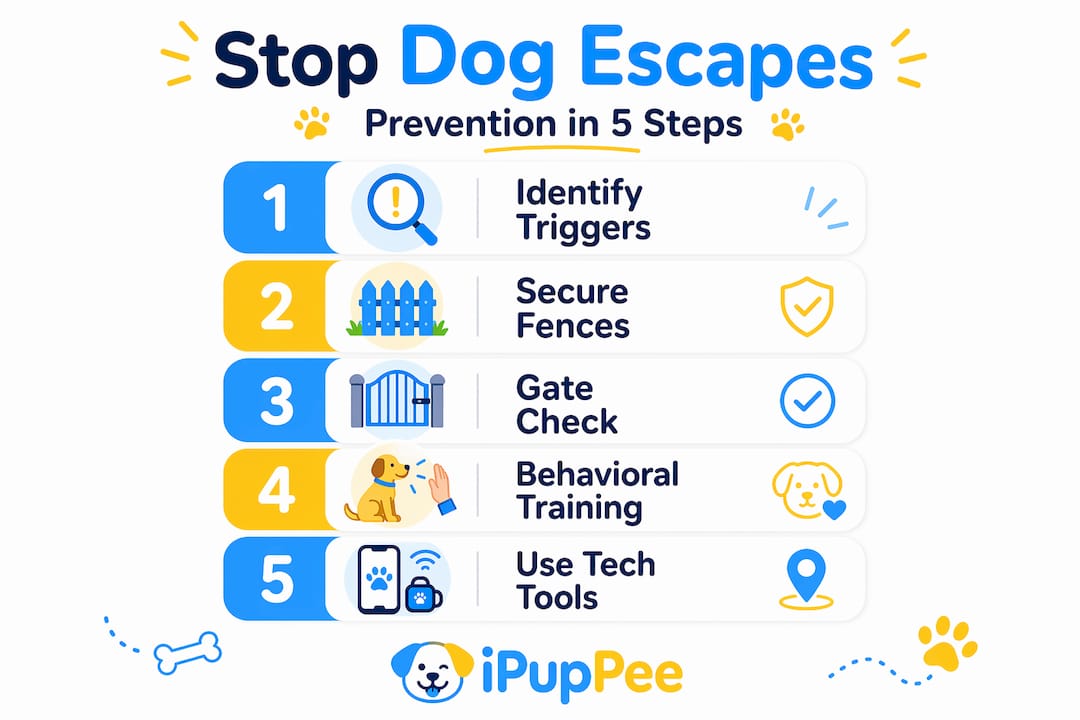
- Understanding your dog’s motivations—such as boredom, anxiety, or instinct—is essential for creating effective escape prevention strategies.
- Combining physical barriers with behavioral enrichment, consistent routines, and high-risk dog gear significantly reduces the likelihood of escapes and keeps your dog safe at home.
Knowing how to prevent dog escapes is one of the most critical skills you can develop as a dog owner. A dog that slips through a fence gap, bolts out an open door, or digs under a gate faces real dangers: traffic, aggressive animals, disoriented wandering, and worst of all, never making it home. The problem is more common than most owners expect, and the solutions require more than just a taller fence. This guide covers the full picture, from understanding why your dog wants to leave in the first place to building a physical and behavioral system that actually holds.
Table of Contents
- Key takeaways
- How to prevent dog escapes by understanding why they happen
- Securing your yard: fences, gates, doors, and overlooked gaps
- Behavioral strategies to reduce your dog’s urge to escape
- Managing high-risk dogs with gear and tracking
- Avoiding common pitfalls in long-term prevention
- My take on stopping dog escapes for good
- How Ipuppee supports your dog’s safety at home and beyond
- FAQ
Key takeaways
| Point | Details |
|---|---|
| Know your dog’s motivation | Identifying why your dog escapes (boredom, fear, instinct) makes every other prevention method more effective. |
| Layer your physical barriers | Combine fence repairs, inward extensions, locks, and buffer zones to close every escape route. |
| Address behavioral needs daily | Regular exercise, training, and mental enrichment reduce the urge to escape at the source. |
| Gear up high-risk dogs | Flight-risk dogs need two attachment points, ID tags, microchipping, and GPS trackers at all times. |
| Stay consistent long-term | Fence inspections, household communication, and routine maintenance keep prevention from breaking down over time. |
How to prevent dog escapes by understanding why they happen
Before you fix a single fence board, you need to understand what is driving your dog out of the yard. Solving escape problems requires addressing your dog’s specific motivation directly, not just adding more barriers.
The most common motivations behind escape attempts include:
- Social isolation. Dogs left alone for long periods will seek company anywhere they can find it.
- Separation anxiety. This goes deeper than loneliness. Anxious dogs enter a near-panic state and treat any boundary as an obstacle between them and safety.
- Boredom. A dog with too much pent-up energy and nothing to do will treat your fence like a puzzle to solve.
- Reproductive drive. Intact dogs are powerfully motivated to find mates. This drive can override almost every other barrier you put in place.
- Fear. Thunderstorms, fireworks, or unfamiliar visitors can trigger a flight response so strong that a previously calm dog will tear through fencing.
- Predatory instinct. Squirrels, rabbits, and neighborhood cats can trigger a full-sprint chase that sends a dog right over or through a fence.
To figure out which of these applies to your dog, observe when escape attempts happen. Does your dog try to get out only when you leave? That points to separation anxiety. Does it happen mostly in the evening when foot traffic peaks? Likely predatory instinct or social interest. Keeping a simple log for one week reveals patterns that are impossible to see day to day.
Pro Tip: Film your yard with a phone propped against a window while you are out. Reviewing the footage often reveals exactly how and when your dog attempts to escape, which makes your prevention plan far more targeted.
Containment alone frequently fails because it treats the symptom without touching the cause. A dog motivated by separation anxiety will find a new escape route every time you patch the old one, until the anxiety itself is addressed.
Securing your yard: fences, gates, doors, and overlooked gaps
Once you understand your dog’s motivation, you can match your physical defenses to the actual risk. A thorough environment audit covers far more than just the main fence line.
Fence inspection and reinforcement
Walk your fence line at ground level and look for gaps, rotting boards, weak post footings, and spaces under the fence where digging has already started. Inspecting fences and removing climbing aids are two of the most overlooked steps in preventing escapes. Repair holes immediately. For diggers, bury an L-shaped footer of wire mesh at the base of the fence, bent outward underground so that digging hits resistance fast.
Pro Tip: For jumpers, install coyote rollers along the top of the fence. These spinning cylinders prevent dogs from getting a grip when they hook their paws over the top, and they work on most standard fence styles.
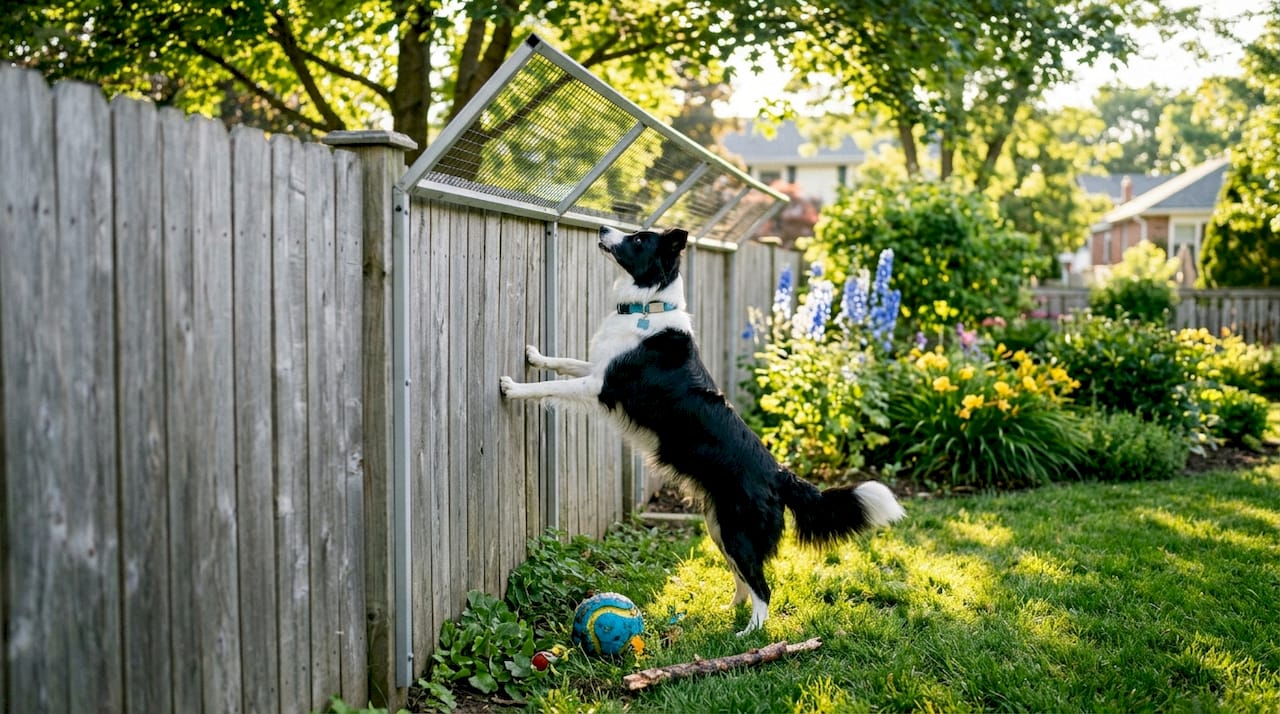
For climbers, an inward-slanting fence extension at a 45-degree angle removes the grip advantage they rely on. Also remove anything close to the fence that a dog could use as a launch pad: patio furniture, large planters, woodpiles, and even parked vehicles near the fence line.
Door and gate security
| Escape point | Risk level | Recommended fix |
|---|---|---|
| Unsecured main gate | High | Add a self-latching, key-lockable gate lock |
| Front door entry | Very high | Install a buffer zone gate inside the entry |
| Sliding glass door | Medium | Use a secondary latch and door alarm |
| Window screens | Medium | Replace with reinforced pet-proof screens |
| Back gate used by guests | High | Post a visible “Keep Gate Closed” sign and add a spring return hinge |
Door dashing is one of the most vulnerable escape points in any home. A buffer zone solves this elegantly. Place a baby gate, exercise pen, or secondary interior gate a few feet inside the main entry. Even if the front door swings open unexpectedly, your dog has a second barrier to clear. This is especially worth doing if you have frequent delivery visitors or young children who may not close doors carefully.
Also check window screens. Standard screens are not designed to hold a motivated dog, and a dog that spots a squirrel through a second-story window can pop a screen surprisingly fast. Reinforced pet screens or window guards cost very little and close a risk most owners never consider.
Behavioral strategies to reduce your dog’s urge to escape
Physical barriers buy you time. Behavioral strategies solve the actual problem. Daily exercise, obedience training, and mental enrichment are among the most effective tools you have for reducing escape motivation from the inside out.
Here is a practical weekly framework you can start today:
- Morning walks before alone time. A 30-minute walk before you leave for work burns physical energy and satisfies your dog’s need to explore. A dog that has already “seen the neighborhood” is far less driven to go find it.
- Obedience training sessions. Even 10 minutes of sit, stay, recall practice, and impulse control drills gives your dog a mental workout that rivals an hour of physical exercise. Consider a behavioral training guide to build a structured routine.
- Puzzle feeders at meal times. Swap at least one daily meal into a Kong, snuffle mat, or lick mat. Interactive devices and enrichment tools directly reduce boredom-driven escape attempts by keeping your dog mentally occupied.
- Doggie daycare or structured playgroups. Social dogs that escape to find other dogs often stop trying once they get reliable social time. Two to three daycare visits per week can be transformative for socially motivated escapers.
- Desensitization for fear-based escapes. If your dog bolts during thunderstorms or fireworks, work with a trainer on graduated desensitization and consider calming tools like anxiety wraps or white noise machines.
Pro Tip: Never punish your dog after you catch it outside your yard. Punishment after escape links your return with a negative experience, which increases anxiety and can make the problem significantly worse over time.
The goal of behavioral work is to make staying home feel better than leaving. That shift takes consistency, but it compounds. A dog that trusts its environment, gets enough stimulation, and feels connected to you has very little reason to look for the exit.
Managing high-risk dogs with gear and tracking
Some dogs are what handlers call “flight risks.” These include newly adopted strays, dogs with a history of escaping, sighthounds, and certain high-drive working breeds. For these dogs, standard prevention is not enough. You need an additional layer of redundancy.
The core checklist for high-risk dogs:
- Always leash outside, even in a fenced yard. A leash is your last line of defense if a gate opens unexpectedly. Flight-risk dogs should stay leashed outdoors until their reliability is fully established.
- Use two points of attachment. Attach your leash to both a properly fitted collar and a harness simultaneously. If one fails or the dog backs out of one, the other holds. This double attachment approach is standard practice among professional trainers working with escape-prone dogs.
- ID tags and microchipping. Tags can fall off or become unreadable. Microchipping is permanent and dramatically increases the chance of a safe return. Keep your contact information updated with the chip registry every time you move or change numbers.
- GPS tracking devices. GPS trackers worn at all times give you real-time location data the moment your dog goes missing. Pair this with dog safety device resources to understand which options work best for your dog’s size and lifestyle.
- Managed entry and exit. Establish a rule: no one opens the front door until the dog is secured in another room or behind a buffer gate. Brief every household member, regular guests, and service workers.
For additional guidance on keeping dogs safe outdoors, the outdoor safety tips at Ipuppee cover leash protocols and supervision strategies in practical detail.
Avoiding common pitfalls in long-term prevention
Dog escape prevention is not a one-time project. Fences age, behaviors change, and routines slip. Most escapes that happen after owners think they have “fixed the problem” trace back to one of these common mistakes.
- Chasing your dog after an escape. Running after a dog almost always makes it run faster. Instead, crouch low, turn away, and use an excited happy voice. Dogs are curious and will often circle back.
- Skipping seasonal fence inspections. Frost heaving, summer heat warping, and storm damage silently create new gaps. Walk your perimeter at the start of each season and after major weather events.
- Assuming routines hold without reinforcement. A new roommate, a baby, or a change in your work schedule can disrupt the containment habits your dog has adapted to. Revisit your protocols whenever your household changes.
- Treating all escapes the same. A dog that escapes in response to a specific trigger needs a tailored solution. Blindly adding more fence height when the real issue is separation anxiety will not stop anything.
Pro Tip: Post a short “Dog Safety Rules” note on your front door or mud room wall. List the buffer zone step, gate-closing reminders, and your dog’s name. Guests follow instructions far more reliably when they are written down and visible.
My take on stopping dog escapes for good
I’ve worked with a lot of dog owners who arrive at prevention with the wrong mental model. They think about escapes as a security problem when it is actually a relationship and enrichment problem that has physical symptoms.
Every time I’ve seen an owner focus exclusively on building a higher fence or adding more locks, the dog eventually found a new way out. What worked, consistently, was pairing the physical fixes with a genuine improvement in the dog’s daily life. More exercise. More training. More connection.
What I’ve also learned the hard way is that fear-based escapes are in a category of their own. A dog driven out by terror does not respond to enrichment alone. You have to treat the fear, which often means working with a certified behaviorist, not just adding a coyote roller.
My honest opinion: if your dog has escaped more than once, stop asking “where did it get out?” and start asking “what does my dog need that it is not getting?” The physical barriers are part of the answer. But the behavioral piece is where most owners give up too soon, and it is exactly where the lasting wins are hiding.
— Andrew
How Ipuppee supports your dog’s safety at home and beyond
Keeping your dog safe is not a single purchase or a one-day project. At Ipuppee, the focus is on giving dog owners the resources, tools, and education they need to build real safety around their pets.
Whether you are trying to manage a newly adopted dog with a history of escaping, working with a high-energy breed that tests every fence, or simply want to be better prepared, Ipuppee has practical resources that go beyond basic checklists. From in-depth blog guides on dog behavioral training to safety devices designed for everyday use, the site covers both the physical and behavioral sides of keeping dogs contained and cared for. Explore the full range of tools and educational content at ipuppee.com and take the next step toward a home your dog has no reason to leave.
FAQ
Why does my dog keep escaping even with a tall fence?
Fence height is rarely the only issue. Dogs escape because of underlying motivations like boredom, anxiety, or reproductive drive, which physical barriers alone cannot resolve.
What is the best fence type for keeping dogs in the yard?
Solid privacy fences with no footholds work best for climbers and jumpers. Adding inward-slanting extensions and burying wire mesh at the base addresses both climbers and diggers in one setup.
Should I punish my dog for escaping?
No. Punishment after escape increases fear and anxiety, which can make escapes more frequent, not less. Focus on prevention and positive reinforcement instead.
How do GPS trackers help with dog escape prevention?
GPS trackers do not prevent escapes directly, but they dramatically reduce the risk of permanent loss by giving you real-time location data the moment your dog leaves your property.
How often should I inspect my yard for escape risks?
Walk your fence line at the start of each season and after any major storm. New gaps, frost damage, and chewed boards are easy to miss until a motivated dog finds them first.