

TL;DR:
- Travelers must comply with U.S. regulations and prepare their service dogs well before flying. Proper documentation, behavioral training, and airport planning are essential for a smooth journey. Consistent preparation reduces the risk of disruptions and ensures legal access throughout the trip.
Traveling safely with service dogs means following specific legal protocols, training standards, and preparation steps that protect both handler and dog throughout the journey. The Air Carrier Access Act and U.S. Department of Transportation regulations govern air travel with service animals, setting clear rules on documentation, behavior, and handler responsibilities. Knowing these rules before you book removes the guesswork and prevents costly last-minute problems at the gate. This guide covers every stage of the process, from paperwork to post-flight care, so you can travel with confidence.
How to safely travel with service dogs: documentation and advance steps
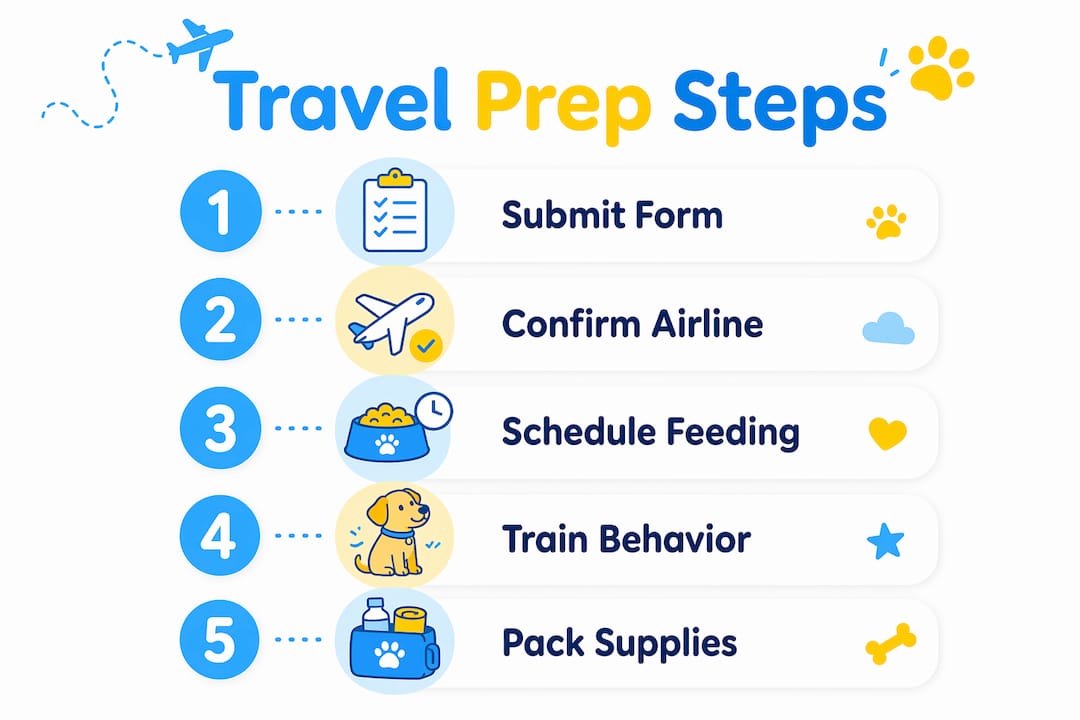
Preparation for service dog travel starts weeks before departure, not at the airport. The U.S. DOT requires handlers to submit a Service Animal Air Transportation Form at least 48 hours before any flight. That form attests to the dog’s training, health, and behavior. For flights lasting 8 or more hours, a second form is required, confirming the dog can either hold its bladder for the duration or relieve itself without creating a sanitation issue.
International travel adds another layer of complexity. Contact the destination country’s embassy at least 30 days before departure to confirm entry rules, required vaccinations, and any breed restrictions. Failure to comply can result in your dog being quarantined or denied entry entirely. That outcome is not just stressful. It can derail your entire trip.
Core documentation checklist:
- U.S. DOT Service Animal Air Transportation Form (submitted 48+ hours in advance)
- Second DOT relief attestation form for flights over 8 hours
- Current vaccination records, including rabies and any destination-specific requirements
- Veterinary health certificate dated within 10 days of travel for most international routes
- Embassy confirmation letter or entry permit for international destinations
Pro Tip: Call the airline directly after submitting your DOT form online. Verbal confirmation with a customer service agent creates a paper trail and reduces the chance of a gate agent claiming they have no record of your service animal.
Plan your dog’s feeding and relief schedule around flight times. Withhold food for 3–4 hours before boarding to reduce the risk of gastrointestinal distress mid-flight. Identify pet relief areas in your departure and layover airports in advance using each airport’s official website or app.
| Preparation step | Timing |
|---|---|
| Submit DOT Air Transportation Form | At least 48 hours before flight |
| Contact destination embassy | 30+ days before international travel |
| Obtain veterinary health certificate | Within 10 days of departure |
| Notify airline of service animal | At booking or as early as possible |
| Research airport relief areas | At least 1 week before travel |
How to prepare your service dog physically and behaviorally
A dog that behaves perfectly at home may struggle in an airport. Public-access proofing over 6–12 months builds the endurance and focus needed for busy travel environments. That timeline is not excessive. Airports combine loud announcements, crowds, unfamiliar smells, moving carts, and other animals, all at once.
Training your dog for travel requires deliberate, graduated exposure. Start with quieter public spaces, then progress to shopping malls, train stations, and finally airports. Practice public access skills in busy environments 1–2 months before your trip. A dog that has never experienced sensory overload at that level will not perform reliably under it.
Behavioral preparation steps:
- Practice the “settle” command on a mat in progressively noisier locations.
- Proof leash control around rolling luggage, crowds, and other dogs.
- Run through security-style scenarios: remove the dog’s vest, walk through a doorframe, re-vest, and continue.
- Practice long “down-stays” of 60–90 minutes to simulate flight duration.
- Introduce the dog to the sounds of jet engines using audio recordings at increasing volume.
- Schedule a veterinary wellness check within 2 weeks of departure to confirm the dog is fit to fly.
Pro Tip: Bring your dog’s exact travel mat to every practice session. The familiar scent and texture become a cue for calm behavior. That same mat in the cabin signals “this is your space,” which speeds up settling significantly.
Under the ADA, service dogs must pass public access standards that require ignoring food, other animals, and sudden noises while remaining calm and focused. Those standards are not optional during air travel. A dog that fails them mid-flight can be removed from the cabin. Behavioral readiness is your strongest protection against that outcome.
Hydration matters as much as training. Offer water at every opportunity before boarding, since cabin air is extremely dry. Carry a collapsible bowl and a sealed water bottle in your carry-on.
Managing your service dog through the airport and flight
Arriving early is the single most effective service dog travel tip for a smooth airport experience. Give yourself at least 2.5 hours before domestic flights and 3.5 hours before international ones. That buffer absorbs documentation checks, relief breaks, and any gate complications.
Step-by-step airport management:
- Check in at the ticket counter in person. Visiting the ticket counter before security verifies your dog’s reservation and seating space. Online check-in alone does not guarantee this.
- Use the pet relief area before security. Most major airports have designated relief areas before the security checkpoint and after. Use both if your layover is short.
- Navigate TSA with the leash on. TSA allows handlers to keep the dog on leash through the metal detector. You do not need to place your dog in a carrier or on the belt. If the detector alarms, request a hand-wand screening.
- Board during pre-boarding. Request pre-boarding at the gate. Extra time to settle your dog before other passengers board reduces crowding stress for both of you.
- Claim a bulkhead or window seat. Bulkhead rows offer floor space. Window seats give the dog a wall to lean against, which many dogs find calming.
- Lay the familiar mat immediately. A familiar mat placed on the floor as soon as you sit down defines the dog’s space and promotes calm behavior quickly.
- Communicate with the crew. Introduce yourself and your dog to the flight attendants at boarding. They can alert you to turbulence in advance and help manage passenger interactions.
Service animals must stay under control at all times during flight. Blocking aisles or displaying disruptive behavior gives the airline legal grounds to refuse transport. Dogs are not required by law to wear vests or carry ID cards. Behavior is the only standard that matters in the cabin.
In-flight behavior checklist:
- Dog remains in the floor space at your feet or under the seat
- Dog does not solicit attention from other passengers
- Dog stays quiet during announcements and turbulence
- Handler stays calm and avoids excessive reassurance, which can reinforce anxious behavior
Most of the handler’s role in-flight is to stay still and calm. The dog’s behavior follows the handler’s cues. Fidgeting, repeatedly checking on the dog, or speaking to it in a high-pitched voice signals that something is wrong. Stillness communicates safety.
Common challenges and how to handle them
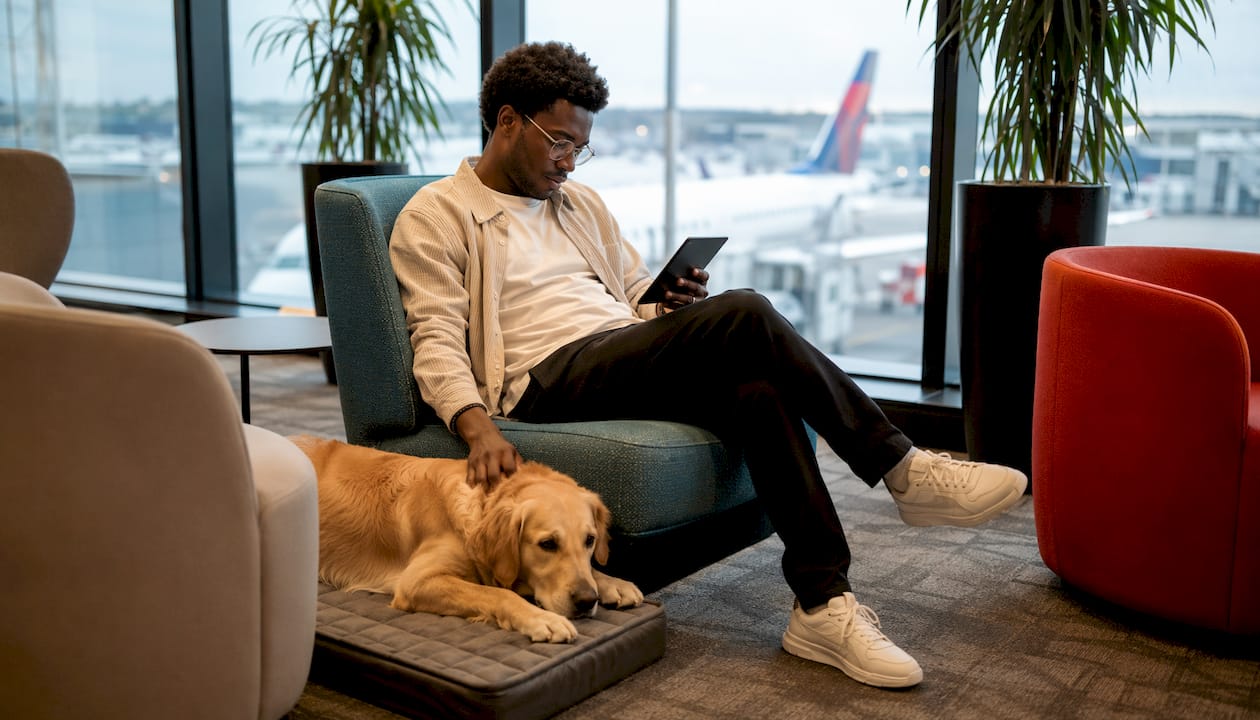
Even well-prepared handlers face complications. Knowing the most common problems in advance lets you respond without panic.
Frequent challenges and solutions:
- Passenger complaints: Politely explain that your dog is a trained service animal with legal access rights under the Air Carrier Access Act. If a crew member intervenes, present your DOT form calmly.
- Dog stress signals: Panting, yawning, lip-licking, and scanning are early stress signals. Respond with a calm, low voice and a familiar command like “settle.” Avoid removing the dog from the mat.
- Gate agent disputes: Carry printed copies of your DOT forms and the airline’s own service animal policy. Gate agents sometimes misapply rules. Printed documentation ends most disputes quickly.
- Multi-leg trips: Treat each leg as a separate event. Use every layover for a relief break, water, and a short walk. Do not skip this step even on short connections.
- Large service dogs: Request a bulkhead seat at booking, not at the gate. Airlines are not required to bump other passengers for your dog’s comfort, but bulkhead seats are often available if requested early.
“Treat travel with a service dog as a high-stakes training event requiring deliberate planning of the dog’s biological needs. Every leg of the trip, every layover, and every transition point deserves the same level of attention as the flight itself.”
Post-flight care is often overlooked. After landing, give your dog a thorough relief and recovery break before ground transportation. Offer water immediately. Check paws for dryness or irritation from airport floors. Give the dog 20–30 minutes of calm decompression before entering a new environment like a hotel or rental car.
Key Takeaways
Safe service dog travel requires legal compliance, behavioral preparation, and deliberate in-transit management at every stage of the journey.
| Point | Details |
|---|---|
| Submit DOT forms early | File the Service Animal Air Transportation Form at least 48 hours before any flight. |
| Start behavioral training months out | Practice public access skills in busy environments 1–2 months before travel. |
| Check in at the ticket counter | Visit in person before security to confirm your dog’s reservation and seating space. |
| Use a familiar mat in the cabin | A consistent mat cues calm behavior and defines the dog’s space during the flight. |
| Plan every relief break deliberately | Use airport relief areas before security, after security, and at every layover. |
What I’ve learned from watching handlers get this wrong
The most common mistake I see is handlers who prepare their dog but not themselves. They spend months training the dog to settle, ignore distractions, and hold a long down-stay. Then they board the plane visibly anxious, check on the dog every five minutes, and wonder why the dog is unsettled by hour two. Handler anxiety transfers directly to dogs. That is not a soft observation. It is a behavioral fact that experienced trainers repeat constantly.
The second mistake is treating documentation as a formality. Handlers submit the DOT form online and assume that is enough. It is not. Airlines lose records. Gate agents misread systems. The handlers who travel without friction are the ones who call ahead, carry printed copies, and arrive early enough to resolve problems before they become crises.
The third mistake is underestimating the airport itself. A dog that has never experienced a busy terminal will find the experience genuinely overwhelming. The sounds, the smells, the moving floors, the crowds. None of that is replicable at home. Frequent exposure to busy environments is the only preparation that actually works. One or two mall visits are not enough. Six months of graduated exposure is the standard that produces reliable behavior.
The handler-dog partnership during travel is unlike any other context. You are both out of your element, both relying on each other, and both being watched. The handlers who do this well share one trait: they have done the work long before the trip begins.
— Andrew
Planning your next trip with Ipuppee
Ipuppee supports service dog handlers with guides, training resources, and tools built for real-world travel situations.
Whether you are preparing for your first flight with a service dog or refining your process after a difficult trip, Ipuppee’s service dog resources cover the full range of handler needs. From understanding your dog’s behavior in high-stress environments to choosing the right gear for long-haul flights, the Ipuppee blog gives you practical, handler-tested guidance. Explore the safe mobility solutions section for specific advice on comfort and compliance during extended travel.
FAQ
What forms do I need for air travel with a service dog?
The U.S. DOT requires a Service Animal Air Transportation Form submitted at least 48 hours before your flight. Flights over 8 hours require a second form confirming the dog’s ability to manage its relief needs.
Can airlines deny boarding to my service dog?
Airlines can deny transport if the dog displays disruptive behavior, blocks aisles, or poses a direct threat to others. Legal access rights under the Air Carrier Access Act do not override behavior-based refusals.
Does my service dog need to wear a vest or ID?
No. Federal law does not require service dogs to wear vests, patches, or carry ID cards. Behavior and handler documentation are the only legally recognized standards.
How early should I start preparing my dog for air travel?
Public-access proofing in busy environments should begin 1–2 months before travel at minimum, with full behavioral preparation ideally spanning 6–12 months for dogs new to public access work.
What do I do if a gate agent disputes my service dog’s access?
Present your printed DOT Service Animal Air Transportation Form and the airline’s own published service animal policy. If the dispute continues, ask to speak with a supervisor and document the interaction in writing.