

Yes, you can train your dog to press a button, ring a bell, or use a shaped natural signal to ask for the door. The rule that makes it work: every signal must trigger the door opening and a potty chance within about five seconds. That immediate payoff is what turns a random paw tap into a reliable communication tool. Get that loop right, and most dogs pick it up within a few weeks.
TL;DR:
- Consistent immediate payoff within five seconds of pressing the button is crucial for building a reliable communication loop with dogs.
- Equipment choice depends on noise sensitivity, handler mobility, and household environment, with quiet buttons favored for sound-sensitive dogs.
- Training should focus on modeling, pairing, and generalizing the press behavior over several weeks with short, daily sessions, and tracking success rates.
- Common training stalls are caused by false presses, confusion over multiple signals, low engagement, or inconsistent follow-through by handlers.
- Using a dedicated device like the iPupPee system, combined with proper training and an outdoor spot, can improve accessibility and reliability of potty signaling.
Table of Contents
- Choose Your Method: Bells, Buttons, or a Natural Signal
- The Device Training Protocol: From First Press to Reliable Alert
- Fixing Stalled Training and Making the Alert Bulletproof
- How Ipuppee Approaches Accessible Potty Signaling
- Setting Up an Outdoor Spot That Speeds Up the Habit
- Reading Your Dog’s Body Language Before the Signal Kicks In
- What Actually Matters Here
- A Device and Course Built Around This Exact Method
- Where This Guide’s Evidence Comes From
- Sources
- FAQ
Choose Your Method: Bells, Buttons, or a Natural Signal
Three approaches dominate this space, and each fits a different dog and a different handler.
Potty bells hang on the door and get a nose bump or paw swipe. They’re cheap, nearly indestructible, and work well for dogs who already nose-touch objects readily. The downside is noise. A bell clanging at 2 a.m. isn’t ideal in an apartment, and dogs with sound sensitivity sometimes avoid the whole setup.
Recordable buttons let you record your own voice saying “outside” or “potty,” and the dog presses a soft, quiet pad to trigger it. This matters more than it sounds for two groups: seniors who may not hear a bell from another room, and handlers who want a system that can pair with remote alerts rather than relying on being within earshot. The IAABC Foundation Journal has documented dogs using these buttons for specific requests, including asking to go outside, with careful shaping and consistent follow-through.
Shaping a natural signal means capturing and reinforcing a behavior the dog already offers, like standing at the door or a specific bark. This works when equipment isn’t practical, such as for a dog with joint pain who struggles to press anything, or when the dog already signals somewhat reliably and just needs the behavior sharpened.
Before picking one, weigh these accessibility factors:
- Noise sensitivity in the dog or household (bells vs. quieter buttons)
- Handler mobility and how quickly you can reach the door
- Hearing ability, since a silent visual cue may work better for some households
- Living situation, since apartment neighbors and bell volume don’t always mix
The Device Training Protocol: From First Press to Reliable Alert
Start with the right equipment. A good button sits flat, has enough surface area for an easy paw or nose press, and stays in the exact same spot near the door every single time. Dogs build location memory fast, and moving the button resets progress. Floor placement at paw height works better than wall mounting for most dogs.
Phase 1: Teach the press. Model it yourself first. Press the button, say the word, and immediately treat. Practical trainer guidance from Chewy recommends modeling the button and rewarding any approach or interaction, then narrowing the reward to actual presses. Free shaping works too: reward the dog for looking at the button, then touching it, then pressing it, in small increments. A verbal marker or clicker helps mark the exact moment of success.
Phase 2: Pair the press with the door and the outdoor trip. This is where most training plans quietly fail. The dog needs to experience, over and over, that a press leads to the door opening within roughly five seconds and a trip outside. Once the behavior is reliable, fade the treats. According to Chewy’s training guidance, long-term food rewards for pressing can actually muddy the signal, since you want the press to communicate a real need rather than solicit a snack.
Phase 3: Generalize and proof. A press that only works when you’re standing three feet away isn’t useful. Practice from farther rooms, add mild distractions like a TV on or a visitor at the door, and vary the time of day. Track how often a press actually leads outside; that number tells you more than how “smart” the dog seems.
- Place the button permanently near the exit door.
- Model the press and reward the association for several days.
- Shift rewards from treats to the functional outcome (door plus potty trip).
- Practice from increasing distances and in different rooms.
- Introduce mild distractions once the press is consistent at close range.
Run sessions short: five to ten minutes, several times a day, rather than one long drilling session. Devoted to Dog reports that most dogs reach reliable use within two to four weeks of this kind of consistent daily practice. Seniors and service-dog handlers with limited mobility can stretch that timeline; slower, shorter sessions still get there, they just take a bit longer to build the same muscle memory.
Pro Tip: Keep a small notebook or phone note logging every press and whether it led outside. A week of data beats a week of guessing when you’re deciding if the behavior has actually clicked.
Fixing Stalled Training and Making the Alert Bulletproof
Training rarely fails outright. It stalls, and most stalls have a specific cause.
- False presses: If your dog presses just to get attention or a treat, stop responding to presses that aren’t followed by genuine potty behavior once outside. Removing the button for a day or two and reintroducing it with tighter timing often recalibrates the association.
- Multi-meaning buttons: A button that means both “outside” and “I want attention” is a design problem, not a training failure. Keep each button’s meaning atomic. If confusion has already set in, split the behavior into two distinct buttons with distinct sounds or textures.
- Low engagement: If your dog ignores the button entirely, go back to modeling and rule out physical discomfort before assuming it’s a motivation problem. Also confirm the dog is actually getting rewarded outside; a rushed potty break with no payoff teaches nothing.
- Fading reliability: Occasional randomized practice, even after the behavior seems solid, keeps the signal sharp over months.
An experimental study on assistance dogs using touchscreen alert systems found that backchaining and incremental distance training sped up generalization to new home contexts, and that sessions as short as five minutes were still effective for building these chains. Teaching the last step first, then working backward, often gets a stuck dog moving again faster than repeating the whole sequence from scratch.
A simple weekly check works well: count how many presses in the past seven days led to an actual outdoor potty trip within five seconds of the door opening. Most well-trained alert dogs hold well above 80 percent once the loop is established; anything consistently lower signals a step in the process that needs revisiting.
How Ipuppee Approaches Accessible Potty Signaling
Ipuppee builds its training resources around the same Alert Loop principle covered here: signal, immediate door response, potty reward. The company’s focus sits squarely on service-dog teams, seniors, and people with disabilities who need a communication method that doesn’t depend on being within earshot of a bell.
The core insight behind accessible signaling design isn’t about adding features. It’s about making the press itself dead simple, the placement consistent, and the feedback loop instant, because a handler with limited mobility or reduced hearing can’t afford a system that requires guesswork.
Ipuppee’s training materials walk through the same modeling and shaping steps outlined above, adapted for its device’s press mechanism and remote alert function. Expect step-by-step videos, setup guidance for button placement, and course modules that build from first press to full reliability, though independent, third-party outcome data on long-term success rates is still limited across this product category generally.
Setting Up an Outdoor Spot That Speeds Up the Habit
A dog that presses the button perfectly but then wanders the yard for ten minutes hasn’t finished the job. The outdoor setup matters almost as much as the signal itself.
Pick one consistent spot, ideally the same patch of grass or gravel every time, since dogs key into scent markers left by previous visits. A spot near the door cuts the gap between signal and payoff, which reinforces the whole loop faster. If you’re working with a puppy or a dog still building reliability, keep that spot on a short leash walk rather than off-leash free roam. Wandering off-leash invites distraction and delays the actual potty behavior, which weakens the connection between the signal and the reward.
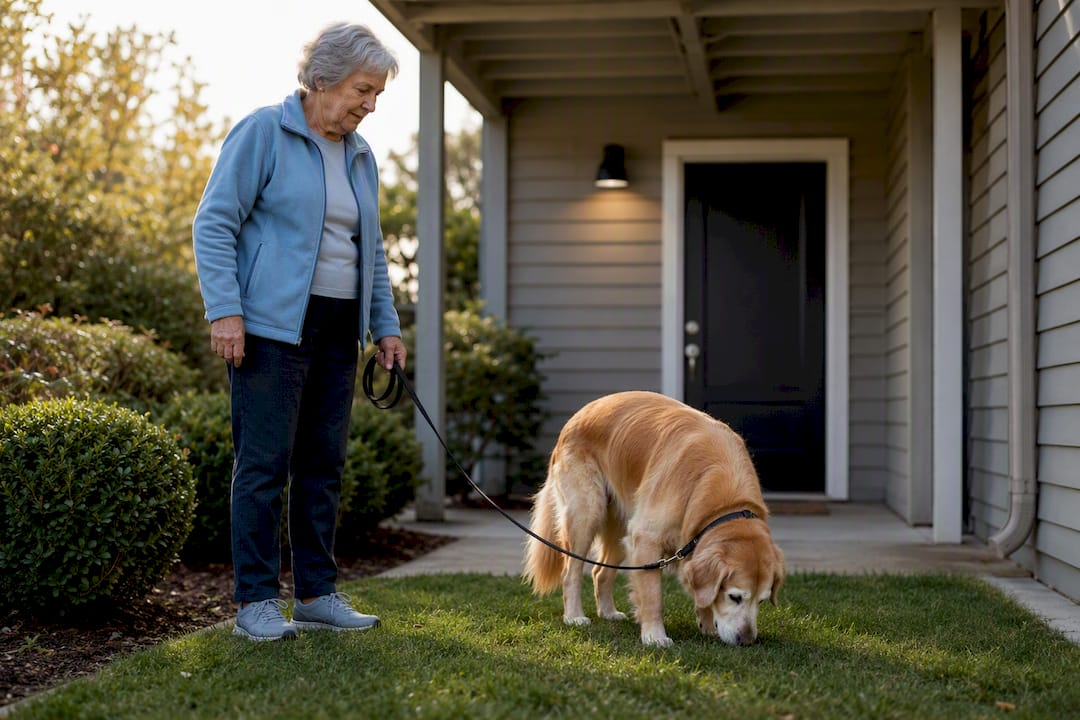
Reward immediately after elimination, not after the walk back inside. Timing here is as important as it is in the button training itself; a reward that lands ten seconds late teaches the dog less than one that lands within two or three. For nighttime trips, a small motion light near the designated area helps dogs orient quickly and reduces hesitation. Weather matters too: a covered spot or a mat under an overhang keeps the routine consistent even when it’s raining, so the dog doesn’t associate the signal with an unpleasant outdoor experience and start delaying presses.
Reading Your Dog’s Body Language Before the Signal Kicks In
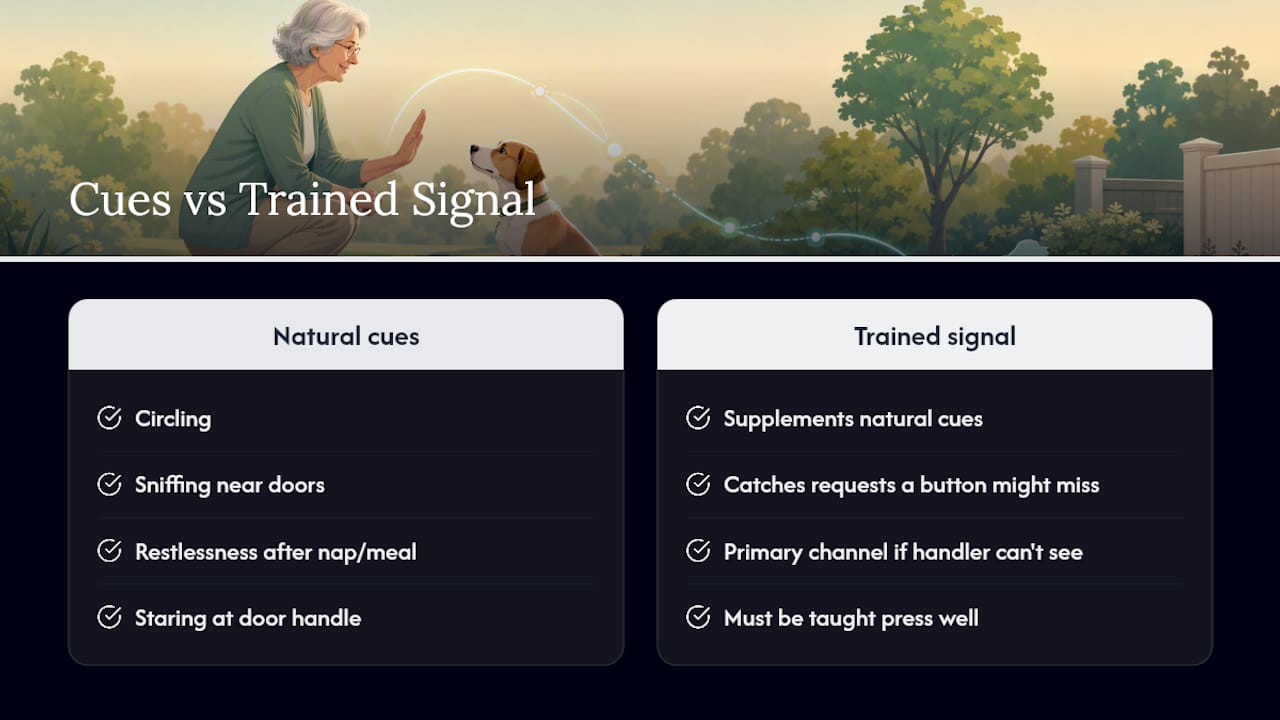
Device training doesn’t replace watching your dog. It supplements it, and the two working together catch requests that a single button might miss during the early weeks.
Circling, sniffing the floor near doors, and sudden restlessness after a nap or meal are classic early cues that predate most dogs’ formal signal use. Some dogs stand at the door and stare at the handle; others whine in a specific tone reserved for that need. Pacing between two rooms, one of which contains the exit, is another common tell.
For handlers who can’t always see these cues, such as someone with limited vision or a service-dog handler focused elsewhere, the trained signal becomes the primary channel rather than a backup. That’s precisely why teaching the press well matters more for this audience than for someone who can simply watch their dog’s ears and posture across the room. Recognizing both the natural cues and the trained signal gives you two overlapping systems instead of one, which is useful during the two to four weeks when the button behavior is still solidifying.
What Actually Matters Here
Most guides on this topic oversell the equipment and undersell the timing. A recordable button, a bell, or a shaped natural signal all work about equally well when the follow-through is consistent. What separates a dog that reliably alerts from one that gives up on the button within a month is almost always the five-second rule, not the hardware.
The conventional advice tends to focus on which product to buy first. That’s backward. The harder, more important discipline is training yourself to respond every single time, even when it’s inconvenient, because a handler who occasionally ignores a press teaches the dog that the signal is optional. For service-dog handlers and seniors especially, that inconsistency is the single biggest reason training stalls, not the dog’s intelligence or the button’s design.
If there’s one thing to prioritize first, it’s follow-through discipline before device choice. Get that right, and almost any reasonable signal method will eventually work.
— Andrew
A Device and Course Built Around This Exact Method
If you’d rather start with a purpose-built system than assemble bells and shaping plans on your own, the iPupPee device pairs a quiet, remote-alert button with the same shaping and modeling steps covered in this guide, and it’s built for service-dog teams, seniors, and anyone who needs a signal that doesn’t depend on being within earshot.
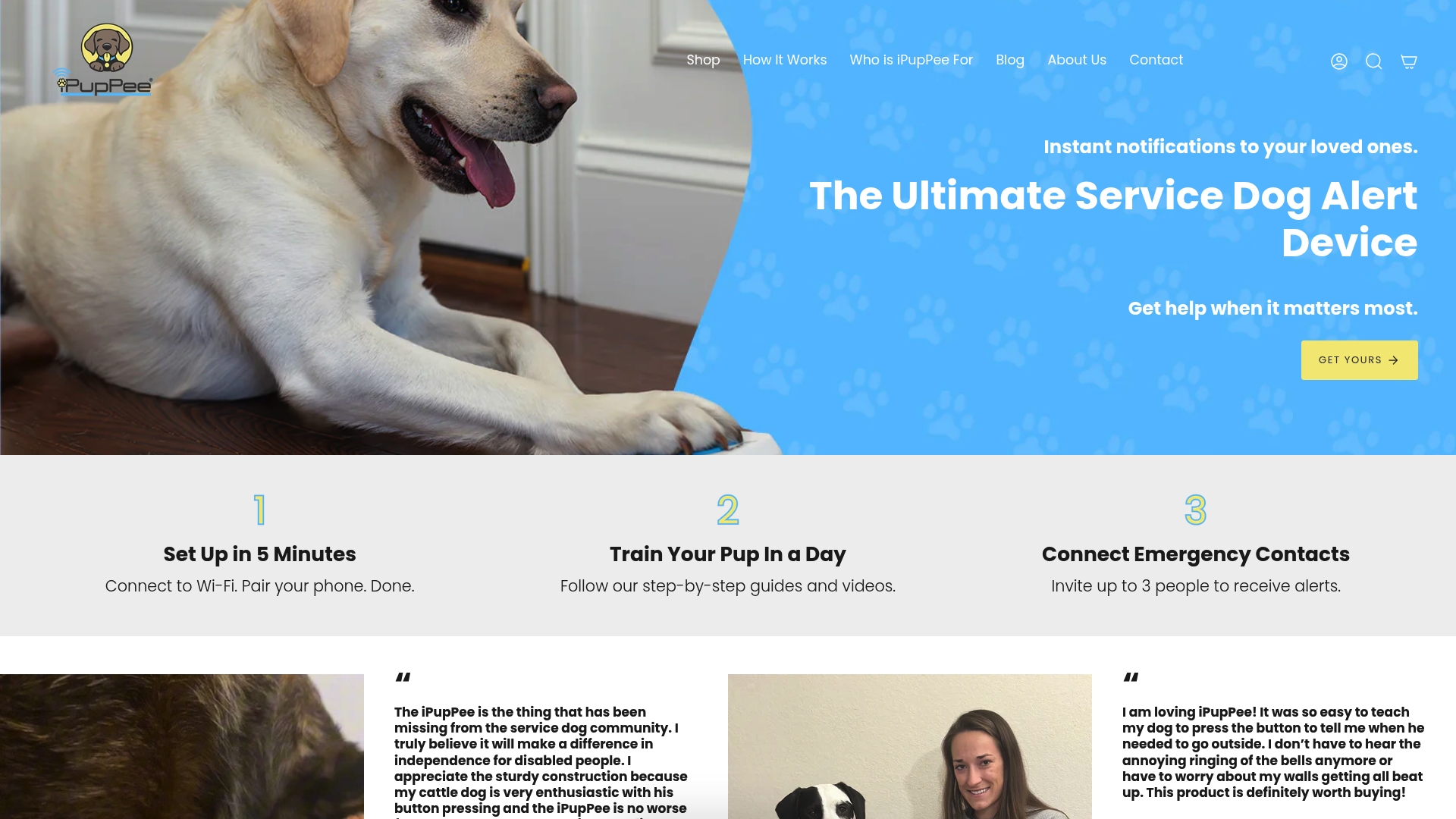
It suits handlers who want live video and two-way audio alerts sent directly to a phone, and it’s designed to work for dogs of various sizes without requiring a monthly subscription. For readers who want a guided, stepwise path rather than piecing methods together, the Psychology & Training Course walks through the same modeling, pairing, and proofing phases described above with video instruction built specifically around the device. Start with the product page to see setup details, or check the training course if you want structured lessons alongside the hardware.
Where This Guide’s Evidence Comes From
This article draws on practical training guides, a documented case narrative from the IAABC Foundation, and an experimental touchscreen alert study on assistance dogs.
For formal service-dog task certification, consult an accredited trainer rather than relying solely on self-guided methods.
Sources
- Pushing ALL My Buttons: Dogs Using Communication Buttons - IAABC Foundation Journal
- Teach your pup to ‘talk’ with dog buttons — Chewy
- Teach dog to alert outside — Devoted to Dog
- Dogs Using Touchscreens in the Home: A Case Study for Assistance Dogs Operating Emergency Notification Systems
- Fluent
FAQ
How Long Does It Take to Train a Dog to Signal?
Most dogs reach reliable use within two to four weeks of consistent daily practice, using short five to ten minute sessions. Seniors and handlers working at a slower pace may need a few extra weeks, but the same protocol still applies.
Should I Use Treats Every Time My Dog Presses the Button?
No, treats should fade once the press reliably leads to an outdoor trip. The functional outcome itself, the door opening and the chance to go outside, becomes the reward, and keeping food in the loop too long can muddy what the dog is actually communicating.
What Should I Do About False Button Presses?
Stop responding to presses that aren’t followed by real potty behavior outside, and consider temporarily removing the button if the pattern continues. Reintroduce it with tighter timing between the press and the door opening to recondition accuracy.
Can Service Dogs Use This for a Formal Task?
Communication buttons can absolutely support a signaling task, but formal certification for a service-dog task should go through an accredited trainer. This guide covers the foundational shaping and pairing methods; certification adds task-specific standards on top.
Is a Button Better Than a Bell for Seniors?
Recordable buttons tend to work better for seniors who may not hear a bell clearly from another room, since the sound level and word choice can be customized. Devices like iPupPee also add remote alert features, which give an extra layer of reliability beyond sound alone.