

The best thing about dogs is their steady, undemanding companionship, a bond that produces measurable effects on the body, not just warm feelings. That closeness lowers stress hormones within minutes, encourages daily movement, and buffers loneliness in ways few other relationships can match. The mechanisms behind it are specific: stress buffering through touch, increased physical activity, and social facilitation that pulls owners into contact with other people.
TL;DR:
- The health benefits of dogs depend heavily on attachment quality and the owner-dog relationship, not just ownership status or breed.
- Brief, calm contact with a dog can reduce cortisol levels and promote measurable hormonal shifts within just 10 minutes, providing immediate stress relief.
- Long-term studies show mixed results for health improvements, but daily routines like walks and petting sessions reliably boost owner activity and reduce stress.
- The physical advantages are influenced by breed temperament, with high-energy dogs encouraging more exercise and calmer breeds offering more consistent stress-buffering benefits.
- Advanced alert devices can enhance safety for vulnerable owners, but strengthening the emotional bond through training and routine maintains most health and well-being advantages.
Table of Contents
- What’s the Best Thing About Dogs? A Quick-Glance List
- The Science: How Dogs Affect the Body and Brain
- Companionship, Loneliness, and the Dog-Human Bond
- Practical Ways Dogs Deliver Value Every Day
- When Dogs Aren’t a Guaranteed Health Fix
- How to Support the Human-Dog Bond
- The Sense Dogs Have That You Don’t
- Can Dogs Actually Read Your Emotions?
- How Dogs Pull Communities Together
- Why Loyalty and Protection Still Matter to Owners
- Does the Breed You Choose Change the Benefits?
- A Ten-Minute Reset, Every Single Day
- Sources
- FAQ
What’s the Best Thing About Dogs? A Quick-Glance List
Ask a hundred dog owners what makes dogs great pets, and you will get a hundred slightly different answers. But the research keeps circling back to the same handful of benefits. Here is the short version, ranked roughly by how strong the evidence is behind each one.
- Steady companionship. Dogs offer a low-conflict presence that fills gaps in a person’s social world, especially for people living alone.
- Fast stress relief. Petting a familiar dog for just 10 minutes can meaningfully lower cortisol, the body’s primary stress hormone.
- Heart and activity benefits. Owners tend to walk more, and some large studies link ownership to better cardiovascular markers, though the picture is complicated (more on that below).
- Social facilitation. A dog on a leash is a built-in conversation starter, connecting owners to neighbors and other walkers.
- Assistance and service roles. Trained dogs help people manage physical disabilities, seizure alerts, and psychiatric conditions like PTSD.
- Routine and purpose. Feeding times, walks, and vet visits impose structure that can be grounding during hard stretches of life.
- Support across the lifespan. Kids raised with dogs often show gains in responsibility and empathy; older adults report less isolation.
- Emotional mirroring. Dogs respond to human emotional cues, which makes them feel less like pets and more like attentive partners.
The Science: How Dogs Affect the Body and Brain
The physiological story starts with two hormones: cortisol and oxytocin. Brief, calm contact with a dog you know well can reduce cortisol levels while nudging up oxytocin, the same bonding hormone involved in human parent-child attachment. That is not a metaphor. It is a measurable hormonal shift that happens after as little as 10 minutes of petting.
Statistic Callout: A 2019 analysis in Circulation: Cardiovascular Quality and Outcomes found dog owners had a 24% lower risk of death in unadjusted models. Once researchers controlled for other health and lifestyle factors, that benefit shrank substantially, a reminder that healthier, more active people may simply be more likely to own dogs in the first place.
That confounding problem shows up throughout the research on long-term ownership. A biopsychosocial review covering social, psychological, and physiological pathways found real benefits, but flagged mixed results across studies and stressed that relationship quality matters more than simply having a dog in the house.
- Controlled therapy-dog trials, run in clinical or lab settings, show consistent short-term drops in anxiety.
- Long-term ownership studies, run in the real world, show weaker and more inconsistent effects once confounders are accounted for.
- The gap between the two matters: a 20-minute session with a trained therapy dog is a different exposure than living with a dog for a decade.
Dogs also function as what Harvard researchers call “mindfulness instructors.” Their attention lives entirely in the present moment, and that pulls owners out of anxious loops about the past or future.
Companionship, Loneliness, and the Dog-Human Bond
Loneliness is a public health problem, and dogs address a piece of it directly. Multiple studies tie dog ownership and even brief dog contact to reduced loneliness and more incidental social contact throughout the day, whether that’s a chat with a neighbor during a walk or eye contact with a stranger at the dog park.
What makes the dog-human bond unusual is not just frequency of contact. It is the quality of it.
- Dogs offer consistent, low-conflict affection without the friction that comes with human relationships.
- A 2025 survey reported in The Guardian found many owners rated their relationship with their dog as more satisfying than their relationship with their closest human friend.
- Dogs read human gestures and emotional signals, creating what Harvard describes as a bi-directional feedback loop built over thousands of years of co-evolution.
None of this means dogs replace human relationships or fix loneliness on their own. The strongest evidence comes from controlled animal-assisted intervention (AAI) trials and specific populations, such as older adults living alone or people recovering from trauma, while broader population surveys show more mixed effects.
Practical Ways Dogs Deliver Value Every Day
The benefits above are not abstract. They show up in small, repeatable moments that anyone with a dog can build into a routine.
- Take the walk, even the short one. Daily walks are the single most reliable way dogs increase owner activity, and the effect compounds over weeks, not just one outing.
- Schedule deliberate petting breaks. A quiet 10-minute session with your dog during a stressful afternoon can measurably lower cortisol, turning a habit into a stress-management tool.
- Look at service and therapy roles. Trained service dogs assist with everything from mobility to PTSD symptom management, combining task-based help with emotional steadiness, though outcomes depend heavily on training quality and fit between dog and handler.
- Volunteer with a therapy dog program. If you don’t own a dog, structured time with a trained therapy animal produces short-term anxiety relief in controlled settings, per Scientific American’s review of the evidence.
- Build the routine into your day, not around it. Owners who fold walks and feeding into fixed times report more consistency and, over time, better overall well-being.
Pro Tip: Pick one consistent time each day for a calm, no-agenda petting session. The physiological benefit comes from the calm, focused contact itself, not from how long the session lasts.
When Dogs Aren’t a Guaranteed Health Fix
Dogs are not a prescription. The biopsychosocial review makes a point worth repeating: attachment quality explains more of the variation in health outcomes than ownership status alone. A dog you resent walking or can’t afford to feed properly will not deliver the same benefits as one you’re securely bonded with.
Real costs come with the relationship:
- Financial strain from food, vet care, and unexpected emergencies.
- Time pressure, especially for high-energy breeds that need more than a quick walk.
- Compatibility mismatches, where a dog’s temperament clashes with a household’s lifestyle.
- Grief, since the bond that provides so much support also means eventual loss.
Mitigate these by choosing a dog whose energy and needs match your actual life, not your aspirational one, and by building in support (dog walkers, training help, pet insurance) before problems pile up. Benefits vary by person, by dog, and by how well the two fit together.
How to Support the Human-Dog Bond
Some devices focus on the mechanics of that bond: communication and safety. Advanced alert devices may let a dog send a direct alert, complete with live video and two-way audio, to an owner or emergency contact at the press of a button, designed to assist service dog teams, seniors, and people living alone who need a reliable way for their dog to reach them.
Strengthening attachment quality, the factor the research keeps pointing to, takes more than a device. A few resources worth reading if you want to go deeper:
- How to bond with dogs for proven ways to build a lasting connection.
- Dog training and emotional benefits for how structured training deepens attachment.
- How dogs reduce anxiety for a closer look at the evidence behind everyday anxiety relief.
The Sense Dogs Have That You Don’t
A dog’s nose is doing something your brain simply cannot replicate. Dogs have roughly 300 million scent receptors compared to a human’s 6 million, and the part of their brain devoted to processing smell is proportionally far larger than ours. That sensitivity is why trained dogs can detect certain medical conditions, from blood sugar swings to some seizure patterns, before visible symptoms appear, and why service dogs alert handlers to danger long before a human would notice anything.
Hearing works the same way. Dogs pick up frequencies far beyond human range and can localize a sound’s source faster than a person can turn their head. That combination of smell and hearing is part of why service dogs function as an early-warning system for people with certain medical conditions or safety risks, catching what human senses miss entirely.
For everyday owners, this sensory gap explains behaviors that otherwise seem mysterious. A dog perking up before a thunderstorm, alerting to a visitor minutes before the doorbell rings, or reacting to a change in an owner’s scent during a stress spike or illness. None of that is a sixth sense. It is ordinary canine biology operating at a scale humans can’t access, and it’s one more concrete way the human-dog relationship offers something a human friendship simply cannot.
Can Dogs Actually Read Your Emotions?
Dogs pick up on human emotional cues with more precision than most people expect. They track facial expressions, body posture, tone of voice, and even the scent changes tied to stress and fear. That is not projection from doting owners. It is a documented feature of the bi-directional feedback loop that Harvard researchers describe as central to how dogs and humans co-evolved as social partners.
This emotional attunement is part of why dogs feel like they “understand” a bad day. A dog that leans against your legs after you raise your voice, or goes quiet when you cry, is reading real signals, not performing on cue. Communication runs both directions. Dogs use posture, tail position, ear movement, and vocalization to signal their own emotional state, and owners who learn to read those signals accurately report stronger, more satisfying relationships with their dogs.

That two-way fluency is precisely why some owners describe their dog relationship as calmer and more dependable than some human friendships. It is not that dogs understand language. It’s that they read nonverbal emotional signals constantly and respond with consistent, low-conflict warmth, exactly the trait that shows up in survey data on relationship satisfaction.
For owners, the practical takeaway is that emotional communication with a dog improves with attention, not just time together. Learning your dog’s specific signals, and being consistent in how you respond, builds the kind of mutual understanding that makes the bond feel less like pet ownership and more like a genuine relationship.
How Dogs Pull Communities Together
Dog parks, sidewalks, and neighborhood walking routes function as informal social infrastructure, and dogs are the reason strangers talk to each other there. A leash gives people permission to start a conversation they’d otherwise skip, and that small opening adds up over time into real neighborhood familiarity.
This effect shows up most clearly in places where people might otherwise stay isolated. Older adults walking dogs report more daily social contact than non-dog-walking peers. New residents in a neighborhood often meet more people through dog walks in a few months than through any other single routine. Dog owners frequently form loose but reliable community networks, everything from group walks to shared recommendations for vets and sitters, built entirely around the shared experience of dog ownership.
None of this requires effort beyond the daily walk you’re already taking. The social benefit is a byproduct of a routine that exists for the dog’s sake, which may be exactly why it works. It doesn’t feel like networking, so people do it consistently, and consistency is what actually builds community ties over months and years.
Why Loyalty and Protection Still Matter to Owners
Ask owners what they value most about their dogs, and loyalty and a sense of protection come up constantly, and for good reason. Dogs form strong attachments to their households and often display protective behavior, alertness to unfamiliar visitors, positioning themselves between a perceived threat and their owner, that owners interpret, correctly, as a sign of the bond’s depth.
This protective instinct is not just emotional reassurance. For people living alone, especially seniors and individuals with disabilities, a dog’s heightened awareness of the environment functions as an early warning system, whether that’s alerting to an intruder, noticing a medical change, or simply signaling when something in the home is wrong. That instinct is also the foundation service dogs are trained to build on, channeling natural alertness into specific, reliable tasks like alerting a handler to a medical event before it becomes dangerous.
Loyalty, in the dog sense, is really consistency: showing up the same way every day regardless of a person’s mood, appearance, or circumstances. That reliability is rare in any relationship, human or otherwise, and it’s a large part of why the bond feels different from other forms of companionship.
Does the Breed You Choose Change the Benefits?
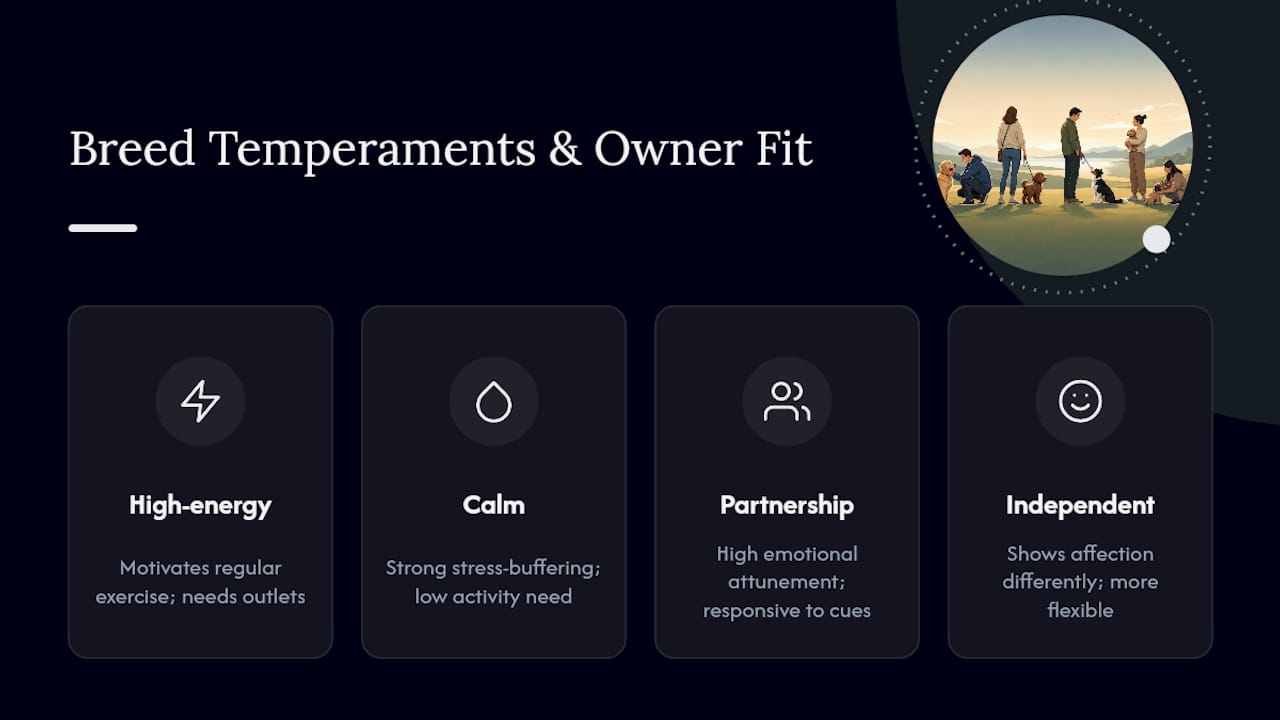
Yes, and this is one of the more overlooked pieces of the puzzle. Temperament and breed background shape how a dog delivers its benefits, even if the underlying mechanisms (stress buffering, activity, social facilitation) stay the same across dogs generally.
High-energy working breeds tend to push owners into more consistent physical activity, since a bored Border Collie or Australian Shepherd will make that need known. Calmer, lower-energy breeds may offer more of the stress-buffering, mindfulness-instructor benefit described earlier without demanding as much physical output from their owners. Breeds bred for close human partnership, retrievers, many herding breeds, tend to show the strongest emotional attunement and responsiveness to human cues, while independent breeds may express affection differently without it being any less real.
None of this means one temperament is objectively better. It means the benefit profile shifts depending on fit. A high-anxiety owner might get more from a steady, low-key dog. Someone needing motivation to exercise might benefit more from an energetic one. Matching temperament to lifestyle, rather than picking a breed for looks alone, is what determines whether a dog’s natural traits translate into real benefit or into daily friction.
A Ten-Minute Reset, Every Single Day
There’s a version of this that plays out in a lot of households: a rough day, a door opening, and a dog that doesn’t ask what happened, just leans in. That ten minutes of quiet contact does something real to your stress hormones, not just your mood. It’s a small, repeatable act, and it’s available every single day without requiring anything more from the dog than being present.
That’s the piece the research keeps circling back to. The benefit isn’t abstract affection. It’s a specific, physiological reset that a dog offers reliably, whether or not you’re having a good day.
— Andrew
Sources
- 10 Science-Based Benefits of Having a Dog — American Kennel Club
- Association of Pet Ownership With Cardiovascular Outcomes — Circulation: Cardiovascular Quality and Outcomes
- Dogs supporting human health and well-being: a biopsychosocial approach — PMC
- Why we love dogs — and they love us back — Harvard Gazette
- Can Dogs, Cats and Other Pets Truly Improve Your Health? — Scientific American
FAQ
What Is the Best Thing About Dogs?
The best thing about dogs is their reliable, low-conflict companionship, which produces real physiological effects, including lower cortisol after brief petting and reduced loneliness through daily social contact.
What Are Good Facts About Dogs?
Dogs have vastly more scent receptors than humans, hear frequencies well outside human range, and read human emotional cues closely enough to adjust their own behavior in response. They also form attachments strong enough that many owners rate the relationship as more satisfying than a close human friendship, according to a 2025 survey.
What Is So Great About Dogs, Scientifically Speaking?
Scientifically, dogs offer a rare combination: measurable stress reduction from brief contact, increased physical activity through daily walks, and social facilitation that connects owners to their communities. A biopsychosocial review found these benefits work through multiple overlapping pathways rather than one single mechanism.
What Are Some Unique and Interesting Qualities About Dogs?
Dogs communicate emotional states through posture, ears, and vocalization, and they read human emotional cues with real precision rather than simple conditioning. They also function differently depending on breed and temperament, with high-energy breeds pushing owners toward more activity and calmer breeds offering more of the stress-buffering, mindfulness effect described by Harvard researchers.
Do the Benefits of Dogs Depend on the Individual Dog?
Yes. Research consistently shows that attachment quality, not simply owning a dog, drives most of the health and emotional benefit, meaning a mismatched or strained relationship delivers far less than a secure, well-fitted one.