

TL;DR:
- Dog boundary training teaches dogs to respect physical and invisible limits through consistent cues and positive reinforcement. Owners must use the right tools, maintain household consistency, and reinforce boundaries regularly to achieve lasting results. Proper training builds trust and gives dogs more freedom, reducing anxiety and dangerous behaviors.
Dog boundary training is the practice of teaching your dog clear, consistent limits that define where they can go and what they can do. Done right, it reduces anxiety, prevents dangerous behavior, and builds a stronger bond between you and your dog. The good news: you do not need to be a professional trainer to make it work. Learning how to teach dogs boundaries comes down to the right tools, consistent cues, and a patient, positive approach that every member of your household can follow.
What tools do you need before starting boundary training?
Preparation matters more than most owners realize. Walking into a training session without the right equipment leads to confusion for your dog and frustration for you.
Leash and physical control
Start with a 15-to-20-foot leash for initial indoor boundary training sessions. That length gives your dog enough room to move and explore while keeping you in control when they approach a restricted area. A standard 6-foot leash is too short for this work. It limits movement and prevents your dog from making the choice to stop at a boundary on their own.
Visual markers and barriers
Indoors, baby gates and exercise pens create physical boundaries your dog can see and feel. Outdoors, use small training flags spaced every 8 to 10 feet as visual markers along the boundary line. These flags condition your dog to stop at a visual cue before any correction is needed. They reduce stress and build confidence during the learning phase.
Rewards and resting areas
High-value treats, a clicker, and a designated mat or dog bed are non-negotiable. The mat gives your dog an approved alternative space, which makes it easier for them to understand what “stay here” actually means.
Pro Tip: Pick one verbal cue for each boundary command before you start. Write them down and share them with every person in your household. Switching between “off,” “no,” and “stay back” teaches your dog nothing.
Here is a quick reference for the core tools you need:
| Tool | Purpose |
|---|---|
| 15-to-20-foot leash | Maintains control during threshold training |
| Training flags (8–10 ft apart) | Visual outdoor boundary markers |
| Baby gates or exercise pens | Physical indoor barriers |
| High-value treats and clicker | Positive reinforcement for correct behavior |
| Dog bed or mat | Designated approved resting zone |
How to teach dogs boundaries indoors and outdoors
Teaching dogs limits works best when you build from simple, controlled environments before adding complexity and distraction.
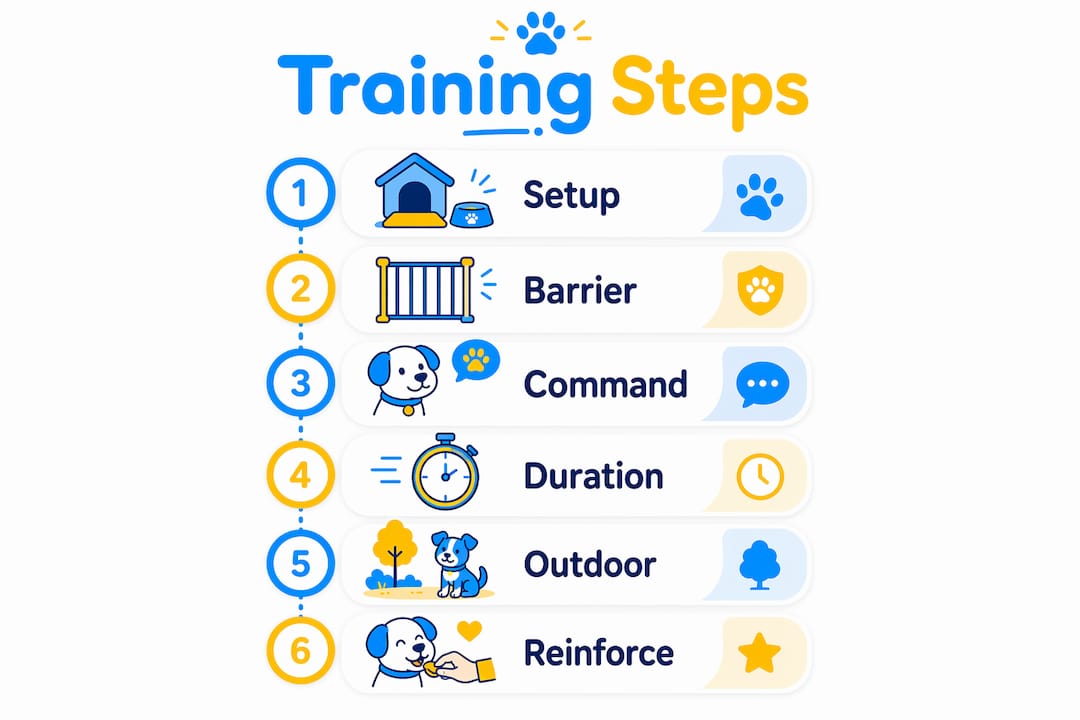
Step 1: Start indoors with physical barriers
Place a baby gate at the entrance to a restricted room, like the kitchen or home office. Walk your dog toward the gate on the long leash. The moment they stop at the gate without crossing, say your chosen command, such as “place” or “wait,” and reward immediately. Repeat this 10 to 15 times per session. The goal is for your dog to associate stopping at the barrier with something good happening.
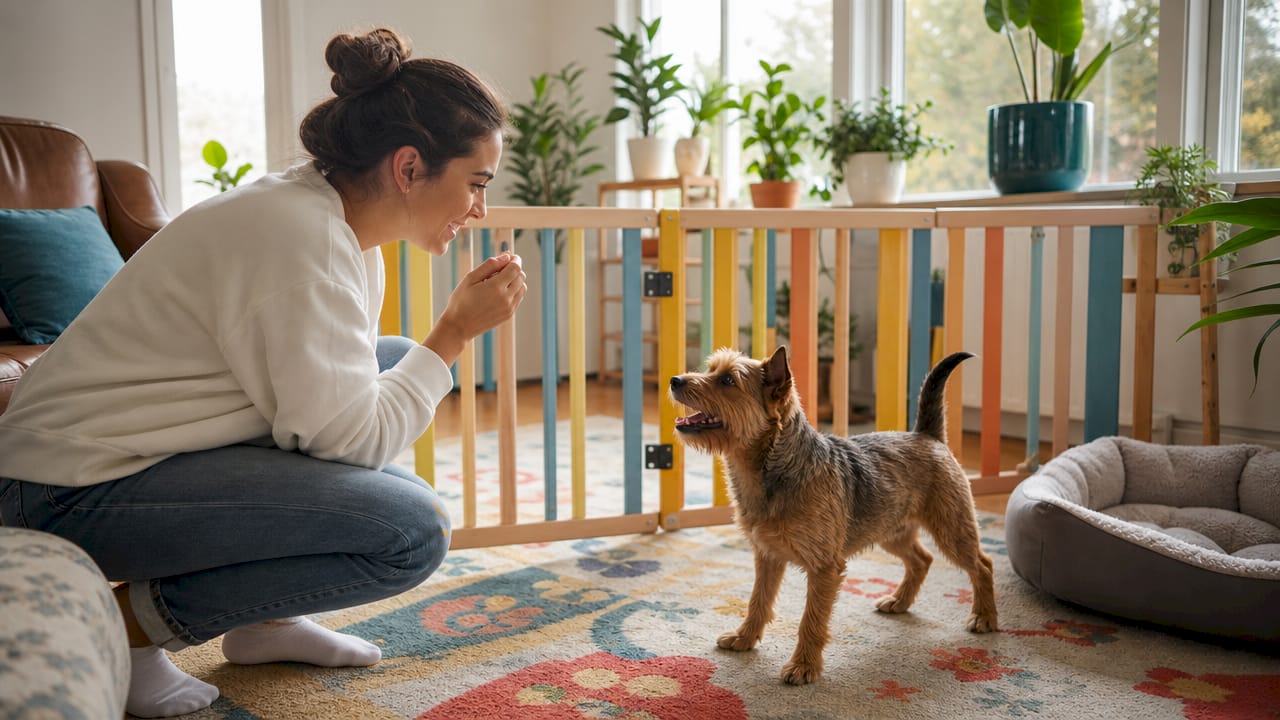
Step 2: Introduce verbal commands without the barrier
Once your dog reliably stops at the gate, remove it for a session. Use your verbal cue and hand signal at the same spot. Reward every correct stop. If your dog crosses the line, calmly guide them back without scolding, then reward when they return to the correct side. Returning the dog calmly and rewarding correct behavior is more effective than any form of punishment.
Step 3: Increase duration and distraction
Ask your dog to hold the boundary for longer periods before rewarding. Add mild distractions, like tossing a toy near the boundary line. Practice in different rooms. The AKC recommends dogs show reliable boundary respect for at least six months before you consider indoor training complete.
Step 4: Move to outdoor boundary training
Set up training flags along your yard’s boundary line, spaced 8 to 10 feet apart. Walk your dog along the flag line on the long leash. When they approach a flag, use your verbal cue and reward them for stopping. Clicker training works especially well here because the click marks the exact moment your dog makes the right choice.
- Walk the full boundary line daily for the first two weeks
- Reward every correct stop at a flag
- Gradually reduce treat frequency as the behavior becomes reliable
- Run short supervised off-leash sessions only after your dog consistently respects the flags on leash
Pro Tip: Use a clicker to mark the precise moment your dog stops at a flag. The timing of the click matters more than the treat itself. A delayed reward teaches the wrong lesson.
How to reinforce safe boundaries for dogs over time
Boundary training is not a one-time event. Many owners train well for the first month and then stop reinforcing, which leads to regression. Maintenance is what separates a dog that respects limits reliably from one that tests them constantly.
Consistency across all family members
Using exactly the same verbal cues and hand signals across every person in the household is the single most important factor in long-term success. If one person enforces the kitchen boundary and another lets the dog wander freely, your dog learns that the boundary is optional. Hold a brief household meeting and agree on every command before training begins. Resources like Ipuppee’s guide on teaching dog commands can help your whole family get on the same page.
Monthly refresher sessions
Run a dedicated boundary check once a month. Walk your dog through every boundary, reward correct stops, and replace any worn or missing outdoor flags. Environmental changes, like new furniture, a new pet, or a move, can trigger boundary testing even in well-trained dogs.
Handling boundary testing calmly
Boundary testing is normal learning behavior, not defiance. Dogs explore limits repeatedly to confirm they are real. Calm, consistent enforcement builds long-term security.
When your dog crosses a boundary, guide them back quietly and reward the return. Raising your voice or using physical correction creates anxiety, which makes testing worse, not better.
Pro Tip: Keep a training log for the first three months. Note which boundaries your dog tests most often. Patterns tell you where to focus your refresher sessions.
Common challenges in dog boundary training and how to fix them
Even well-planned training hits obstacles. Knowing what to expect makes the difference between giving up and pushing through.
- Inconsistency between household members. This is the most common failure point. One person’s lax enforcement undoes weeks of work. Assign one person to lead training sessions and brief everyone else on the exact commands in use.
- Dogs who test boundaries frequently. Frequent testing signals that the boundary is not yet fully understood, not that your dog is stubborn. Increase session frequency and reduce the difficulty level temporarily.
- Mixed signals from different commands. Using “off,” “no,” “stay,” and “back” interchangeably confuses your dog. Pick one command per boundary and use it every time. Ipuppee’s dog signal training guide covers how to pair verbal cues with hand signals for clearer communication.
- High distraction environments. A dog that respects the kitchen boundary when the house is quiet may fail when guests arrive. Practice boundary training during mild distractions first, then gradually increase the level of excitement before expecting reliable behavior in high-energy situations.
- Anxiety instead of confidence. If your dog shows stress signs like panting, pacing, or cowering near a boundary, the training is moving too fast. Back up to the previous step and build success at a lower difficulty level. Early boundary setting from puppyhood prevents this anxiety from developing in the first place.
Pro Tip: If your dog breaks a boundary during a distraction, do not repeat the command louder. Lower the distraction level at the next session and rebuild from there. Repetition at the right difficulty beats volume every time.
Key takeaways
Consistent, positive boundary training gives dogs the structure they need to feel secure and behave reliably at home and outdoors.
| Point | Details |
|---|---|
| Start with the right tools | Use a 15-to-20-foot leash, training flags, and high-value treats before your first session. |
| Build indoors before outdoors | Master threshold commands inside before moving to flag-based outdoor boundary work. |
| Consistency across the household | Every family member must use the same verbal cues and hand signals every time. |
| Treat testing as learning | Respond to boundary testing with calm guidance and rewards, never punishment. |
| Maintain with monthly refreshers | Run boundary checks monthly and replace worn flags to prevent long-term regression. |
What I have learned from years of watching owners train boundaries
Andrew here. The biggest mistake I see is owners treating boundary training like a switch they flip once and forget. They put in two solid weeks, the dog looks great, and they stop. Six weeks later the dog is back on the couch and wandering into the kitchen at will.
The owners who get lasting results treat boundaries the same way they treat any relationship habit. They check in regularly. They stay consistent even when it is inconvenient. They do not let one bad day become a new normal.
The other thing I have noticed is that boundaries actually give dogs more freedom, not less. A dog that understands its limits is a dog you can trust off-leash in the yard. A dog without limits is a dog you keep on a short leash forever. That trade-off is worth every minute of training.
My honest recommendation: start the day you bring your dog home. Early habits are far easier to build than bad ones are to break. And if you are starting with an adult dog, be patient. It takes longer, but it works.
— Andrew
Ipuppee resources for better dog training at home
Building clear boundaries is one piece of a larger communication system between you and your dog. Ipuppee offers practical training guides, tips on dog communication, and resources designed to help owners at every experience level.
Whether you are working with a new puppy, a rescue dog, or a service animal, Ipuppee’s blog covers the training steps that make daily life safer and more connected. From improving dog behavior at home to understanding how communication devices support independence for owners with special needs, the site brings together practical tools and expert guidance in one place. Visit Ipuppee to find the resources that fit your training goals.
FAQ
What is dog boundary training?
Dog boundary training teaches your dog to stop at defined physical or invisible lines using consistent verbal cues, visual markers, and positive reinforcement. The goal is reliable behavior without constant supervision.
How long does it take to teach a dog boundaries?
Most dogs show reliable boundary respect after several weeks of consistent daily practice. The AKC recommends maintaining training for at least six months before considering the behavior fully established.
What commands work best for boundary training?
Single, clear commands like “place,” “wait,” or “leave it” work best. The key is choosing one command per boundary and using it the same way every time across all household members.
Should I punish my dog for crossing a boundary?
No. Calmly guide your dog back to the correct side and reward the return. Punishment creates anxiety and makes boundary testing worse over time.
Can I teach an adult dog boundaries?
Yes. Adult dogs take longer to learn new limits than puppies, but the same methods apply. Start with physical barriers, use consistent cues, and run short daily sessions to build reliable behavior gradually.