

Dog training is the process of teaching a dog to perform specific behaviors on cue and to respond predictably to its environment, using consistent consequences to strengthen or weaken those behaviors. The goal is behavior change, not obedience for its own sake. The bottom line: peer-reviewed research and the field’s leading behavior organizations agree that reward-based, positive-reinforcement methods produce reliable results with far less risk to a dog’s welfare than punishment-heavy approaches.
TL;DR:
- Reward-based training methods are proven to produce reliable results with less risk to a dog’s welfare compared to aversive techniques.
- Proper timing and consistency are critical, as behaviors must be reinforced or corrected immediately after the action occurs to be effective.
- Basic commands like recall and “leave it” are the most important safety behaviors to teach early in training.
- Using environmental management tools, such as barriers, can prevent unwanted behaviors and support training efforts more effectively than corrections.
- Professional help is necessary when dealing with aggression, severe fear, or bite history, with certified behaviorists more equipped for complex cases.
Table of Contents
- Definition and Scope of Dog Training
- How Do Dogs Actually Learn New Behaviors?
- Which Dog Training Methods Actually Work Best?
- What Are the Core Dog Training Techniques?
- Which Commands Should You Teach First?
- When Should You Hire a Professional Dog Trainer?
- The Everyday Principles That Make Training Stick
- How Ipuppee Supports Dog Owners Through Training
- Common Misconceptions About Dog Training
- An Editorial Take: Why the Simplest Definition Still Confuses People
- A Safety Layer That Works Alongside Training
- Sources
Definition and Scope of Dog Training
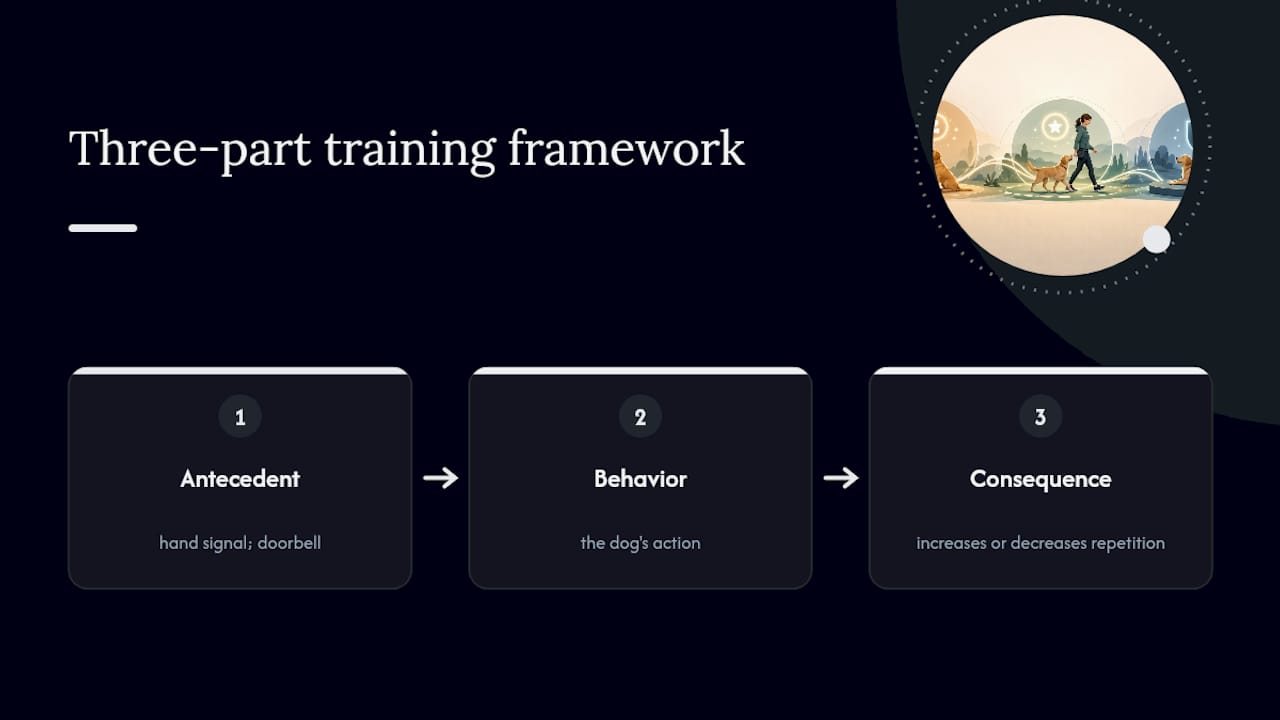
Behavior scientists describe training with a simple three-part framework: antecedent, behavior, consequence. An antecedent is whatever comes before the behavior, like a hand signal or a doorbell ringing. The behavior is the action the dog takes. The consequence is what happens right after, and that consequence determines whether the behavior happens more or less often in the future. Once you see training through this lens, a lot of confusing dog behavior stops being confusing. A dog that jumps on guests isn’t being “dominant.” It jumped once, got attention (a consequence), and the behavior stuck.
That framework covers a wider range of activities than most people assume. Dog training includes basic household manners like not counter-surfing, sport disciplines like agility and rally, working and service tasks such as alerting to a medical event or retrieving dropped items, and formal behavior modification for issues like resource guarding or noise phobia. Socialization, the process of exposing a puppy to new people, animals, sounds, and surfaces, also falls under this umbrella even though it looks nothing like teaching “sit.”
Where training actually happens varies just as much. Some owners work entirely at home with five-minute sessions before meals. Others enroll in group obedience classes, which the AKC recommends pairing with regular home practice for puppies and adult dogs alike. Service dog programs run formal, multi-month curricula with task-specific benchmarks, while shelter and rescue organizations often need to address fear or trauma-driven behaviors before any obedience work can begin.
Formal dog training as a discipline is younger than most people think. Military and police dog programs in the early 20th century relied heavily on compulsion and correction. It wasn’t until the mid-to-late 1900s, as operant conditioning research from psychology labs moved into animal training, that reward-based methods started replacing choke-chain-and-correction models as the default approach. That shift is still happening in some corners of the training world, which is part of why so much conflicting advice exists online.
Understanding dog training, in other words, isn’t just about memorizing commands. It’s about understanding the mechanism connecting a dog’s environment, its actions, and what follows those actions. Everything else in this article builds on that mechanism.
How Do Dogs Actually Learn New Behaviors?
Dogs learn through a handful of well-documented processes, and knowing which one is at work changes how you should respond to a given situation.
Classical conditioning pairs two things that happen close together in time until the dog responds to one as if it were the other. The textbook example is Pavlov’s dogs salivating at a bell because the bell had been paired with food. In a living room, this looks like a dog getting excited the instant you touch the leash hook by the door, long before you’ve said a word. The leash predicts the walk, so the leash itself now triggers the excitement.
Operant conditioning works differently. It’s about consequences following a voluntary behavior, and it breaks into four “quadrants” based on whether something is added or removed, and whether it increases or decreases the behavior:
- Positive reinforcement: adding something the dog wants after a behavior, which increases that behavior (treat after “sit”).
- Negative reinforcement: removing something unpleasant after a behavior, which increases that behavior (releasing leash pressure once the dog stops pulling).
- Positive punishment: adding something unpleasant after a behavior, which decreases that behavior (a leash jerk for jumping).
- Negative punishment: removing something the dog wants after a behavior, which decreases that behavior (turning away and ending play when a puppy bites too hard).
The word “positive” and “negative” here mean “added” and “removed,” not “good” and “bad,” which trips up a lot of new owners.
Beyond those four quadrants, a few other learning types matter in daily practice. Shaping breaks a complex behavior into small pieces and rewards each step toward the final goal, useful for anything a dog can’t do in one leap, like a full spin or a nose-to-hand touch from a distance. Extinction is what happens when a previously reinforced behavior stops earning its reward and gradually fades, though it often gets briefly worse before it improves (the “extinction burst”). Habituation is simply a dog getting used to a repeated, harmless stimulus, like the vacuum cleaner, through nothing more than exposure over time. Observational learning lets some dogs pick up cues by watching another dog perform a behavior and get reinforced for it, though this is less reliable in dogs than in social species like primates.
None of these mechanisms work well without tight timing. A reward or correction delivered more than a couple of seconds after the behavior teaches the dog almost nothing about that behavior. It teaches the dog about whatever it happened to be doing when the consequence landed, which is usually not what you intended. Consistency matters just as much. If “off” sometimes means get off the couch and sometimes gets ignored, the cue loses its meaning, and the dog has to guess.
Which Dog Training Methods Actually Work Best?
Training methods generally fall into three camps: reward-based, mixed (sometimes called “balanced”), and aversive. The distinctions matter more than most marketing around dog training methods lets on.
Reward-based training relies almost entirely on positive reinforcement and negative reinforcement built around removing mild pressure, never pain or fear. Clicker and marker training, luring, and shaping all live in this category. The dog earns something it wants for the right behavior, and unwanted behavior is addressed by preventing it, redirecting it, or simply not reinforcing it.
Mixed approaches combine reward-based methods with occasional corrections, often justified as “balanced” training. Aversive approaches lean primarily on punishment and negative reinforcement through pain, startle, or discomfort, using tools like choke chains, prong collars, or shock collars.
The American Veterinary Society of Animal Behavior has taken a clear position here: it recommends reward-based methods for all dog training and specifically advises against aversive techniques because of the welfare risks involved.
AVSAB position statement: Reward-based methods should be used for all training, and aversive techniques should be avoided due to the risk of physical and psychological harm to the animal.
That recommendation isn’t just a preference. A large-scale study of companion dogs found that dogs trained with aversive stimuli showed more stress behaviors during training, elevated cortisol afterward, and more pessimistic results on cognitive-bias testing (a measure researchers use to gauge an animal’s underlying emotional state) compared with dogs trained using reward-based or mixed methods. Stress during training doesn’t just feel unpleasant for the dog in the moment. It can spill into the human-animal relationship, making a dog warier of the owner overall.
The efficacy argument for aversive tools mostly falls apart under scrutiny, too. The same research base shows reward-based techniques hold up well for demanding tasks, including scent detection and service-dog work, and several comparative studies suggest reward methods perform at least as well as aversive ones across a wide range of goals. In practice, that means:
- Choke chains and prong collars solve leash pulling by making pulling painful, not by teaching an alternative behavior.
- Shock collars can suppress a behavior quickly, but suppression isn’t the same as learning what to do instead.
- Reward-based programs take slightly longer to show results in some cases, but they build a dog that offers behaviors voluntarily instead of one that avoids punishment.
If you’re choosing a method, the practical takeaway is straightforward: reward-based training carries lower welfare risk, comparable or better outcomes across most tasks, and a documented professional consensus behind it. That’s not a small thing to have on your side when you’re the one making decisions for an animal that can’t opt out of the plan.
What Are the Core Dog Training Techniques?
Four techniques show up constantly in reward-based programs, and each one solves a slightly different problem.
-
Clicker or marker training. Pick a distinct sound, a click or a short verbal word like “yes,” and pair it with a treat delivered within one to two seconds. The click marks the exact instant the dog did something right, which matters because your hands are often too slow or too imprecise to communicate that on their own. Over a few dozen repetitions, the dog learns the click itself predicts a reward, and you can use it to pinpoint behaviors from across a room.
-
Shaping and chaining. Shaping rewards small steps toward a final behavior. Teaching a dog to go to a mat might start with rewarding a glance toward the mat, then a step toward it, then all four paws on it, then a lie-down on it. Chaining links several trained behaviors into one sequence, like a formal retrieve that includes running out, picking up an object, returning, and dropping it in hand.
-
Luring. A lure uses a treat or toy to physically guide the dog into a position, like tracing a treat over the dog’s head to prompt a sit. Luring gets fast initial results but needs to be faded quickly, or the dog ends up only responding to a visible treat instead of a cue. Shaping takes longer to teach but tends to produce a behavior the dog offers more independently, since the dog worked it out itself rather than being physically guided into it.
-
Desensitization and counterconditioning. This pairing addresses fear and reactivity rather than teaching new commands. Desensitization exposes the dog to a trigger, like a doorbell, at an intensity too low to provoke a fear response, then very gradually increases that intensity. Counterconditioning pairs that same low-intensity trigger with something the dog loves, changing the emotional association. A dog afraid of the vet’s office might start by simply walking into the parking lot and getting fed high-value treats, with no exam involved at all, repeated over several visits before ever setting foot inside.
Pro Tip: Keep your marker sound completely separate from anything you say in daily life. If you use “yes” as a marker but also say “yes” casually while talking to your dog, you’ll dilute its meaning fast. A clicker avoids that problem entirely.
Which Commands Should You Teach First?
Not every command deserves equal priority. Two behaviors matter more than the rest combined: recall and “leave it.” Both are safety commands. A dog that reliably comes when called won’t bolt into traffic chasing a squirrel. A dog that reliably drops interest in something on cue won’t swallow a dropped medication or a piece of trash on a trail.
A practical learning sequence for a new dog or puppy generally looks like this:
- Attention/name recognition first, since every other cue depends on the dog checking in with you.
- Sit and stay, which build impulse control and a default calm position.
- Recall, practiced heavily in low-distraction settings before ever testing it around distractions.
- Leave it, taught initially with a low-value item under your foot or hand before progressing to tempting objects.
- Leash manners, which tend to improve fastest once the other basics are solid, since a dog that already understands reinforcement patterns generalizes leash skills faster.
Puppies benefit from starting socialization and light training as early as seven or eight weeks old, while their critical socialization window (roughly through 12 to 16 weeks) is still open. That window is when exposure to new people, sounds, surfaces, and other animals has the biggest long-term payoff for a confident adult temperament. Adult dogs and rescues can absolutely learn the same skills; it just may take longer to undo existing habits or address fear-based associations, and a dog with an unknown history sometimes needs a slower introduction to new experiences than a young puppy would.
Session length matters more than most owners expect. Five to ten minutes, two to three times a day, consistently outperforms one long weekly session, because dogs, especially puppies, lose focus fast. The AKC points to this same pattern in its guidance: short, regular sessions paired with group class structure build reliability faster than occasional long ones.
When Should You Hire a Professional Dog Trainer?
Some situations call for expert help rather than another training video. Watch for these red flags:
- Aggression toward people, other dogs, or resource guarding that escalates rather than resolving with basic redirection.
- Severe fear or phobia that disrupts daily life, like a dog that can’t be walked because of noise reactivity.
- Compulsive behaviors, such as excessive tail-chasing or spinning that seems disconnected from any obvious trigger.
- Separation-related distress involving destruction, injury, or nonstop vocalizing when left alone.
- Any bite history, which always warrants a professional evaluation before further training attempts.
It helps to know the difference between the professionals available. A dog trainer typically works on obedience, manners, and skill-building, and certification standards vary widely since the title isn’t federally regulated in most places. A certified behavior consultant or applied animal behaviorist has deeper academic training in the mechanics of behavior change and usually handles more complex behavioral cases. A veterinary behaviorist is a licensed veterinarian with specialized board certification in behavior, and they’re the right call when a medical issue might be driving the behavior. As the Merck Veterinary Manual notes, escalating aggression or bite risk sometimes has a medical contributor that needs to be ruled out before behavior modification starts.
When evaluating a trainer, ask directly about their methods, and be wary of vague answers like “whatever works for the dog.” Look for stated use of reward-based, science-based methods, ask about credentials and continuing education, ask whether you can observe a class before enrolling, and request references from past clients. During a first consult, ask how they’d handle your specific behavior concern, what tools they use and why, and how they measure progress. A trainer who can’t explain the mechanism behind their approach, or who leans on dominance-theory language like “alpha” and “pack leader,” is a signal to keep looking.
The Everyday Principles That Make Training Stick
Formal sessions matter, but most of a dog’s learning actually happens outside them, in the thousand small interactions that make up a normal day. Environmental management, simply preventing a dog from practicing an unwanted behavior in the first place, is one of the most underused tools available. A baby gate that keeps a dog away from the front door stops door-dashing rehearsal cold, without a single training rep. That matters because every time a behavior gets rehearsed, whether it’s jumping the fence or raiding the trash, it gets a little more ingrained. Management buys you time to train the replacement behavior properly instead of playing defense against a habit that keeps reinforcing itself.
Finding a dog’s primary reinforcer changes everything about training speed. Some dogs work hardest for food, others for a tennis ball, others for genuine physical play, and a smaller number for praise alone. Testing a few options in a low-distraction setting, then noticing which one gets an immediate, enthusiastic response, usually reveals the answer within a few sessions.

Once a behavior is reliable, switch from rewarding every single repetition to a variable reinforcement schedule, rewarding unpredictably instead of every time. Slot machines are compelling for exactly this reason: unpredictable rewards create more persistent behavior than predictable ones. A dog that sometimes gets a treat for sitting and sometimes doesn’t will often try harder than one that’s rewarded every time, because it never knows which repetition pays off.
Pro Tip: A behavior learned in your kitchen doesn’t automatically transfer to the sidewalk. This is called “proofing,” and it means deliberately practicing known cues in new locations, with new distractions, and at increasing distances before you trust the behavior anywhere.
Plateaus and apparent regressions are normal, not signs of failure. If a previously solid behavior suddenly falls apart, check first for a change in routine, a new source of stress, or a health issue, before assuming the dog “forgot” anything.
How Ipuppee Supports Dog Owners Through Training
Ipuppee’s blog covers a range of practical training ground, including how training strengthens bonding and emotional well-being, step-by-step communication-focused methods, and a beginner-friendly skills primer that pairs well with the command sequence outlined above.
Training builds the behaviors, and communication tools can back those behaviors up when it matters most. The iPupPee device lets a trained dog trigger a direct alert, complete with live video and two-way audio, to an owner or emergency contact with a single button press. For a service dog handler, a senior living alone, or a disabled pet owner, that’s a meaningful safety layer sitting on top of solid training, not a substitute for it. A dog still needs to learn what the button means and when to use it, using the exact reward-based shaping principles covered earlier in this guide.
Case studies and testimonials describing how different households have put the device to use are available on the Ipuppee site, alongside more of the training guides referenced throughout this article.
Common Misconceptions About Dog Training
A few myths persist despite decades of evidence against them.
“Dogs need to know you’re the alpha.” Dominance theory was built on outdated wolf-pack research that’s since been discredited, even by the biologist whose early work helped popularize it. Dogs don’t need to be “dominated.” They need clear, consistent consequences.
“Old dogs can’t learn new tricks.” They can, and often do, well into their senior years. Training also provides mental stimulation that supports welfare across a dog’s whole lifespan, not just during puppyhood.
“Reward-based training means the dog only listens when you have treats.” Properly faded lures and variable reinforcement schedules solve this. A well-trained dog responds to the cue itself, not the visible presence of food.
“Punishment gets faster results, so it’s more effective overall.” Punishment can suppress a behavior quickly, but suppression isn’t the same as teaching an alternative, and it carries documented welfare costs that reward-based methods don’t.
“Training is only for puppies.” Every stage of a dog’s life benefits from continued training, whether that’s refining existing skills or addressing new behaviors that show up with age or changing circumstances.
An Editorial Take: Why the Simplest Definition Still Confuses People
The definition of dog training sounds almost too simple once you break it down. Antecedent, behavior, consequence. Yet the online conversation around it stays muddled, mostly because so much popular advice still leans on personality-based explanations, dominance, stubbornness, spite, instead of the mechanical ones that actually predict outcomes. A dog doesn’t ignore a cue out of spite. It ignores a cue because the cue hasn’t been reinforced enough in that specific context, or because a competing consequence in the environment is currently winning.
What gets underestimated most is how much environmental management does the heavy lifting that training gets credit for. Owners chase the perfect verbal correction for a behavior that a $20 baby gate would have prevented outright. Reward-based training deserves its reputation, but it works best paired with realistic expectations: a dog learns at its own pace, some behaviors take months to solidify, and a communication tool or a management fix isn’t cheating, it’s just good engineering around a good training plan. Anyone building dog training fundamentals from scratch should start there rather than searching for a magic correction that doesn’t exist.
— Andrew
A Safety Layer That Works Alongside Training
Training teaches a dog what to do. It doesn’t cover what happens when a human isn’t in the room to see the result. That’s the specific gap the iPupPee device is built to close. It’s a Wi-Fi enabled alert button a trained dog presses to send a direct notification, complete with live video and two-way audio, to an owner or emergency contact.

For service dog handlers, seniors living alone, or disabled pet owners, that means a trained “alert” behavior actually reaches someone when it counts, not just when someone happens to be watching. The device doesn’t replace the recall, the leave it, or the shaping work covered throughout this guide. It gives a specific, trained behavior somewhere real to go once your dog has learned it. Ipuppee also pairs the hardware with an on-demand dog psychology and training course, so owners teaching the alert behavior from scratch have a structured, reward-based path to follow rather than guessing at the steps. If you’re already investing time in solid training, check the iPupPee device to see whether that added safety layer fits your household.
Sources
The claims in this article draw on a small set of authoritative sources worth bookmarking directly. The AVSAB position statement lays out the professional case for reward-based methods and against aversive techniques. The PMC review of training methods and welfare summarizes the large-scale companion-dog research behind those welfare concerns. The Merck Veterinary Manual’s behavior modification entry defines core techniques like desensitization and counterconditioning in clinical detail. The AKC’s obedience guidance covers class structure and home practice for new handlers, and PetMD’s obedience training overview offers practical, force-free tips including clicker use.
- What are reward-based training methods for dogs and cats? | AVSAB
- Associations between training methods and welfare in dogs: A review and study data | PMC
- Behavior modification in dogs | Merck Veterinary Manual
- Getting started in obedience | AKC
Recommended
- How Dogs Learn: Simple Science for Smarter Training in 2025
- Proven Training Techniques for Dogs: Guide for Owners & Handlers 2025
- Dog Training Fundamentals 2025: Essential Skills for Every Handler
- Unlock the power of reward training with your dog! Learn how positive reinforcement using treats, toys, and praise can teach new behaviors and build a strong bond. Discover effective techniques and tips for successful training. Create a happy, well-trained pet with these reward-based methods.