

The fastest, safest way to learn about dogs is through consistent, reward-based training started right away in short daily sessions. Most dogs pick up a basic cue like sit within a few days, and with gradual proofing across new places and distractions, that cue becomes reliable within a few weeks. Start today with short sessions on recall and “leave it,” two skills that help keep a dog safe.
TL;DR:
- Consistent, reward-based training with short daily sessions and timing precision accelerates learning and builds reliable behaviors within a few weeks.
- Starting training from eight weeks, especially during cognitive and social development windows, optimizes socialization and cue acquisition.
- Reinforcing behaviors at above 80 percent initially and shifting to intermittent rewards sustains durability without dependency on treats.
- Addressing common issues like counter surfing or barking relies on prevention through management rather than punishment, with structured reinforcement of alternative behaviors.
- Proper timing of rewards within two seconds of the behavior is the single most influential habit for effective training progress.
Table of Contents
- How Dogs Learn: Associative, Operant, and Social Learning in Practice
- When to Start: Puppy Cognitive Windows and Age-Based Expectations
- Fundamentals of Effective Training: Rewards, Sessions, and Environment
- Seven Essential Commands: How to Teach Them and Realistic Timelines
- Two-Week Starter Plan: What to Train Each Day
- Common Mistakes and Troubleshooting
- Evidence and Resources Behind This Guide
- The Role of Socialization in a Dog’s Learning Process
- Different Training Methods and Their Pros and Cons
- The Impact of Breed and Temperament on Learning Styles
- Behavioral Problem Prevention and Management Techniques
- Author Perspective: The One Habit That Changes Everything
- How iPupPee Supports Training and Dog-Human Communication
- Sources
How Dogs Learn: Associative, Operant, and Social Learning in Practice
Dogs learn through three overlapping systems, and understanding them changes how you train. Associative (classical) learning links two things that happen together, like the sound of a treat bag and food appearing. Operant learning is about consequences: a dog sits, gets a treat, and sits more often afterward because the behavior paid off.
Social learning rounds out the picture. Dogs read human gestures, pointing, and body posture with startling accuracy, which is why your tone of voice and hand signals matter as much as the words you use. A dog watching another dog get rewarded can also pick up cues faster, something worth remembering if you have multiple dogs in the house.
Timing is where most owners lose ground without realizing it. A reward delivered more than a couple of seconds after the behavior teaches the dog the wrong thing entirely, since dogs connect consequences to whatever they were doing at the moment the reward arrives, not what they did five seconds earlier.
- Mark the exact moment of the correct behavior with a word (“yes”) or clicker.
- Deliver the treat within about two seconds of that mark.
- Keep marks and rewards separate from corrections to avoid mixed signals.
Quick stat: Starting new behaviors with a reward rate above 80 percent builds the behavior faster than sporadic rewarding, and shifting to intermittent reinforcement afterward keeps it strong without treat dependence.
When to Start: Puppy Cognitive Windows and Age-Based Expectations
You can start training the day a puppy comes home, but what you can realistically expect shifts fast as the brain develops. Duke University’s puppy research shows major cognitive and social gains between 8 and 10 weeks, including the ability to follow human gestures, and a jump in self-control closer to 13 to 14 weeks.
That timing explains a lot of frustrating early behavior. A 10-week-old puppy barking at night is not being defiant; the parts of the brain governing impulse control simply are not online yet. Expecting adult-level self-restraint before 13 weeks sets both of you up to fail.
- 8 to 10 weeks: Prime window for gentle exposure, name recognition, and simple markers like “yes.”
- 10 to 14 weeks: Best stretch for structured socialization and first cues like sit.
- 3 to 6 months: Impulse control matures, making “stay” and “leave it” realistic goals.
- Adult dogs starting fresh: Learning speed holds up fine; adjust for existing habits rather than age.
If you are working with a rescue or older dog with no training history, the mechanics stay identical. You will just need more patience unwinding habits that were rewarded, even accidentally, for months or years before you.
Fundamentals of Effective Training: Rewards, Sessions, and Environment
Positive reinforcement is the training approach worth building around, and it is not a soft option. Reward-based methods are recommended over aversive tools partly because punishment-based training carries real welfare risks, including increased fear and stress responses that can bleed into unrelated behaviors.
The mechanics matter as much as the philosophy. Reward a brand-new behavior at a high rate, close to 80 percent or better, then thin the schedule out to roughly every third or fourth success once the dog understands what earns the payoff. That switch is what keeps a trained behavior durable instead of collapsing the moment the treats run dry.
- Keep total daily training to 5 to 15 minutes, split into short bursts rather than one long session.
- Puppies especially may only hold focus for 3 to 5 minutes at a stretch.
- Manage the environment (crates, baby gates, closed doors) so unwanted behaviors never get the chance to be rehearsed and accidentally reinforced.
- End sessions on a win, even a small one, rather than pushing until the dog checks out.
Pro Tip: Build a two-tier reward system: everyday kibble or plain treats for known behaviors, and high-value rewards like chicken or cheese reserved strictly for new skills or high-distraction environments. Save the good stuff for when it actually has to compete with a squirrel.
Seven Essential Commands: How to Teach Them and Realistic Timelines
Every dog benefits from the same core skill set, and each one has a straightforward teaching path.
- Sit – Lure the nose up and back with a treat until the rear hits the floor, then mark and reward.
- Stay – Reward brief stillness first, then add duration in small increments before adding distance.
- Come (recall) – Practice in low-distraction spaces first, always rewarding generously, never calling a dog over for something unpleasant.
- Down – Lure from a sit position down toward the floor between the front paws.
- Leave It – Cover a treat with your hand, reward the moment your dog stops pawing or sniffing at it.
- Heel – Reward position at your side, starting with just a step or two before building distance.
- Place – Lure onto a mat or bed and reward for staying there, gradually extending the duration.
| Command | Initial learning | Reliable, low distraction | Reliable, high distraction |
|---|---|---|---|
| Sit | 1 to 3 days | 1 to 2 weeks | 3 to 6 weeks |
| Down | 2 to 5 days | 1 to 3 weeks | 4 to 8 weeks |
| Leave It | 3 to 7 days | 2 to 4 weeks | 6 to 10 weeks |
| Come (recall) | 1 to 2 weeks | 3 to 6 weeks | 3 to 6 months |
Recall and leave it deserve the most repetition of the seven, since both are safety skills, not party tricks. A dog with a shaky sit is an inconvenience; a dog with a shaky recall near a road is a real risk.
Two-Week Starter Plan: What to Train Each Day
You do not need a training schedule that looks like a syllabus. You need a habit.
- Days 1 to 3: Teach sit and the marker word. Three sessions daily, 3 to 5 minutes each, high-value treats, 80 percent reward rate.
- Days 4 to 6: Add down using the same lure method. Fold in a sit request before every meal and before walking through doors.
- Days 7 to 9: Introduce leave it with a covered treat. Keep sit and down warm with brief refreshers.
- Days 10 to 12: Start recall in a hallway or fenced yard, rewarding enthusiastically every single time your dog comes.
- Days 13 to 14: Add mild distractions, one at a time, such as a second person nearby or a toy on the floor, and start thinning the reward schedule for the most solid behaviors.
Weaving training into daily routines, a sit before the food bowl goes down, a wait before the leash clips on, adds up to real repetition without ever feeling like a formal session.
Pro Tip: Once a behavior holds up in one room, don’t assume it transfers. Practice the exact same cue in the yard, on a walk, and at a friend’s house before calling it “learned.”
Common Mistakes and Troubleshooting
Inconsistency is the single biggest derailer. If sit sometimes gets rewarded and sometimes gets ignored, or if one household member allows jumping while another corrects it, the dog gets conflicting information and progress stalls.
Repeating a cue word over and over (“sit, sit, sit”) teaches a dog that the first two attempts don’t count. Say it once, wait, then help the dog succeed if needed.
- Reward too low-value? Upgrade to chicken, cheese, or freeze-dried liver for anything new or difficult.
- Sessions dragging on? Cut to under 10 minutes and quit while the dog still wants more.
- Sudden regression? Rule out pain or illness before assuming it’s a behavior issue.
- Stuck for more than two weeks on one cue? That is a reasonable point to bring in a certified professional, such as a CPDT-KA trainer or veterinary behaviorist, who can spot what’s happening in real time that’s hard to catch on your own.
Evidence and Resources Behind This Guide
This guide leans on developmental research from Duke University’s puppy cognition work, practical shaping methods from Ohio State University’s extension program, and reward-schedule guidance from the Animal Rescue League of Iowa. Readers wanting the cognitive science behind these methods can also explore Coursera’s Dog Emotion and Cognition course.
Author Andrew draws on this same research base and years of applied training work. For deeper how-to material, see Ipuppee’s dog training fundamentals guide and proven training techniques resource.
The Role of Socialization in a Dog’s Learning Process
Socialization is not a checklist item you finish by six months. It is ongoing exposure that shapes how a dog interprets new people, animals, sounds, and spaces for the rest of its life, and it directly affects how well that dog can learn anything else.

A dog that has never encountered a skateboard, a man in a hat, or a crowded sidewalk will struggle to focus on any cue when those things suddenly appear. Fear and stress hijack attention, and a stressed dog cannot learn efficiently no matter how good your timing is. That is why trainers treat calm exposure to new experiences as a prerequisite for reliable obedience, not a separate project.
The window between 8 and 14 weeks is the most efficient stretch for this kind of exposure, since puppies at that age tend to be curious rather than defensive about novelty. But socialization for an adult dog isn’t wasted effort either; it just requires more patience and smaller steps, pairing new experiences with treats at a distance the dog can handle without shutting down.
Rescue dogs in particular often need socialization run in reverse: instead of introducing brand-new things, you’re often rebuilding trust around ordinary things that carry bad associations from a previous home. The training principles stay the same. Go slow, reward calm behavior, and never force proximity to something the dog is avoiding.
Different Training Methods and Their Pros and Cons
Clicker training and lure-reward training are the two methods most owners encounter first, and they solve slightly different problems.
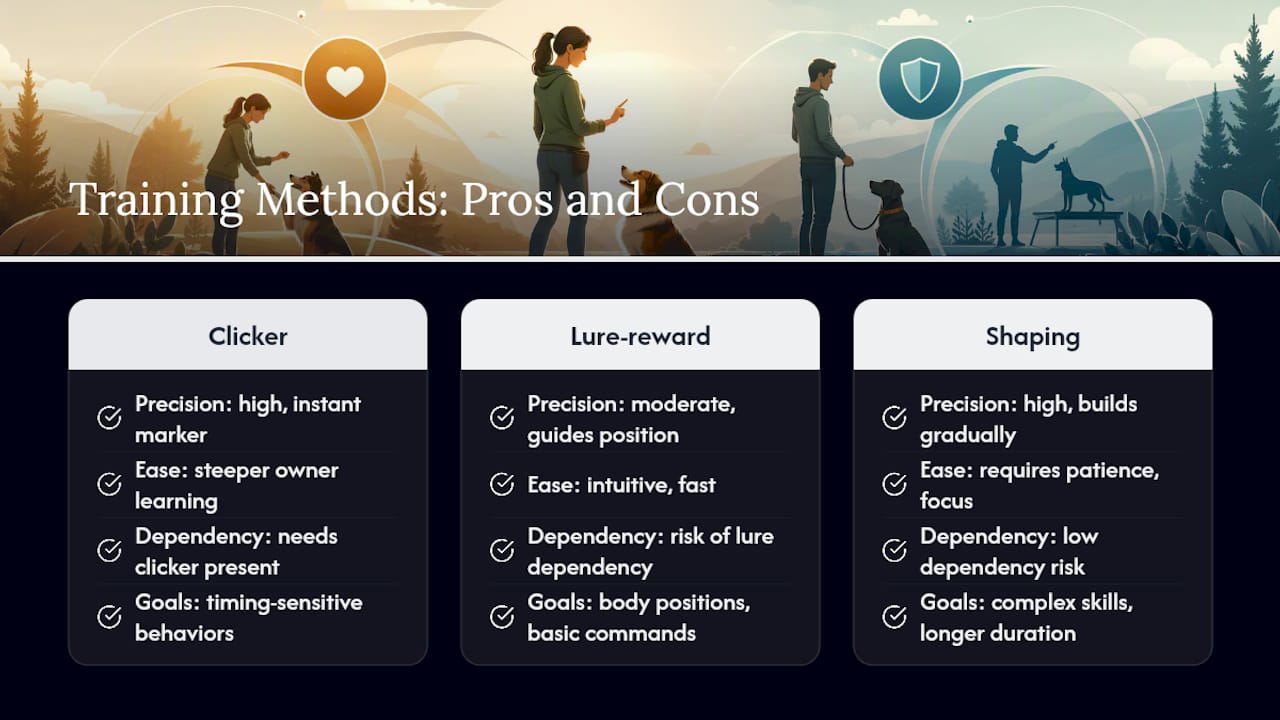
Clicker training uses a distinct sound to mark the exact instant a dog does something right, then follows with a treat. Its strength is precision: the click can happen mid-motion, capturing a behavior a verbal “yes” might arrive a beat too late for. The downside is a short learning curve for the owner, since clicker timing takes a little practice to get consistently right, and you always need the clicker on hand.
Lure-reward training uses a treat to physically guide a dog into a position, like using it to draw a dog’s nose down into a “down.” It is intuitive and fast for teaching basic body positions, which is why it dominates this guide’s command section. Its main weakness is dependency risk: if you never fade the lure, the dog may only respond when it sees food in your hand, not to the verbal cue alone.
Shaping, rewarding small successive steps toward a full behavior, works well for complex skills like extended stays or targeting exercises, but it demands more patience and a sharper eye for incremental progress than either of the other two methods.
Most experienced trainers blend all three: lure early, shape for precision and duration, and use a clicker or clear marker word throughout to nail the timing. There is no single correct method, only the one that matches the skill you’re teaching and how quickly you can read your dog’s body language.
The Impact of Breed and Temperament on Learning Styles
Breed history shapes what motivates a dog and how it processes a training session, even though the mechanics of learning stay universal. A border collie bred for herding tends to be laser-focused on motion and repetitive tasks, which makes it easy to over-arouse in a training session if you’re not careful with pacing. A scent hound bred to track independently over long distances may seem “distractible” when really its nose is doing exactly what generations of breeding selected for.
Temperament matters just as much as breed line. A confident, food-motivated dog will often barrel through a new cue in a couple of sessions. A nervous or sound-sensitive dog needs a slower ramp, quieter environments at first, and rewards delivered calmly rather than with big enthusiastic praise that can spike anxiety instead of confidence.
None of this changes the underlying approach. Positive reinforcement, short sessions, and clear timing work across every breed and temperament type. What changes is the reward choice (a working breed might respond better to a toy or tug than food), the pace of proofing, and how much you lean on management tools like long lines or gates while a more reactive dog builds coping skills.
Mixed-breed dogs and dogs of unknown history are the trickiest to predict, which is exactly why starting slow and watching the individual dog’s response beats assuming anything based on looks alone.
Behavioral Problem Prevention and Management Techniques
Most behavior problems are easier to prevent than to fix after the fact, and prevention almost always comes down to management before the unwanted behavior ever gets a chance to be rewarded by accident.
Counter surfing, for example, rarely starts as a training failure. It starts because a dog found food on a counter once and it worked. Removing the opportunity, keeping counters clear, using baby gates during meal prep, stops the behavior from ever being reinforced in the first place, which is far easier than untraining it later.
Destructive chewing, excessive barking, and jumping on guests follow the same pattern. Each one persists because it is, in some way, getting the dog something it wants: attention, relief from boredom, or access to a person. Redirecting the dog toward an appropriate outlet (a chew toy, a settled mat near the door, a “go to place” cue) while making sure the unwanted version of the behavior never pays off is more effective long term than punishment after the fact.
For established problem behaviors, a structured management plan matters more than any single correction. That means identifying the trigger, controlling the environment so the trigger occurs less often, and reinforcing an incompatible behavior instead, like teaching a dog to sit for greetings instead of jumping. When a problem behavior involves aggression, resource guarding, or anything safety related, that is the clear signal to bring in a certified professional rather than troubleshooting alone.
Author Perspective: The One Habit That Changes Everything
The dogs that make the fastest progress almost always belong to owners who nailed one thing: marking the instant a behavior happens, then treating within two seconds, every single time. Everything else, session length, command order, even breed, matters less than that single habit. Get the timing right and the rest tends to fall into place on its own.
— Andrew
How iPupPee Supports Training and Dog-Human Communication
Solid training habits get you consistency and reliable cues. What they don’t always solve is the gap that opens up when a dog needs to reach you and can’t, whether that’s a service dog handler managing a medical event, a senior living alone, or any owner who wants a faster way for their dog to signal a real need. Ipuppee’s smart alert device closes that gap with a simple button press that sends a direct, live-video alert to you or an emergency contact.
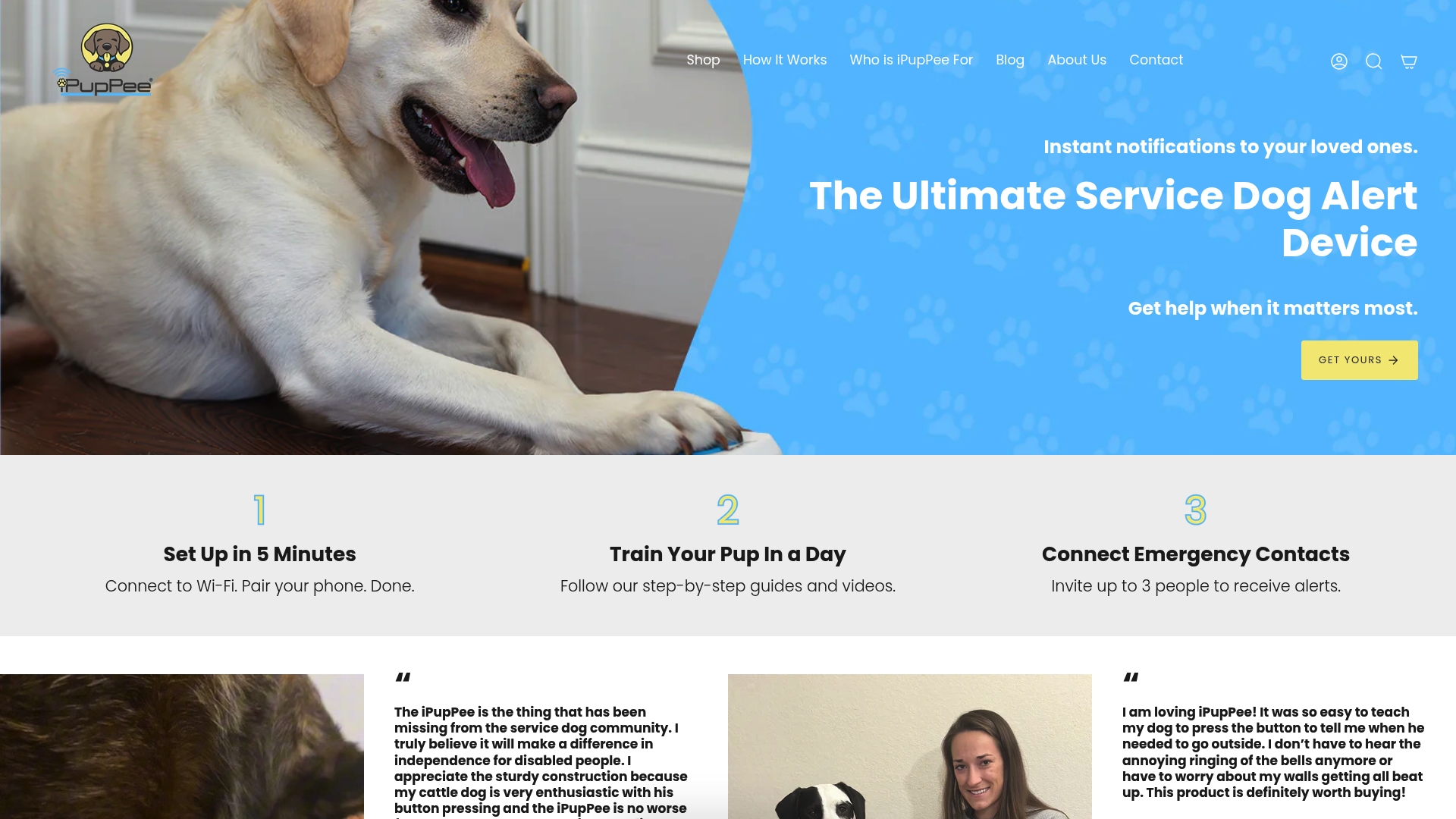
Training the button itself follows the exact same reward-based principles covered throughout this guide: lure the paw or nose toward the button, mark the touch, reward immediately, and build up reliability with the same 80 percent reward rate before thinning it out. It pairs naturally with cues like “touch” or “push” that you’re likely already building into a session.
If you’re working through a training plan and want a communication layer built for real safety needs, visit the Ipuppee product page to see the device and training resources available for service dog handlers, seniors, and any owner who wants their dog to have a way to reach them when it matters most.
Sources
- Positive reinforcement and rewarding — Animal Rescue League of Iowa
- Puppy basic manners — Ohio State University indoorpet
- Duke puppy kindergarten — Brian Hare & Vanessa Woods (Duke University)
- Dog training tips from expert dog trainers — AKC