

Secure or block off your Christmas tree before anything else. That single move prevents most of the injuries that send dogs to the emergency vet every December.
Once the tree is anchored or gated, work through three quick priorities: swap breakable ornaments for shatterproof ones, tuck every cord out of reach, and keep tree water covered.
- Anchor the tree to a wall stud or heavy base, or block it with a gate/playpen.
- Replace glass ornaments in the bottom two-thirds with unbreakable versions.
- Hide or cover all cords and unplug lights when you leave the room.
Pro Tip: Save your local emergency vet’s number and the ASPCA Animal Poison Control line in your phone now, before you need them.
Key Takeaways
Dog-proofing holiday decorations works best when physical barriers, safer materials, and pre-holiday training are combined rather than used alone.
| Point | Details |
|---|---|
| Anchor the tree first | Secure it to a wall stud with a furniture strap, then add a playpen or tunnel skirt for backup. |
| Follow the top-down rule | Keep fragile or small ornaments in the top third; use shatterproof pieces everywhere else. |
| Fix cords before lights go on | Use chew-proof covers, switch to LEDs, and unplug everything overnight. |
| Train “leave it” and “drop it” early | Start weeks before the tree arrives so the cues hold up around real distractions. |
| Add a communication layer | iPupPee’s smart alert device gives dogs a way to signal you directly when you can’t watch them during busy holiday moments. |
Table of Contents
- Why Holiday Decorations Are Risky for Dogs
- What’s the Timeline and Cost to Dog-Proof Decorations?
- How Do You Choose and Anchor a Dog-Safe Christmas Tree?
- Which Ornaments and Decor Items Are Safe for Dogs?
- How Do You Keep Lights and Cords Safe From Dogs?
- What Holiday Plants and Foods Are Toxic to Dogs?
- Can Training Really Reduce Decoration Incidents?
- How Do You Manage Guests and Daily Routines Safely?
- What Should You Do in a Decoration Emergency?
- Room-by-Room Checklist for Dog-Proofing Decorations
- Stay Connected to Your Dog Even When the House Is Full
- Sources
Why Holiday Decorations Are Risky for Dogs
A large tree loaded with lights, water, and dangling ornaments is basically a dog toy store with a hidden bill attached. The dominant hazards break down into five categories: tree tipping onto a dog or child, ingestion of ornaments and tinsel, electrical shock or burns from chewed cords, poisoning from tree water or toxic plants, and swallowed batteries or snow-globe fluid.
Each hazard maps to a specific outcome you’re trying to avoid. Tipping causes blunt trauma. Tinsel and ornament fragments cause choking or intestinal blockages requiring surgery. Chewed cords cause mouth burns, shock, and house fires. Tree water can harbor bacteria and fertilizer chemicals that cause vomiting or worse.
- Tree tipping: bruises, fractures, panic injuries
- Ornament/tinsel ingestion: choking, GI blockage, surgery
- Cord chewing: burns, shock, fire
- Tree water and toxic plants: vomiting, poisoning
- Batteries and snow-globe fluid: chemical burns, ethylene glycol poisoning
None of this is rare. Veterinarians treat a predictable spike of holiday-related preventable injuries and illnesses every year, almost all tied to decorations left within a dog’s reach.
What’s the Timeline and Cost to Dog-Proof Decorations?
Start dog-proofing before the tree ever comes inside, not after your dog has already investigated it.
- 7 to 10 days before: buy supplies (anchors, cord covers, shatterproof ornaments, a gate or playpen panel).
- Day of setup: assemble the tree, anchor it immediately, run and hide cords, then decorate top-down.
- Every day after: a 60-second walk-around to check for fallen needles, ornaments, or chewed cords.
Physical barriers cost far less time than behavior change. Anchoring a tree takes a short amount of time. Teaching a reliable “leave it” takes weeks of short sessions.
Typical supplies to dog-proof decorations include cord protectors and covers, furniture straps or tree anchors, pet gates or exercise pens, shatterproof ornament sets, and zip ties or floral wire for securing ornaments.
How Do You Choose and Anchor a Dog-Safe Christmas Tree?
Artificial trees eliminate the tree-water problem entirely, which removes one of the more overlooked poisoning risks in the house. Real trees smell better to dogs (which is part of the appeal and part of the problem) and their needles can cause GI irritation if swallowed, plus their water can grow bacteria or contain preservatives. If you go real, keep the base covered so no dog can drink from it.
Placement matters as much as the tree itself.
- Pick a corner, not a walkway. A tree in high-traffic areas gets bumped, and bumped trees tip.
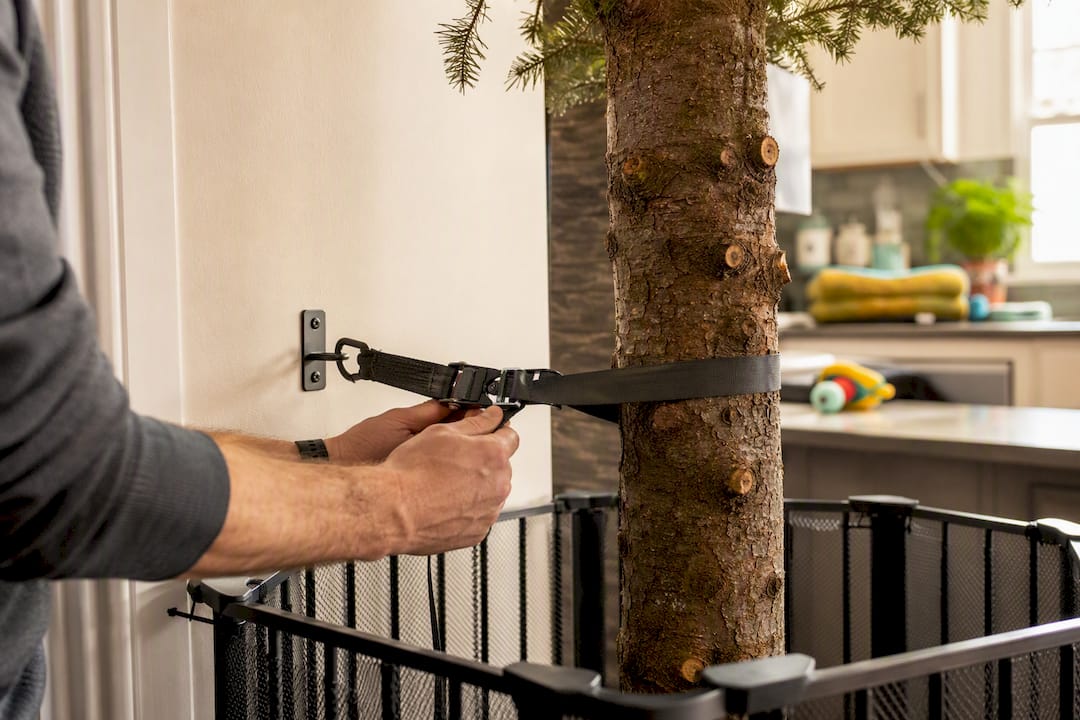
- Anchor to a wall stud, not just the baseboard, using a heavy-duty furniture strap. Museum gel on the base adds extra hold for lighter artificial trees.
- Cover the base with a tunnel-style tree skirt that wraps around the trunk, or ring the whole tree with a small playpen panel so your dog can see it but not reach it.
- Test the anchor by giving the trunk a firm shake before decorating. If it wobbles, add a second strap.
Combining a sturdy anchor with a physical barrier, rather than relying on either alone, is what actually prevents tipping incidents in homes with dogs.
Pro Tip: Wall-stud anchoring plus a playpen enclosure beats either fix alone. Dogs that can’t reach the trunk can’t test how well it’s anchored, and if a strap ever loosens, the pen still holds.
Which Ornaments and Decor Items Are Safe for Dogs?
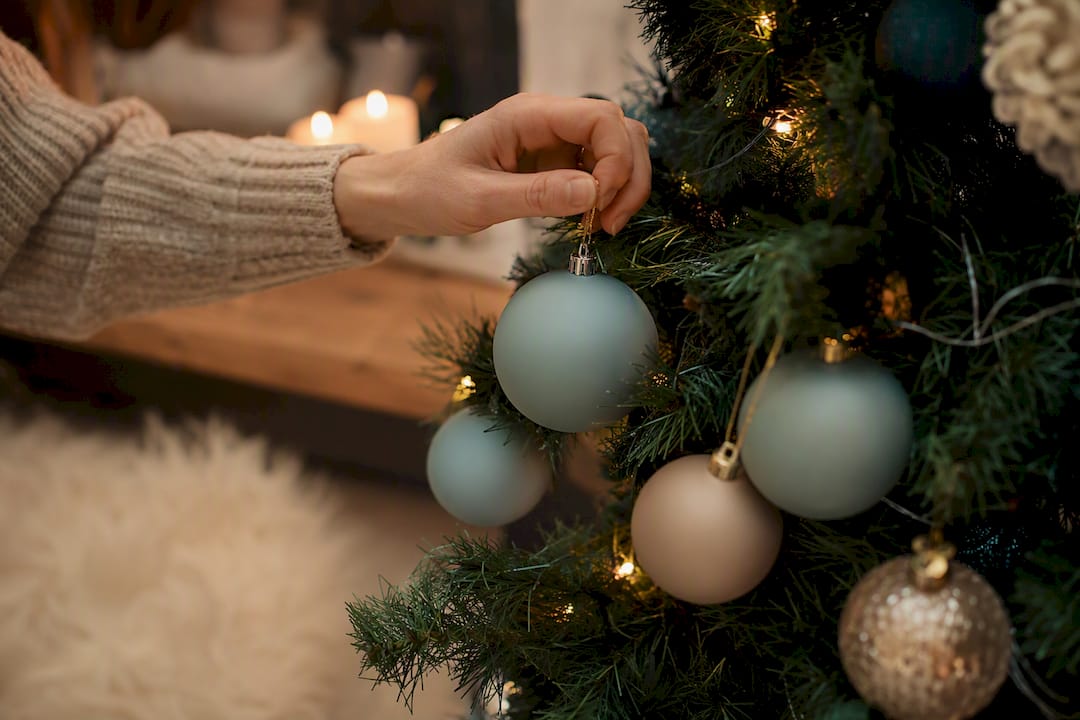
The top-down rule solves most of the ornament problem before it starts: put anything fragile, small, or sentimental in the top third of the tree, where a wagging tail or curious nose can’t reach it. Vets and professional decorators recommend this specifically because most tree-related injuries happen at nose height, not near the top.
Skip these entirely: tinsel, angel hair, metal hooks, small breakable ornaments, and edible garlands like popcorn strings or candy canes. Swap in shatterproof plastic ornaments, plush or fabric decorations, and paper or felt garlands instead. They look just as festive and survive a curious sniff.
- Bottom two-thirds: shatterproof, plush, or fabric only
- Top third: glass, heirloom, or delicate pieces
- Garlands: paper, felt, or fabric, secured tightly
- Hooks: skip metal, use zip ties or floral wire
Installation technique matters more than people expect. Metal ornament hooks fall off constantly, and a swallowed hook is genuinely hard to spot on an X-ray. Zip ties or floral wire hold ornaments firmly in place and don’t leave loose metal on the floor.
Pro Tip: Do a “hook sweep” under the tree every morning during the season. It takes ten seconds and catches the one dropped hook before your dog finds it first.
How Do You Keep Lights and Cords Safe From Dogs?
Cords are the hazard owners underestimate the most, mostly because dogs chew them out of boredom, not malice. Switching to LED lights cuts the risk significantly since they run far cooler than old incandescent strands, and a chewed LED strand is much less likely to cause a burn than a chewed incandescent one.
Beyond the bulbs, cord management is what actually keeps a curious mouth away from live wire:
- Run cords through chew-proof conduit or cable covers rated for pets.
- Route extension cords behind furniture instead of across open floor.
- Use cord clips to keep slack off the ground where a dog can grab it.
- Unplug all lights and unattended electronics overnight or when you leave the house.
- Keep battery compartments snapped shut and store spare batteries in a closed drawer, not a stocking.
Vet-sourced guidance consistently ranks cord covers, LED lights, and unplugging when unattended as the three highest-impact fixes for preventing electrical shock, mouth burns, and holiday house fires. None of them cost much, and all three take under an hour to set up for an average living room.
What Holiday Plants and Foods Are Toxic to Dogs?
Poinsettias, mistletoe, and holly all show up in living rooms every December, and all three can cause anything from mild stomach upset to more serious reactions depending on how much a dog eats. Certain lily varieties are far more dangerous and shouldn’t be in a house with pets at all. Tree water itself is a risk, since it can grow bacteria or carry fertilizer runoff.
Snow-globe fluid is often ethylene glycol, the same toxic ingredient found in antifreeze, and salt-dough ornaments carry enough sodium to cause salt poisoning in a small dog. Both deserve a spot on the top shelf, not the tree.
- Remove or elevate: poinsettia, mistletoe, holly, lilies
- Cover: tree water, especially with any preservative added
- Skip entirely: snow globes, salt-dough ornaments near dog level
- Watch: chocolate, xylitol-sweetened treats, wrapped gifts containing food or medication
Swap risky plants for faux greenery, dried rosemary sprigs, or artificial wreaths, all of which hold up to sniffing without a downside. Keep wrapped gifts that contain food or medication under the tree only until wrapping day, then store them somewhere a determined nose can’t reach.
Can Training Really Reduce Decoration Incidents?
Training is the most sustainable fix you have, because barriers eventually come down and supervision eventually lapses, but a dog who reliably responds to “leave it” carries that skill everywhere.
Start weeks before the tree goes up, not the day it arrives.
- Teach “leave it” and “drop it” using high-value treats in short, five to ten minute sessions, twice a day.
- Add “go to your place” so your dog has a default spot away from the tree during setup and gatherings.
- Desensitize gradually, introducing the bare tree first, then ornaments, then lights, rewarding calm behavior at each stage.
- Practice near real distractions once the basics stick, since a dog that “leaves it” in a quiet kitchen may not yet do it next to a swinging ornament.
Puppies and high-drive breeds need more repetitions and shorter sessions; older, lower-drive dogs often generalize the cue faster. Trainers and pet-care experts point to pre-holiday training as the foundational backup for the moments physical barriers can’t cover.
Pro Tip: If your dog won’t disengage from the tree even with high-value treats, or shows resource-guarding around it, that’s a sign to bring in a professional trainer rather than push through solo, especially with a strong-driven breed.
How Do You Manage Guests and Daily Routines Safely?
Parties introduce new risks: dropped appetizers, purses full of gum or medication set on low tables, and doors left open. A thirty-second briefing at the door (“please keep bags off the floor, and don’t feed him from your plate”) prevents most of it.
- Ask guests to keep food, gum, and medication off low surfaces and out of coat pockets left within reach.
- Sweep for fallen needles, dropped ornaments, and loose hooks daily, more often during parties.
- Check cords and outlets each morning during the tree’s peak season.
- Use gates or a playpen to close off the tree during unsupervised hours.
- Set up a quiet room with a chew toy or puzzle feeder for dogs overwhelmed by crowds.
A five-minute daily walk-through catches almost everything before it becomes a vet visit.
What Should You Do in a Decoration Emergency?
Move fast but stay calm. Most decoration emergencies fall into four categories, and each has a slightly different first move.
- Ingestion: identify what was swallowed, note the time, and call your vet or ASPCA Animal Poison Control before doing anything else. Don’t induce vomiting unless a professional tells you to.
- Electrocution: unplug the cord at the outlet, not by pulling your dog away from it, then check breathing and gums and get to a vet immediately.
- Choking: check the mouth for visible objects, and if your dog can still breathe and cough, let them try to clear it before attempting removal yourself.
- Cuts: apply light pressure with a clean cloth and seek care if bleeding doesn’t slow within a few minutes.
Have the item’s packaging or a photo ready, along with your dog’s weight, age, and the exact time of ingestion. That handful of details lets an emergency vet or poison-control operator give you an answer in seconds instead of minutes.
Room-by-Room Checklist for Dog-Proofing Decorations
Save this list somewhere visible, near the tree switch or on the fridge, and run through it as decorations go up and again once a week after.
- Entry: no low bowls of candy, coats checked for gum or medication (before guests arrive)
- Tree area: anchor checked, cords hidden, fragile items in top third (daily)
- Kitchen/dining: chocolate and xylitol items stored high, trash secured (daily)
- Guest rooms: bags and medication kept off the floor (before guests arrive)
- Outdoors: deicing chemicals and lit candles kept away from paths (weekly)
A Practical Note From Andrew
I’ve seen how fast a curious dog can turn a calm holiday evening into an emergency room trip, and most of these fixes take less effort than people assume. I write on dog safety and training for iPupPee.
Stay Connected to Your Dog Even When the House Is Full
Physical barriers, training, and a daily walk-through cover most of the risk, but the holidays also mean more doors opening, more guests, and more moments where you can’t watch your dog directly. That’s where a device built for exactly that gap earns its place. The iPupPee smart alert button lets your dog send you a direct notification with live video and two-way audio, so if your dog gets shut in a guest room or wanders near the tree while you’re carving the turkey, you’ll know immediately instead of finding out later.

It’s not a substitute for anchoring your tree or calling your vet in a real emergency, those steps still come first. But paired with the training resources in iPupPee’s dog psychology course, it adds a layer of communication that physical barriers alone can’t give you. Visit Ipuppee to see the device and training bundle before your next gathering.
Sources
- Pet Safe Holiday Decorations - American Humane Society
- Holiday Safety Tips - ASPCA
- Dog-friendly holiday decorating - AKC
- How to dog-proof home - Zoetis Petcare
- Christmas safety for dogs - Purina